Granny Square Calculator — How Many Squares Do You Need?
Enter your target blanket dimensions and the finished size of one granny square to calculate the exact number of squares, how they arrange in a grid, and the actual finished size including any joining width.
Granny Square Layout Planner
Enter your target blanket size and finished square size to calculate how many granny squares you need and how they lay out.
Formula: squares across = floor((blanket width + joining) ÷ (square size + joining))
Results
Squares Across
8
- Squares Down
- 10
- Total Squares
- 80
- Actual Finished Size
- 48" × 60"
- 121.9 × 152.4 cm
All measurements are in inches. Joining width is the seam or flat-join row added between squares — use 0 for JAYG or slip stitch joins with no added width.
Layout Preview — 8×10
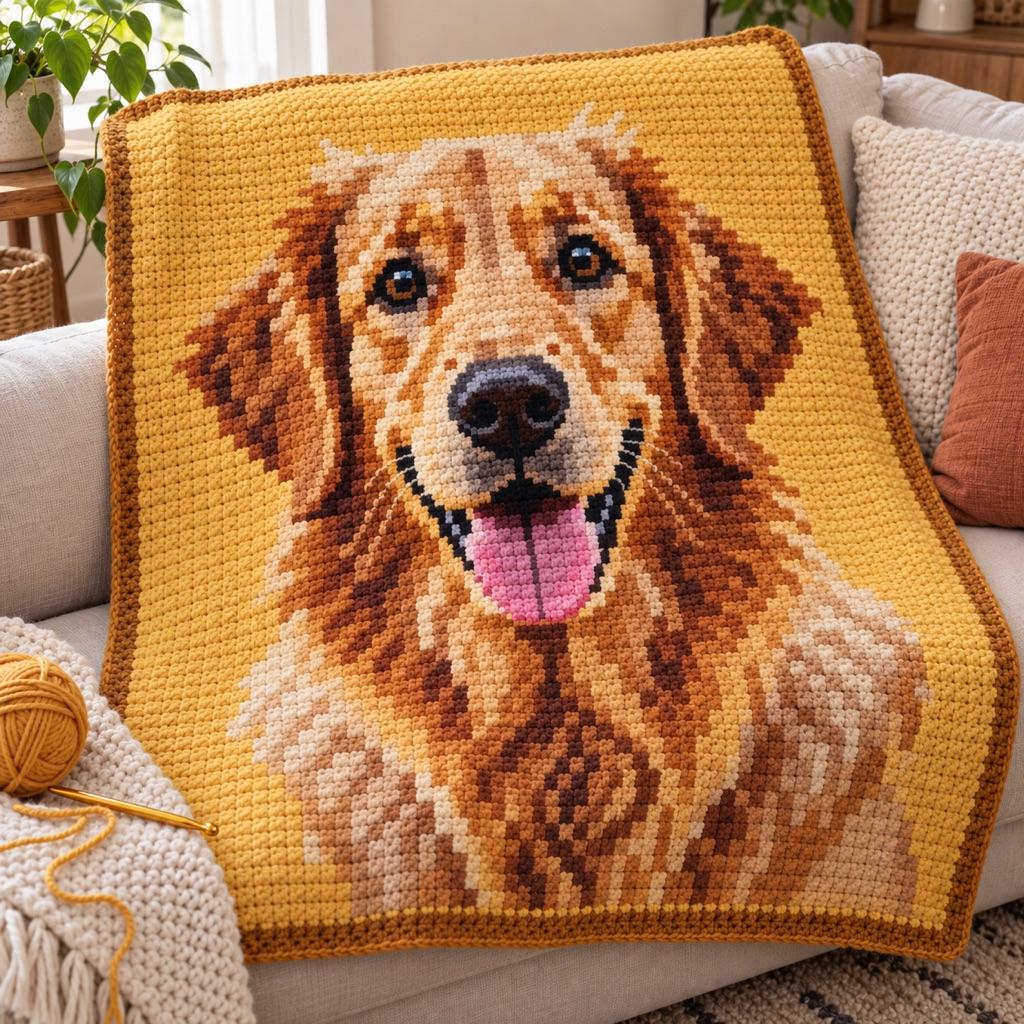
Turn a photo into a real pattern
Turn any photo into a crochet color chart sized to your granny square grid — upload a portrait, landscape, or artwork and get a printable pattern with stitch counts.
Generate a PatternHow Many Granny Squares to Make a Blanket: Size Chart
Squares across × down and the total for each blanket size, using whole squares with a join-as-you-go seam. A border brings the blanket up to the full size.
| Blanket | 4×4 in squares | 5×5 in squares | 6×6 in squares | 8×8 in squares | 12×12 in squares |
|---|---|---|---|---|---|
| Baby36×45 in | 99 (9×11) | 63 (7×9) | 42 (6×7) | 20 (4×5) | 9 (3×3) |
| Lap / throw50×60 in | 180 (12×15) | 120 (10×12) | 80 (8×10) | 42 (6×7) | 20 (4×5) |
| Twin66×90 in | 352 (16×22) | 234 (13×18) | 165 (11×15) | 88 (8×11) | 35 (5×7) |
| Queen90×100 in | 550 (22×25) | 360 (18×20) | 240 (15×16) | 132 (11×12) | 56 (7×8) |
| King108×100 in | 675 (27×25) | 420 (21×20) | 288 (18×16) | 156 (13×12) | 72 (9×8) |
How Many Granny Squares Do You Need for a Blanket?
The number of granny squares for a blanket depends on two things: the finished size of each square after blocking, and the size of the blanket you want. The formula is straightforward — divide the blanket width by the square size to get squares across, divide the blanket height by the square size to get squares down, and multiply for the total. The joining method affects the result because each join adds a small amount to the overall width.
For a typical throw blanket (48×60 inches) made with 6-inch squares and no joining width, you need 8 squares across and 10 squares down — 80 total. For the same blanket with a flat seam join that adds 0.25 inches between squares, the effective square size increases slightly and the count adjusts accordingly. The calculator above handles this automatically.
Square size must be measured from your actual blocked squares, not from the pattern description. Granny squares grow when blocked, and the amount of growth depends on fiber content, hook size, and how aggressively you block. Always make and block a test square before calculating the full project count.
Granny Square Blanket Size Chart
The size chart above covers baby, throw, twin, queen and king blankets with 4, 5, 6, 8 and 12-inch squares. For example, a throw (50×60 inches) takes 120 squares of 5×5 inches (10 across, 12 down) or 80 squares of 6×6 inches (8×10). Counts are whole squares only, so the joined panel can come out a few inches short of the target — a border makes up the difference.
For the standard sizes themselves — lovey to king in inches and centimetres, plus a bed-by-bed coverlet chart — see the crochet blanket sizes chart.
These counts assume no joining width. If you use a flat seam, single crochet join, or any method that adds width between squares, use the calculator above with your actual joining width to get an exact count. A 0.25-inch join across 10 squares adds 2.25 inches to the final width — enough to shift the count by one square in each direction on a large blanket.
For garments like cardigans, the same calculator applies. Enter the finished panel width as the blanket width and the panel height as the blanket height to find how many squares fit across and down. Most granny square cardigan patterns use 4–6 inch squares arranged in rectangles for body panels, with smaller squares or half-squares for shaping.
Granny Square Calculator FAQ
A baby blanket (36×45 inches) takes 63 squares of 5×5 inches (7 across, 9 down). A throw (50×60 inches) takes 120 (10×12), a twin (66×90 inches) 234 (13×18), and a queen (90×100 inches) 360 (18×20).
A baby blanket (36×45 inches) takes 42 squares of 6×6 inches (6×7). A throw (50×60 inches) takes 80 (8×10), a twin (66×90 inches) 165 (11×15), and a queen (90×100 inches) 240 (15×16).
Always after blocking. Blocking can add 15–30% to a square's dimensions depending on fiber and technique. A square that measures 5 inches unblocked may be 6 inches after blocking with wet blocking on wool. If you calculate using the unblocked size you will make more squares than you need and the finished blanket will be larger than planned.
Use 0 for join-as-you-go (JAYG) methods where no additional rows are added between squares. Use 0 for slip stitch joins worked through both layers with no chain. Use 0.25–0.5 inches for single crochet joins or flat seam joins worked with a separate round — the exact amount depends on your hook size and tension. If unsure, join two test squares and measure the seam width before calculating the full project.
The calculator rounds down to the nearest whole square and shows you the actual finished size, which will be slightly smaller than your target. To compensate, you can add a border to the finished blanket — a border of any width will bring the overall size up to your target. Most granny square blankets benefit from a border regardless, as it frames the layout and covers any uneven edges.
Yes — convert your measurements to inches before entering them (divide centimeters by 2.54). For example, a 15 cm square is approximately 5.9 inches. The results panel shows both inches and centimeters for the finished size.
The layout preview shows the grid arrangement. For color planning, print the grid (or screenshot it) and color in each square with pencil or a spreadsheet. A common approach is to arrange by color in a diagonal stripe, alternating solid and patterned squares in a checkerboard, or distributing colors randomly then adjusting until no two same-colored squares share an edge.
Related Tools and Pages
Crochet Yarn Calculator
Estimate how many skeins of yarn you need for a crochet blanket based on stitch type, dimensions, and yarn weight.
Crochet Blanket Size Calculator
Calculate finished crochet blanket dimensions from stitch count and gauge, or find the stitch count for a target size.
Crochet Pattern Generator
Convert a photo into a crochet color chart for graphghans, C2C, and grid-based crochet projects.
C2C Crochet Pattern Generator
Generate corner-to-corner crochet charts from any photo with row-by-row stitch counts.
Crochet Gauge Converter
Adjust a crochet pattern's stitch and row counts when your gauge does not match the pattern.
Granny Square Blanket Border Ideas
Ten crochet border stitch patterns — scallops, shells, crab stitch, and more — to finish any blanket.
How to Join Granny Squares
Six joining methods compared — flat seam, single crochet, JAYG, slip stitch, and lattice join.