Estimate Your Diamond Painting Canvas Size
Convert drill count into design area and full canvas size before you buy adhesive canvas, order a custom kit, or choose a frame.
Diamond Painting Size Calculator
Turn a drill count into the canvas size, or a canvas size into the drill count, for square or round drills. Shows the true sticky area, the full canvas with its border and the frame that fits.
Formula: design size = drills × 0.25 cm (4 drills per cm); full canvas = design size + border on each side
Results
True Sticky Design Area
30 × 40 cm
11.8 × 15.7"
- Total Drills
- 19,200
- 120 × 160 square drills (2.5 mm)
- Full Canvas (with border)
- 35 × 45 cm
- 13.8 × 17.7"
- Detail Suitability
- Portraits, pets & medium detail
- 120 drills on the shorter side
- Estimated Time
- ~27–48 hrs
- At 400–700 drills an hour
- Closest Standard Frame
- 12×16" / 30×40 cm
- Trim the white border to the 30×40 cm frame; the frame lip hides the edge.
Cheap kits often label the full canvas, so a 30 × 40 cm kit with a 2.5 cm border has only 25 × 35 cm of sticky area. Kits sold by image size ship a larger canvas.
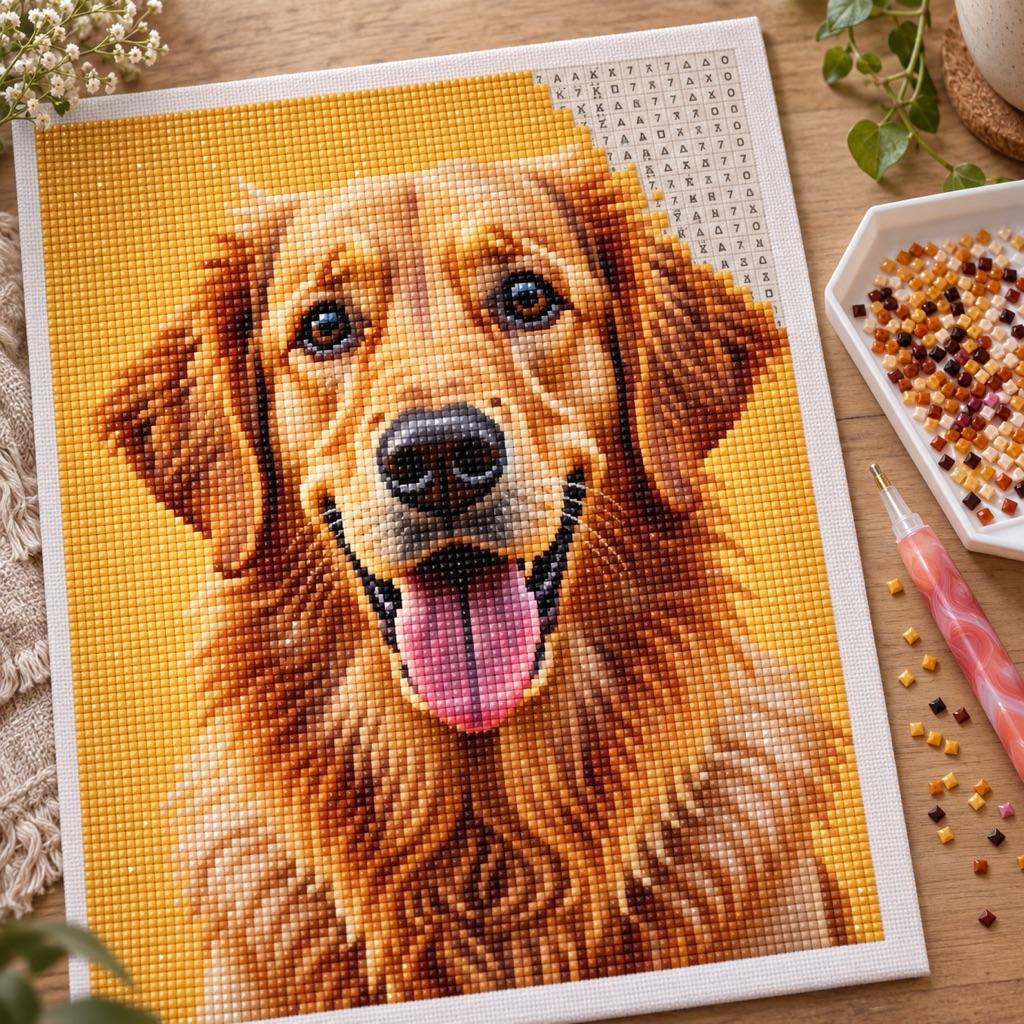
Turn a photo into a real pattern
Once the canvas dimensions look right, generate the full diamond painting pattern with DMC drill colors.
Open Diamond GeneratorTrue Diamond Painting Size Chart — Labeled Canvas vs. Sticky Design Area
The size printed on a kit can mean two different things. This chart gives both readings for every common catalog size, with exact drill counts.
Swipe the table sideways to see all 6 columns.
| Catalog Size (cm) | Approx. Inches | True Sticky Area (2.5 cm border) | Square Drills (2.5 mm) | Round Drills (2.8 mm) | Best For |
|---|---|---|---|---|---|
| 20 × 30 cm | 7.9 × 11.8" | 15 × 25 cm5.9 × 9.8" | 9,6006,000 if labeled | 7,5974,806 if labeled | Simple scenes & bold portraits |
| 30 × 40 cm | 11.8 × 15.7" | 25 × 35 cm9.8 × 13.8" | 19,20014,000 if labeled | 15,30111,125 if labeled | Portraits, pets & medium detail |
| 40 × 50 cm | 15.7 × 19.7" | 35 × 45 cm13.8 × 17.7" | 32,00025,200 if labeled | 25,59720,125 if labeled | Portraits, pets & medium detail |
| 40 × 60 cm | 15.7 × 23.6" | 35 × 55 cm13.8 × 21.7" | 38,40030,800 if labeled | 30,60224,500 if labeled | Portraits, pets & medium detail |
| 50 × 70 cm | 19.7 × 27.6" | 45 × 65 cm17.7 × 25.6" | 56,00046,800 if labeled | 44,75037,352 if labeled | Fine detail & group photos |
| 60 × 80 cm | 23.6 × 31.5" | 55 × 75 cm21.7 × 29.5" | 76,80066,000 if labeled | 61,20452,528 if labeled | Fine detail & group photos |
| 70 × 90 cm | 27.6 × 35.4" | 65 × 85 cm25.6 × 33.5" | 100,80088,400 if labeled | 80,25070,528 if labeled | Fine detail & group photos |
| 80 × 100 cm | 31.5 × 39.4" | 75 × 95 cm29.5 × 37.4" | 128,000114,000 if labeled | 102,10290,852 if labeled | Fine detail & group photos |
First number: the catalog size is the drilled image. Second line ("if labeled"): the catalog size is the whole canvas, so a 2.5 cm border comes off each side. Square drills are 4 per cm, round drills about 3.57 per cm.
Canvas size is the whole sheet including the white border. Many low-cost kits on Amazon and AliExpress list it, so a 30 × 40 cm kit with a 2.5 cm border gives you only 25 × 35 cm of sticky area.
Image or design size is the drilled area alone. Kits sold by image size, and custom designs, use this size, so a 30 × 40 cm image comes on a canvas of about 35 × 45 cm. Look for "image size" in the listing, or measure the sticky area, before you buy a frame.
Diamond Painting Frame Size Chart
Frame the sticky area, not the labeled size. Trim the white border when the frame matches; use a mat (passe-partout) when the frame is larger.
| Sticky Design Size | Closest US Frame | Closest Metric Frame | Framing Note |
|---|---|---|---|
| 15 × 25 cm20 × 30 cm labeled canvas | 8×10" | 20×30 cm | Use a mat (passe-partout) in the 20×30 cm frame, or leave about 2.5 cm of white border showing on each side. |
| 20 × 30 cm20 × 30 cm image size | 11×14" | 20×30 cm | Trim the white border to the 20×30 cm frame; the frame lip hides the edge. |
| 25 × 35 cm30 × 40 cm labeled canvas | 11×14" | 30×40 cm | Use a mat (passe-partout) in the 11×14" frame, or leave about 1.5 cm of white border showing on each side. |
| 30 × 40 cm30 × 40 cm image size | 12×16" | 30×40 cm | Trim the white border to the 30×40 cm frame; the frame lip hides the edge. |
| 35 × 45 cm40 × 50 cm labeled canvas | 16×20" | 40×50 cm | Use a mat (passe-partout) in the 40×50 cm frame, or leave about 2.5 cm of white border showing on each side. |
| 40 × 50 cm40 × 50 cm image size | 16×20" | 40×50 cm | Trim the white border to the 40×50 cm frame; the frame lip hides the edge. |
| 35 × 55 cm40 × 60 cm labeled canvas | 18×24" | 50×70 cm | Use a mat (passe-partout) in the 18×24" frame, or leave about 5.4 cm of white border showing on each side. |
| 40 × 60 cm40 × 60 cm image size | 18×24" | 50×70 cm | Use a mat (passe-partout) in the 18×24" frame, or leave about 2.9 cm of white border showing on each side. |
| 45 × 65 cm50 × 70 cm labeled canvas | 20×28" | 50×70 cm | Use a mat (passe-partout) in the 50×70 cm frame, or leave about 2.5 cm of white border showing on each side. |
| 50 × 70 cm50 × 70 cm image size | 20×28" | 50×70 cm | Trim the white border to the 50×70 cm frame; the frame lip hides the edge. |
| 55 × 75 cm60 × 80 cm labeled canvas | 24×32" | 60×80 cm | Use a mat (passe-partout) in the 60×80 cm frame, or leave about 2.5 cm of white border showing on each side. |
| 60 × 80 cm60 × 80 cm image size | 24×32" | 60×80 cm | Trim the white border to the 60×80 cm frame; the frame lip hides the edge. |
| 65 × 85 cm70 × 90 cm labeled canvas | Custom frame | Custom frame | Larger than standard frames: use a custom frame or stretch the canvas over stretcher bars. |
| 70 × 90 cm70 × 90 cm image size | Custom frame | Custom frame | Larger than standard frames: use a custom frame or stretch the canvas over stretcher bars. |
| 75 × 95 cm80 × 100 cm labeled canvas | Custom frame | Custom frame | Larger than standard frames: use a custom frame or stretch the canvas over stretcher bars. |
| 80 × 100 cm80 × 100 cm image size | Custom frame | Custom frame | Larger than standard frames: use a custom frame or stretch the canvas over stretcher bars. |
The smallest standard frame that holds the sticky area in either orientation. A frame lip covers about 5 mm of each edge.
Why Diamond Painting Size Matters
Diamond painting detail is limited by drill density. A photo that looks good at a large size can become muddy if you squeeze it into too few drills, especially for faces and pets.
This calculator helps before you generate the final pattern. Use it to compare a smaller starter canvas against a larger display-sized version and decide whether the subject has enough room to stay recognizable.
It also helps with framing and workspace planning. Full canvas size is often larger than the sticky design area because of border space for taping and handling.
How to Use the Size Estimate
Start with the design area to judge image readability. Then add the border margin to understand the full physical canvas you will order or mount.
If the design dimensions feel too small for the subject, increase the drill width and height before generating the final chart. That is almost always easier than trying to salvage a muddy low-detail canvas later.
Diamond Painting Size Calculator FAQ
The full canvas includes blank border space around the sticky design area. That margin is useful for taping, stretching, and framing.
If the main subject, especially a face or pet, only gets a small number of drills across, detail will get lost. Larger canvases preserve more recognizability.
Yes. Diamond painting detail depends heavily on final size, so it is best to choose a realistic canvas scale before generating the chart.
30 × 40 cm (about 12 × 16 inches) with round drills is the sweet spot: big enough for a recognizable subject, small enough to finish in a few weeks. Square drills and 60 × 80 cm canvases are better saved for a second project.
At least 90 drills across the subject to stay recognizable — which at standard 2.5 mm drills means the design area should be 23 cm (9 inches) wide or more. Simple high-contrast subjects can work at 60–80 drills across.
The common catalog sizes convert to roughly 12 × 16 inches (30 × 40 cm), 16 × 20 inches (40 × 50 cm), and 24 × 31 inches (60 × 80 cm). The calculator converts any custom size both ways.
Square drills are 2.5 mm, so 4 fit in every centimeter; round drills are 2.8 mm, about 3.57 per centimeter. The same canvas holds about 25% more square drills: a 30 × 40 cm design takes 19,200 square drills (120 × 160) or 15,301 round drills (107 × 143). Square drills give finer detail; round drills are quicker to place.
Because the kit lists the canvas size, not the image size. The canvas includes a blank border, typically 2.5 cm on each side, which takes 5 cm off both the width and the height. A 30 × 40 cm canvas leaves 25 × 35 cm of sticky area: 14,000 square drills instead of 19,200. Kits that list the image size ship a bigger canvas, about 35 × 45 cm for a 30 × 40 cm image.
Measure the sticky area first. A labeled 30 × 40 cm canvas (25 × 35 cm sticky) fits an 11×14" frame, or a 30×40 cm frame with a mat; a 30 × 40 cm image fits a 12×16" or 30×40 cm frame once you trim the white border. A labeled 40 × 50 cm canvas (35 × 45 cm sticky) goes in a 16×20" or 40×50 cm frame with a mat, and a 40 × 50 cm image in a 16×20" or 40×50 cm frame, trimmed. Trim the border when the frame matches the sticky area; use a mat (passe-partout) when the frame is bigger.