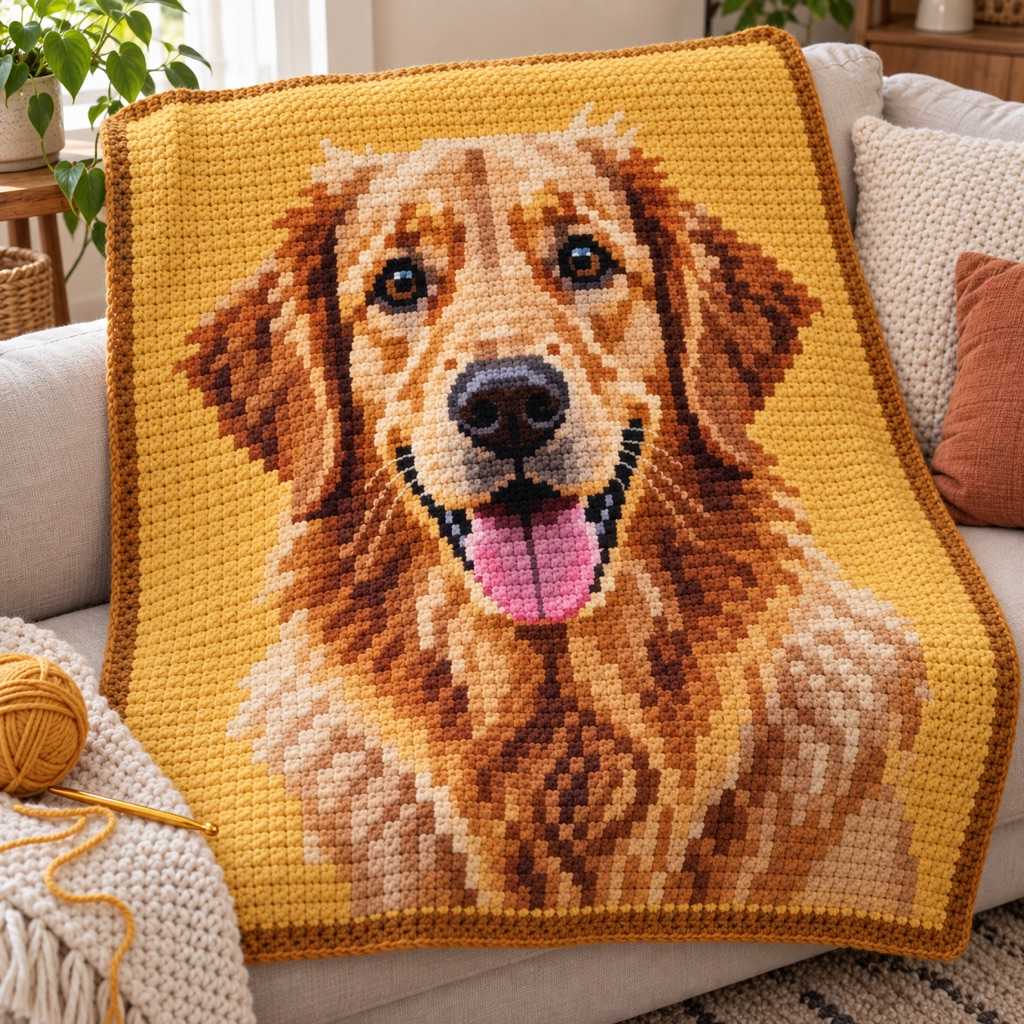
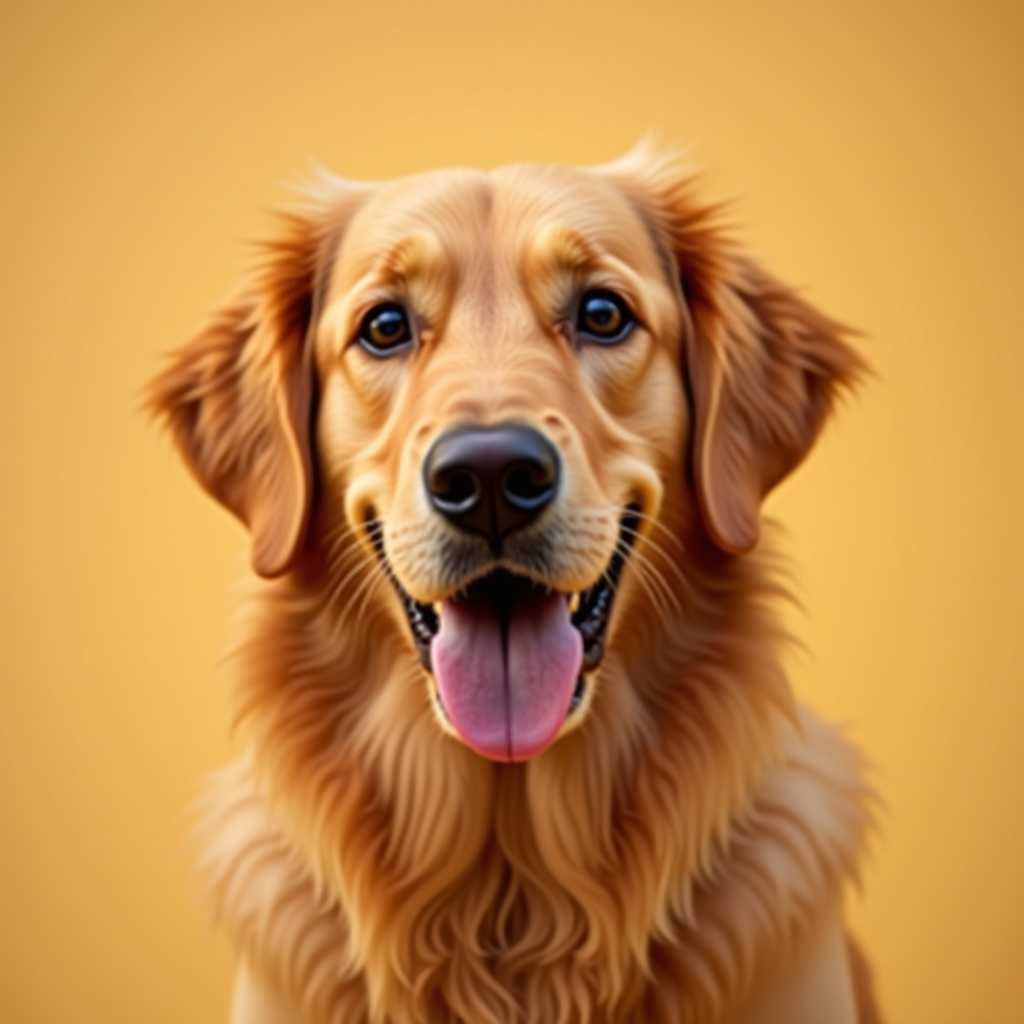
Your photo
Filet Crochet Pattern Maker
From Any Picture
Filet is block or space: upload a picture and get a chart — solid where it's dark, open mesh where it's light.
Free to use · No sign-up
Filet previews are deliberately two-tone: the dark squares are your blocks, the light squares stay open.
What You Get from One Photo
Two-color techniques need a bold picture, so this one is made from our fox sample: 60 × 60 filet crochet chart in 2 colors.
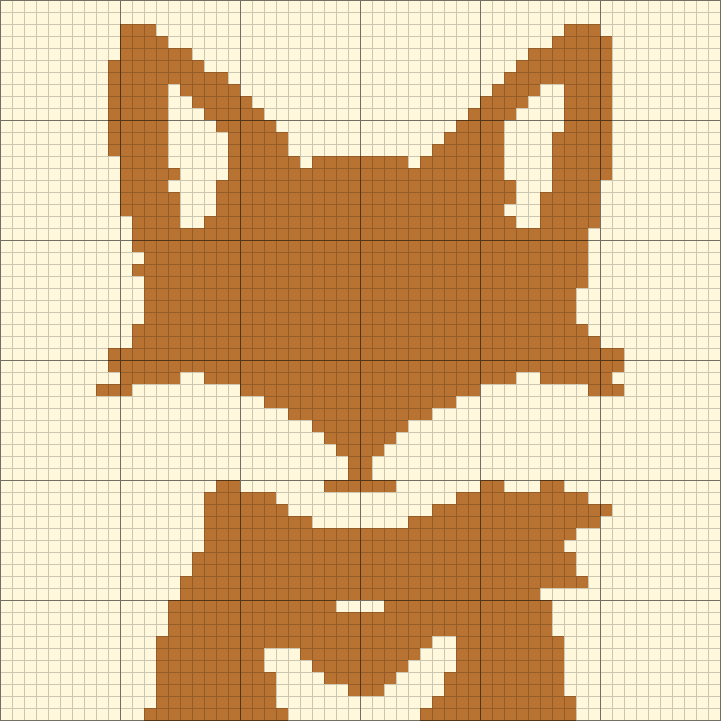
Two colors, high contrast
The picture is reduced to a dark and a light shade, which is all this technique uses.
Written rows
Every row is written out as runs, so you can work from the list instead of counting squares.
Yarn counted for both colors
Stitch counts are turned into how much of each yarn you need.
Color legend from this chart
- Cornsilk2 balls
- Copper2 balls
From Chart to Finished Filet crochet
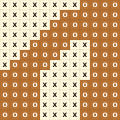
The same few squares, as they sit on the chart and as they look once worked.
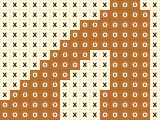
On the chart
- One square, one color, one symbol
- Rows and columns are numbered in the PDF
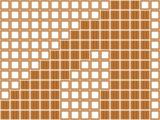
Blocks and spaces
- Dark squares become solid blocks of double crochet
- Light squares stay open mesh
- Works in one color of thread or yarn
Built for Blocks and Spaces
Filet is the one crochet colourwork with no colours in it. That changes what a generator has to do.
Two Tones, Not Twelve
Every other generator here fights to keep colour count down. Filet starts at the floor: two. The preset drops your picture to two tones so the chart maps straight onto the only two things filet can say — a filled square (block) and an open one (space). If your image needs more than two tones to be legible, it is not a filet design.
Squares, Not Stitches
A filet chart is not a stitch chart. One square is one mesh unit, and the usual 3-dc mesh turns a row of N squares into 3N + 1 double crochet, because neighbouring squares share a stitch — the last dc of one square is the first dc of the next. Read the grid width as squares and do the arithmetic once.
Stray Squares Weaken the Mesh
In tapestry a stray stitch is a cosmetic bump. In filet a lone block floating in open mesh is structural — nothing braces it, and it drags the surrounding chain spaces out of shape. Heavy confetti reduction clears one-square specks so your shapes stay connected and the fabric hangs square.
It Has to Survive Being a Silhouette
Filet renders a picture the way a paper cut-out does. Shapes with a clean outline — a letter, a heart, a bird in profile, a leaf — survive. A face, a gradient sky, or anything relying on mid-tones collapses into noise. The two-tone preview tells you which one you have before you wind a single ball.
What Filet Crochet Is Actually For
Filet is the oldest picture-making trick in crochet, and it comes from thread rather than yarn: doilies, tablecloth edgings, curtain panels, chair backs, christening gifts. Worked in size 10 cotton with a steel hook it produces lace you can read from across the room. Worked in DK or worsted with a 4 mm hook the same chart becomes a blanket, a market bag panel, or a nursery name banner — the grid does not change, only the scale does.
The classic subjects have not changed in a century because they are the ones the technique can hold: monograms and single letters, whole words and names, hearts, crosses, roses, butterflies, swans, deer and birds in profile, ivy and vine borders, and geometric lace repeats. All of them are outlines. That is not a stylistic preference — it is the entire vocabulary of a fabric that can only be solid or open.
The mesh itself is simple. A space is one double crochet, chain 2, skip 2, then the next double crochet. A block is that same span filled solid with double crochet. Charts are read from the bottom up, with odd rows worked right to left and even rows back the other way. Because adjacent squares share their edge stitch, a fully solid row of N squares is 3N + 1 double crochet rather than 3N — the single most common place a first filet project goes wrong.
Filet vs the Other Crochet Colourwork
Filet vs tapestry crochet: tapestry carries every colour inside the stitches and makes a dense, opaque fabric — good for bags, useless for lace. Filet makes its picture out of holes, so the fabric is light and semi-transparent and needs a background to be seen against: a window, a table, a contrasting cushion. If you want a picture in colour, that is tapestry. If you want a picture in shadow, that is filet.
Filet vs C2C: both are worked in double crochet, and ArtPatt uses the same square-block geometry for each. The difference is what a square means. In C2C every square is a colour; in filet every square is a decision to leave a hole or not. C2C blankets are warm and solid, filet panels are lace. Same chart shape, opposite fabric.
Filet vs cross-stitch: filet charts look like cross-stitch charts and behave almost nothing like them. A cross-stitch grid can carry hundreds of shades and any amount of fine detail, because the fabric underneath never changes. In filet the grid is the fabric, so every square you leave open is a hole you have to design around.
Filet Crochet FAQ
Yes. 1 upload, generation, and full browser preview and all of its edits are free, with no account required. A $2.99 single-pattern unlock gives you the PNG and printable PDF. Pro ($6.99/month or $39.99/year) unlocks unlimited projects, every export, and every other craft generator.
With the common 3-dc mesh, a solid row of N squares is 3N + 1 double crochet. The +1 is there because neighbouring squares share a stitch — the last dc of one square doubles as the first dc of the next. So a 40-square chart is 121 dc across when fully filled, not 120. Some patterns use a smaller 2-dc mesh instead (a block is 2 dc, a space is 1 dc and 1 chain); check which one your pattern assumes before you count.
From the bottom up — Row 1 is the bottom row of the grid, not the top. A filled square is a block: solid double crochet. An empty square is a space: one dc, chain 2, skip 2. Because the piece is worked flat, the direction alternates every row, so ArtPatt marks each row RS or WS with an arrow for the reading direction, and there's a left-handed toggle that mirrors it. Rows and columns are numbered so you can find your place again after putting the work down.
From a photo of a person or a landscape, realistically no — filet has two states, and a photograph needs dozens. What works is anything that survives being cut out of black paper: a monogram, a name, a heart, an animal in profile, a leaf or vine. Upload it, set the colour count to 2, and the preview will tell you honestly. If the shape is still readable in two tones, you have a filet design; if it turns to speckle, pick a bolder image.
Because it has not been blocked yet, and filet is lace. Fresh off the hook the chain spaces sit closed and the design is genuinely hard to see — this alarms almost every first-timer. Pin the piece out damp, square to its true dimensions, and let it dry. The mesh opens, the blocks square up, and the picture appears. Judge your work after blocking, never before.
Traditionally size 10 cotton thread with a 1.65–1.9 mm steel hook, which is what gives doilies and curtain panels their crispness. Cotton matters more than the weight does: it has almost no stretch, so the mesh holds its shape and the blocks stay square. The same chart in DK or worsted with a 4 mm hook gives you a blanket or a banner instead — nothing about the pattern changes, only the finished size.
No — turn it off, and the preset already does. Dithering fakes extra tones by scattering alternating squares, which is precisely the speckle that filet cannot render: each of those scattered squares would be a real hole or a real block. Dithering and filet want opposite things.
Filet crochet is lace made on a grid of squares. Each square is either a block (filled with double crochet) or a space (double crochet, chain 2, skip 2), so the picture appears as solid shapes against open mesh. Patterns are charts read from the bottom up, one square per block or space, which is why any black-and-white grid design — letters, hearts, flowers, borders — can be worked as filet.
Make them here. Upload a silhouette, a monogram or clip art and the generator turns it into a blocks-and-spaces chart for free, or start from an empty grid and fill squares by hand. For names and words, the crochet letter pattern generator types them straight onto a two-color grid that you work as filet. Every chart shows block counts per row, so it is ready to crochet.
More Crochet Pattern Tools
Crochet Pattern Generator
The main crochet generator — full colour, with SC, HDC, and DC ratio compensation.
Tapestry Crochet Generator
Dense multicolour SC colourwork — filet's opposite in every way.
C2C Crochet Generator
Corner-to-corner graphghan charts — same square blocks, solid fabric.
Mosaic Crochet Generator
Generate a two-color overlay X chart with BLO sc and mdc row instructions.
Crochet Letter Pattern Generator
Type a word or name and get a grid — the classic filet subject, without a photo.
Crochet Yarn Calculator
Estimate yardage before you start.
Free to Try — Finished Chart from $2.99
Create and refine 1 filet chart free, with no account required. Unlock when you want the chart to print and stitch from.
Free
Make one pattern free every week.
- 1 free chart project with unlimited edits
- Two-tone filet preset
- Heavy confetti reduction
- Numbered rows and columns
- Full pattern preview in the browser
- No account required
Tax is added at checkout where it applies.