How to Start Cross-Stitch: A Complete Beginner Guide (Supplies, First Project, Common Mistakes)
Quick Answer
Complete beginner guide to starting cross-stitch — what supplies you actually need, what to skip, your first practical project, and the 5 mistakes every new stitcher makes (and how to avoid them).
What Is Cross-Stitch and Why Is It Easier Than It Looks
Cross-stitch is counted needlework where you make small X-shaped stitches in a grid pattern on evenly woven fabric (usually Aida cloth). Each X is one 'stitch' and corresponds to one square on the chart. There are exactly two motions to learn — bringing the needle up through one corner and down through the next — and you repeat them across the design. There is no measuring, no sewing seams, no hand-eye precision beyond counting holes in the fabric. This is why cross-stitch is one of the most beginner-friendly needlecrafts: it is visually impressive but the underlying skill is just counting. The hard part is finishing a project — picking something small enough to actually complete is the difference between someone who tried cross-stitch once and someone who keeps doing it.
Cross-Stitch Starter Supplies — What You Actually Need
Six essentials, total cost about $15–25. (1) 14-count Aida cloth, white, 8×8 inches — the standard beginner fabric, large enough for a small first project. (2) DMC stranded cotton floss, 4–6 colors matching your pattern. Loose skeins are $0.65–1 each at craft stores. (3) Tapestry needle size 24 — blunt tip, large eye, slides between Aida threads without splitting them. (4) Embroidery hoop, 5–6 inch, plastic or wood. Holds the fabric taut. (5) Small sharp scissors — embroidery scissors or any pointed scissors with a sharp tip. (6) A cross-stitch chart — your first pattern. SKIP for now: needle threader (a piece of thin paper folded over works), thread organizer (zip-loc bags work), cross-stitch starter kits (overpriced — buy supplies separately), magnifier lamp (only needed for 18-count and finer), Q-snap frames (hoops are fine for beginners). The total starter kit fits in a sandwich bag.
Your First Cross-Stitch Project (Pick Something You Will Actually Finish)
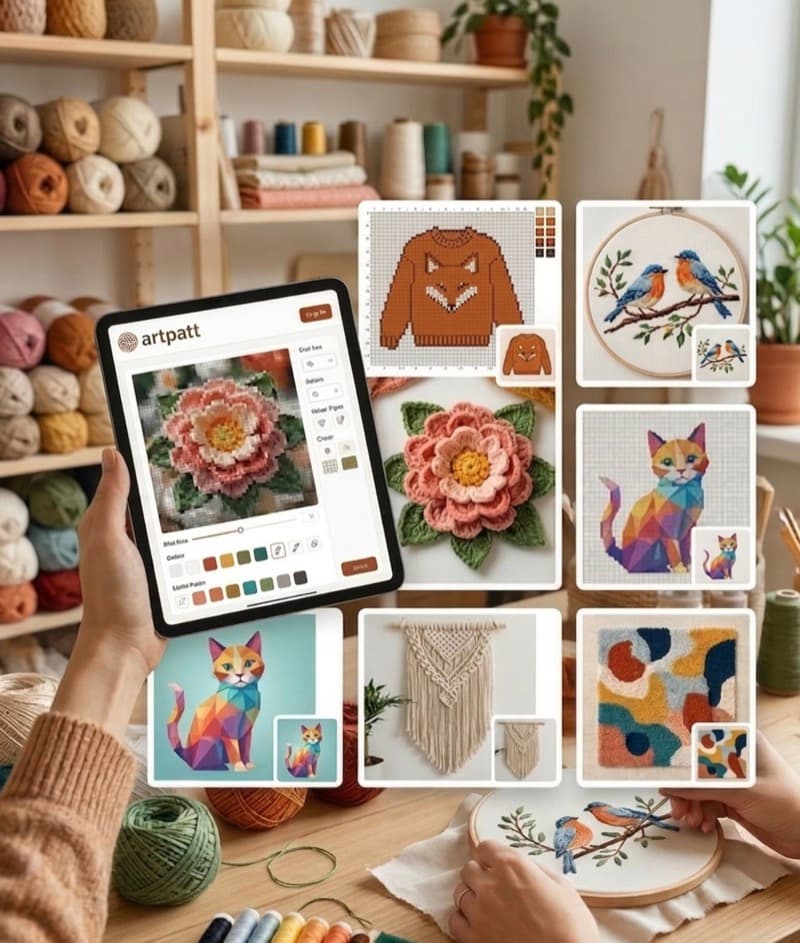
Pick a project under 50×50 stitches with 4 colors maximum. At 14-count that is a 3.5×3.5 inch finished piece. Estimated time: 8–15 hours, finishable in a week of evening stitching. Good first projects: a single letter monogram (your initial), a small heart, a simple flower, a geometric symbol (anchor, star, music note), a tiny landscape (mountain silhouette, sailboat). Bad first projects: pet portraits (too detailed), full quotes or song lyrics (too repetitive, too long), anything labeled 'sampler' (assumes existing skill), patterns with more than 8 colors (overwhelming), patterns over 100×100 stitches (will not finish, will demoralize). You can generate a custom small first pattern from any photo — upload a simple image to ArtPatt's cross-stitch pattern generator, set dimensions to 50×50 and color count to 4. Use the free browser preview to start, then unlock the PNG/PDF export if you want to print it.
How to Make a Cross-Stitch (The Two Motions)
Cross-stitch uses one of two methods — the English method (each X complete before moving on) or the Danish method (a row of half-X going one direction, then a row of half-X completing each X going back). Both produce identical results; pick whichever feels comfortable. English method, step by step: (1) Bring the threaded needle up through the bottom-left corner of an Aida square. (2) Push the needle down through the top-right corner of the same square — that is one diagonal half-X. (3) Bring the needle up through the bottom-right corner of the same square. (4) Push the needle down through the top-left corner — that completes the X. (5) Move to the next square and repeat. The chart shows you which color goes in which square. Always cross your X's the same way (e.g., bottom-left to top-right first, then bottom-right to top-left) so your work has a consistent texture.
Cross-Stitch Floss — How Many Strands to Use
DMC stranded cotton floss comes as a 6-strand bundle. You separate the strands and use 2 strands at a time for cross-stitch on 14-count Aida — this is the standard. Cut a 50–60 cm (20–24 inch) length, pull off 2 strands from the bundle, smooth them flat together, and thread the needle. For finer fabric (18-count Aida or 28-count evenweave over 2), use 2 strands. For very fine fabric (32-count over 1), use 1 strand. For coarse fabric (11-count Aida) or chunky-look samplers, use 3 strands. Backstitch (outline stitches) is usually 1 strand for fine detail or 2 for bold lines. Never separate and recombine the strands without smoothing — the strands have a natural twist and re-pairing them roughly causes tangles.
Starting and Ending a Thread Without Knots
Cross-stitch convention is to never use knots — they create bumps on the back, can pull through the fabric, and look amateur on the front. Two no-knot starts: (1) Loop start — fold a single strand in half, thread the loop end through the needle, take the first half-X stitch from the back, leaving the loop on the back. Pass the needle through the loop on the back to lock the thread. Only works with even strand counts (2 strands threaded as 1 looped strand). (2) Tail-under start — leave a 2 inch tail on the back, hold it against the back of the fabric, and stitch the next 4–5 stitches over it to lock it in. Trim the tail. Ending a thread: weave the needle through the back of the last 4–5 completed stitches, then trim flush. Never tie off — the woven path locks the thread securely.
5 Common Beginner Cross-Stitch Mistakes
(1) Not counting carefully on the first row. The first row sets the position for the entire design. Off by one square at the start = the whole design is shifted. Always count from a center marker (most charts have one) outward. (2) Crossing X's inconsistently. Some bottom-left to top-right, some top-left to bottom-right. The texture looks scrambled. Pick one direction for all bottom halves and stick to it. (3) Using too long a thread. Long threads tangle and fray. Stay under 60cm (24 inches) per cut. (4) Pulling stitches too tight. The Aida fabric distorts and your stitches look pinched. Pull just until the X sits flat — no more. (5) Picking a project that is too big or too detailed. The biggest mistake of all. Beginner enthusiasm picks the 200×300 stitch portrait. It does not finish. Pick something under 50×50 first.
What to Stitch After Your First Project
Once you finish one small project, level up gradually. Second project: 80×80 stitches, 6–8 colors, ~25 hours. A small framed piece (4×4 inches at 14-count) or a 3×5 inch greeting card insert. Third project: introduce backstitch — outlines that sharpen detail. Pick a pattern with backstitch already charted (most patterns include it). Fourth project: try 16-count or 18-count Aida. Smaller stitches, more detail, slightly slower. Fifth project: a custom photo-to-pattern conversion of something meaningful — a pet, a wedding photo, a family home. Use ArtPatt's cross-stitch pattern generator to convert the photo, pick dimensions in the 100×120 range, color count 12–16, enable confetti reduction. Sixth project: tackle your first 'sampler' or larger framed piece (200×200 stitches+). At this point you have the technique to handle the long-form commitment.
Cross-Stitch Beginner FAQ
How long does cross-stitch take to learn? About 30 minutes to learn the stitching motion. About 5–10 hours of practice on a small project to feel confident. About 2–3 finished projects to develop consistent tension and counting accuracy. Is cross-stitch hard? No — it is one of the easiest needlecrafts to learn. The 'hard' part is patience, not skill. Can I cross-stitch from a photo? Yes — use a photo-to-cross-stitch pattern generator like ArtPatt's. Upload any image, pick fabric count, color count, and dimensions, and preview the counted chart in the browser. Unlock the PNG/PDF export for $2.99 for one pattern. What is the difference between cross-stitch and embroidery? Cross-stitch is counted (you stitch in a grid following a chart) and uses only one stitch type. Embroidery is freeform (you follow a printed outline on the fabric) and uses dozens of stitch types. Cross-stitch is more beginner-friendly because there is no drawing or stitch-type variation to learn. Where can I find free cross-stitch patterns? Designer giveaways on Ravelry and Instagram, DMC's free pattern library, Lord Libidan's archive, or generate your own free from any photo using ArtPatt.
Avoiding Eye Strain and Hand Fatigue as a New Stitcher
New stitchers often quit within the first project not because the technique is hard but because 45 minutes of close counting work leaves their eyes tired and their shoulders tight — and they assume that discomfort is normal. It isn't, and it's fixable. Stitch under a direct light source positioned in front of you rather than overhead or behind, since overhead light casts your own head's shadow onto the fabric and forces you to squint or lean in. A simple clip-on daylight lamp clipped to a table or hoop stand solves most of the visibility complaints beginners have on 14-count Aida. For posture, hold the hoop at a comfortable mid-chest height rather than low in your lap — a stitching lap stand or propping the hoop against a table edge keeps your neck neutral instead of bent forward for an hour at a time. Take a 5-minute break every 30–40 minutes to look at something across the room and stretch your hands — this single habit prevents most of the eye fatigue and hand cramping that makes new stitchers set a project down and never pick it back up.
FAQ
What supplies do I need to start cross-stitch?
Start with 14-count Aida, a blunt tapestry needle, six-strand cotton floss, small scissors, and a simple counted chart. A hoop is optional for many small pieces but can improve tension and make the fabric easier to hold.
How do I read a counted cross-stitch chart?
Match the chart symbols to the thread legend, find the center or marked starting point, and count one grid square for each full cross-stitch. Work in small sections and mark completed rows on a printed copy so you can stop and restart without losing your place.
What is the best first cross-stitch project?
Choose a small design with a clear palette and 14-count fabric, such as a simple icon, initials, or a short border. Avoid a large photorealistic chart for the first project; a smaller finish teaches tension, counting, color changes, and finishing without becoming overwhelming.
Related Articles