Tunisian Crochet Color Change: How to Change Color in Tunisian Crochet (TSS, TKS, TPS)
Quick Answer
How to change color in Tunisian crochet — when to swap colors during the forward vs return pass, clean stripes in TSS, vertical and diagonal colorwork, color pooling, and weaving in tails. Beginner-friendly steps with stitch-by-stitch detail.
Why Tunisian Color Change Is Different from Regular Crochet
Regular crochet has one phase per stitch — insert hook, pull through, complete the stitch. Tunisian crochet has two: a forward pass that picks up loops across the row (loops stay live on the hook), and a return pass that works each loop off in pairs from right to left. That second phase is what makes Tunisian feel like a hybrid of crochet and knitting, and it is also what makes color changes work differently. The wrong color appearing one row too high or too low is the most common mistake — it almost always traces back to changing color on the wrong pass. The rule of thumb: a color change made during the return pass shows up at the top of the row you just finished. A color change made during the forward pass shows up vertically inside the row you are about to build. Pick the pass based on the visual result you want.
Clean Horizontal Stripes in Tunisian Crochet (Change at End of Return Pass)
For horizontal stripe colorwork — the most common Tunisian color change — switch on the very last yarn-over of the return pass. Work the return pass in the old color until one loop remains on the hook. Drop the old yarn, yarn-over with the new color, and pull through the final loop. The new color is now the active loop. Begin the next forward pass with the new color and continue normally. The color boundary lands at the exact top of the row, sharp and clean. Carry the unused color up the side rather than cutting if the stripe sequence repeats every 2–6 rows — wrap the carried color around the working color once at the start of each new row to lock it against the edge. For wide stripes (8+ rows) cutting and rejoining is cleaner than carrying.
Vertical Color Blocks (Change Mid-Forward Pass)
For vertical or block colorwork inside a single row — like intarsia — the color change happens during the forward pass at the column boundary. Work the forward pass in color A up to the last vertical bar before the new color block. Pick up the next loop on color A as normal. On the very next loop pickup, drop color A, lay color B over the hook, and pick up using color B. Continue the forward pass with color B. On the return pass, work back across the row using whichever color is at each position. Because the return pass is right-to-left and you completed the forward pass left-to-right, the return pass naturally re-encounters color B first, then crosses to color A. The two colors must twist around each other at the boundary on the wrong side to lock them — without that twist, you get a vertical gap (the same problem intarsia knitters solve by twisting yarn at color changes).
Tunisian Knit Stitch (TKS) Color Change
Tunisian knit stitch produces a fabric that looks like knitting on the front. Color changes in TKS follow the same return-pass rule as TSS but the visual result is slightly different — the color boundary in TKS appears as a clean horizontal knit-style row, whereas TSS shows the boundary slightly more textured. For Fair Isle-style stranded colorwork in TKS: change colors on every stitch as needed during the forward pass (drop and pick up each color as the chart calls for it), then work the return pass with the matching colors. The strands of unused color sit on the wrong side. Keep them loose to avoid puckering — Tunisian fabric does not stretch as much as knitting, so tight floats are more visible.
Tunisian Purl Stitch (TPS) Color Change
Tunisian purl stitch creates ridges across the fabric and tends to hide color transitions in the texture. The color change rule is identical: switch on the last yarn-over of the return pass for horizontal stripes. The advantage of TPS for stripes is that the purl ridge naturally creates a visual break between rows, so even a slightly imperfect color change reads as deliberate. For mixed-stitch projects (alternating TSS and TPS rows), match each color change to the row's stitch type — change at the end of the return pass regardless of which forward stitch follows.
Color Pooling and Variegated Yarn in Tunisian
Variegated yarn pools differently in Tunisian than in regular crochet because each row consumes more yarn (forward + return passes), changing the color repeat alignment. To plan deliberate pooling: count how many stitches one full color repeat takes (wrap the yarn around your hook as you'd use it and count cm per stitch in TSS), then divide the variegated repeat length by stitches-per-row. The result tells you how many rows it takes to complete one color cycle. Adjust your row count or stitch count to land color shifts on intentional row boundaries. For non-pooling 'random' variegated effects, use a yarn with a long color repeat (50cm+ per color) — short-repeat variegated will pool whether you plan it or not.
Weaving In Tails on Tunisian Colorwork
Tunisian fabric is denser than regular crochet, which means tails hide more easily but are also harder to thread through. Weave tails along the wrong-side ridges of the return pass — the horizontal bars on the back of the fabric — using a tapestry needle in a figure-eight pattern. Travel at least 5–6cm before cutting, splitting one ply of the yarn through a stitch on the way to lock the end. Tails worked diagonally across the back are more secure than tails woven straight along one row. For acrylic and synthetic fibers, a small dab of fabric glue at the woven end adds extra security on items that will be machine washed. Avoid the temptation to knot tails — knots show as bumps on the right side of dense Tunisian fabric.
Following a Tunisian Color Chart from a Photo
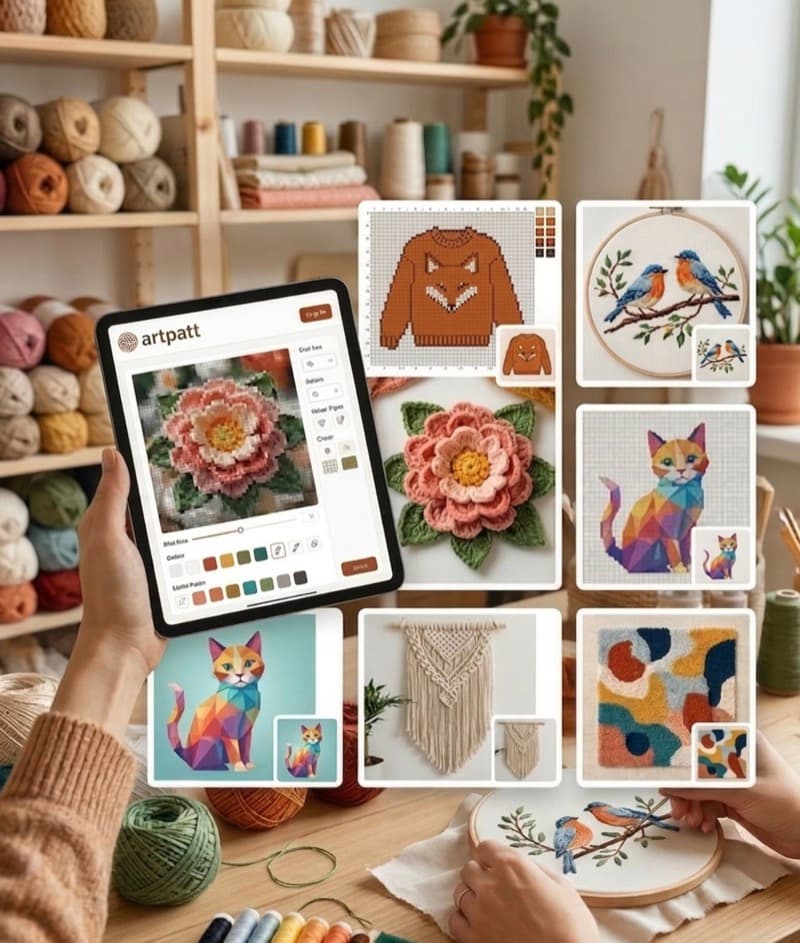
When you generate a Tunisian crochet pattern from a photo using a chart-based generator like ArtPatt, every cell on the grid represents one stitch. The chart reads bottom-to-top, with each row consisting of a forward pass and a return pass for the same row. For colorwork charts: identify the active color for each cell on the forward pass, change colors per the column rule above for vertical blocks, and use the return-pass rule for horizontal bands. Limit total active colors to 2–3 at a time — Tunisian fabric does not tolerate carrying many colors well. ArtPatt's confetti reduction setting helps by collapsing isolated single-cell color runs that would otherwise force constant color changes. Use a row counter — Tunisian color-change mistakes are almost always row-count drift, and the dense fabric makes ripping back painful.
Tunisian Crochet Color Change FAQ
Why does my color show up one row too high? You changed at the start of the next forward pass instead of the end of the return pass. Move the change one step earlier — the very last yarn-over of the return pass. Why is there a gap between vertical color blocks? You forgot to twist the two colors at the boundary on the forward pass. Wrap the new color over the old before picking up the next loop. Why is my edge messy when I carry the unused color up the side? Carry too loose and the strand sags; too tight and the edge puckers. Wrap the carried color around the working color once at the start of each new row — this locks tension without distorting the edge. Should I cut the old color or carry it? For stripes 6 rows or fewer, carry. For wider stripes or one-time color blocks, cut and weave in. Carrying across more than 6 rows produces visible tension lines on the edge.
Related Articles