How to Make a Cross-Stitch Pet Portrait from a Photo (Step-by-Step)
Quick Answer
Step-by-step guide to converting a pet photo into a counted cross-stitch pattern — choosing the right photo, fabric count, color count, backstitch settings, and what to do about confetti. Works for dogs, cats, horses, birds, and exotic pets.
Why Pet Portraits Are the Most Popular Cross-Stitch Project
Pet portraits are the single most-searched custom cross-stitch project — more than wedding pieces, baby announcements, or landscape art. The reasons: pet photos are the most-photographed subjects in any household; finished pet portraits make emotional gifts; a high-quality stitched portrait costs $200–600 to commission but can be DIY'd for $20–40 in supplies; and unlike commissioned drawings or paintings, a stitched portrait carries the personal-handmade weight that printed photos do not. The barrier has historically been the chart — converting a complex pet photo (fur texture, dozens of color variations, busy background) into a stitchable counted chart used to require hand-charting (tedious) or hiring a chart designer ($30–80 per chart). Photo-to-pattern generators removed that barrier — you upload a pet photo, get a chart in seconds.
Choose the Right Pet Photo (This Step Determines Everything)
The single highest-leverage decision in a pet portrait project is the source photo. Best photos: face filling 60–80% of the frame, eye-level angle (camera at the pet's eye height, not looking down at them), even diffused lighting (overcast outdoor or window light, not flash), plain or simple background (solid color, blurred, or easily edited out), pet looking at the camera or in profile. Bad photos: full-body shots from far away (face too small to render with detail), backlit photos (face is shadowed, generator picks up backlight color as the dominant tone), busy backgrounds (chart confetti spreads across the entire image), low resolution (under 1000px wide produces pixelated charts), motion blur, photos taken with phone portrait-mode at extreme aperture (the artificial blur looks unnatural in stitches). If your only photo is bad, take a new one — the source photo quality dwarfs every other decision in the project.
Pre-Convert Photo Editing (Saves Hours of Stitching)
5 minutes of photo editing saves dozens of hours of stitching. Crop tightly to the head and shoulders — pet portraits are not full-body. Increase contrast slightly (10–20%) — flat photos translate to flat-looking charts; sharper contrast gives the chart definition. Adjust exposure if the face is in shadow — bring up shadow detail without blowing out highlights. Remove or simplify the background — use the iOS or Android built-in 'remove background' tool, or any free web tool (remove.bg, photoroom). A solid color or transparent background prevents background confetti. Sharpen the eyes — eyes carry the personality. Increase clarity by 30–50% on the eye area only if your editor supports masks. Save as PNG (lossless) at 1500–3000px wide. JPEG compression artifacts can confuse the color quantizer.
Fabric Count and Chart Dimensions for Pet Portraits
Fabric count determines detail and finished size. 14-count Aida (the standard) at 150×200 stitches = 27×36cm finished piece — good for a recognizable medium-detail portrait. 16-count Aida or 32-count linen over 2 at 200×280 stitches = 31×44cm — adds detail without much more stitching time. 18-count Aida at 250×350 stitches = 35×49cm — high detail, smaller stitches, requires good vision or a magnifier. 28-count linen over 1 (very fine) at 350×500 stitches = 31×45cm — gallery-quality detail, expert-level stitching, 200+ hours. For a first pet portrait, 14-count at 150×200 is the right starting point — finishes in 60–100 hours, looks recognizable, fits a 30×40cm frame.
Color Count for Pet Portraits (Dogs, Cats, Birds, Exotics)
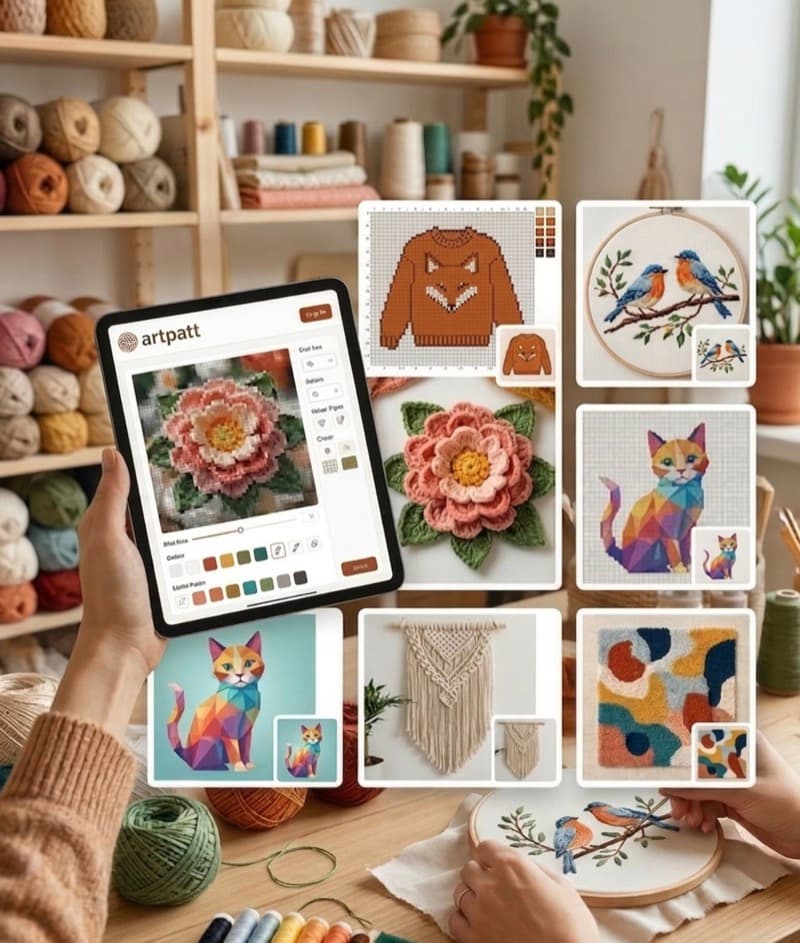
Pet fur and feathers contain dozens of subtle color variations. The right color count balances realism against stitching time and confetti chaos. Short-haired solid-color dogs (Labrador, Pit Bull, Boxer): 12–16 DMC colors. Long-haired multi-color dogs (Husky, Aussie, Border Collie): 16–24 colors. Solid-color cats: 14–18 colors. Tabby and tortoiseshell cats: 18–24 colors. Birds with iridescent feathers (parrots, macaws): 20–30 colors — birds are the highest-color-count subject. Horses (solid color body, mane and forelock variation): 14–18 colors. Reptiles and exotic pets: 12–18 colors typically. Background (if you keep it): add 4–8 colors for sky/grass/wall. ArtPatt's photo-to-cross-stitch generator picks the dominant 12–30 colors automatically using CIEDE2000 perceptual color matching against all 489 DMC colors.
Managing Confetti — The Pet Portrait Killer
Confetti — single-stitch color blocks scattered across the chart — is the #1 reason pet portraits fail to finish. Confetti adds dozens of color changes per row, which means dozens of starts and ends, which means hours of weaving in tails. A pet portrait without confetti reduction can have 1500+ tails to weave; with reduction, 200–400. ArtPatt's confetti reduction setting collapses isolated single-stitch color runs into the surrounding dominant color. Use medium for crisp graphic photos, heavy for fur and feather subjects. Heavy confetti reduction is almost always correct for pet portraits — the visual difference is minimal at 14–16 count, but the stitching time difference is dramatic. Combine confetti reduction with a moderate color count (16–20) rather than maximum color count (30+) — both decisions cut stitching time roughly in half.
Backstitch — When to Use It on Pet Portraits
Backstitch (single-strand outlining) sharpens edges where cross-stitch alone reads soft. For pet portraits, use backstitch on: the eye outline (1 strand DMC 310 black for sharp eyes), the nose outline (1 strand 310), the mouth line, the inside of pointed ears (a thin dark outline gives definition), whisker lines if your subject has visible whiskers (1 strand 762 light grey). Skip backstitch on: fur edges (cross-stitch alone is correct — backstitched fur edges look cartoonish), background edges, the outside silhouette (cross-stitch handles the outline through color contrast). ArtPatt's pattern generator detects high-contrast edges and adds backstitch automatically; you can adjust intensity from none to heavy in the generator settings. For beginner portraits, leave backstitch on auto and only adjust if the result feels too noisy or too sparse.
Fabric Color — White, Cream, or Black?
White 14-count Aida is the safe default for any pet color. Cream Aida (DMC Antique White) softens the look — better for vintage-style portraits or pets photographed in warm sunlight. Black Aida is dramatic for dark-furred pets (black cats, black labs) — the unstitched background becomes the pet's body and you only stitch the face and accent areas (eyes, nose, ears). Cuts stitching time by 30–60% but requires good eyesight (counting on black is harder). Hand-dyed mottled fabric (Picture This Plus, Silkweaver, Sparklies) creates atmospheric texture without stitched background — works well for portrait pieces where the pet is the only stitched element. Avoid: bright white for cream-colored pets (the pet washes out), cream for white pets (the pet disappears), black for pets with dark backgrounds you wanted to keep.
Framing and Finishing Your Pet Portrait
When the cross-stitch is finished, wash gently in cold water with mild soap (Eucalan or Soak Wash), roll in a clean towel to remove excess water, lay flat on a fresh towel to air dry. Iron face-down on a fluffy towel to preserve the texture. Mount on acid-free foam board (lacing or stretching to keep the fabric taut). Frame in a standard photo frame matching the piece dimensions — 8×10 inch frame for ~150×200 stitch pieces, 11×14 for ~200×280, 16×20 for ~250×350. Use UV-protective glass or acrylic if the frame will hang in direct sunlight. Add a mat (acid-free, in a complementary color) for a more polished gallery look. Total finishing cost: $20–60 depending on frame quality. As a gift, a finished framed pet portrait is widely valued at $200–600 for the equivalent commissioned work — even though your supply cost is closer to $40–80.
Cross-Stitch Pet Portrait FAQ
How long does a cross-stitch pet portrait take? Beginner-friendly portrait (14-count, 150×200 stitches, 16 colors): 60–100 hours stitching. Intermediate (16-count, 200×280, 20 colors): 120–180 hours. Gallery-quality (28-count over 1, 350×500, 30 colors): 250–400 hours. Can I cross-stitch a portrait of my deceased pet? Yes — many people commission or DIY pet portraits as memorial pieces. Use the best photo you have (even an older photo is fine), pre-edit to clean up the image, generate the chart, stitch slowly. The act of stitching is part of the memorial process for many people. How much does a custom pet portrait pattern cost? ArtPatt offers a full browser preview for free. A PNG/PDF export is $2.99 for one pattern or included with Pro at $6.99/month. Commissioning a hand-charted custom pattern from a designer typically costs $30–80. Generated patterns are equivalent quality for most pet subjects. Can I generate patterns for unusual pets (snakes, lizards, fish)? Yes — any photo works. Snakes and lizards with patterned scales generate beautifully because the scale pattern translates well to stitch grids. Fish work well for solid-color species (goldfish, koi); harder for iridescent species. Birds with strong color blocks (parrots, macaws, peacocks) are some of the most striking pet portraits. What about black dogs and cats? Use black Aida fabric and stitch only the face features. Cuts time dramatically and produces a high-contrast portrait. Or use white Aida and pick a chart with rich shading (you will use 8–12 different greys and dark browns for the 'black' fur — pure black 310 only for the deepest shadows).
Related Articles