Cross-Stitch for Beginners: Everything You Need to Start (2026 Guide)
Quick Answer
Complete beginner's guide to cross-stitch: what supplies to buy, how to thread a needle, how to make the X stitch, how to read a pattern, and how to finish your first project. Everything in one place.
What Is Cross-Stitch?
Cross-stitch is an embroidery technique where you form X shapes on fabric by passing thread diagonally across intersections in an even-weave fabric grid. It's one of the oldest and most globally widespread needlework crafts — versions of it appear in historical European, Asian, and Middle Eastern textile traditions. Modern cross-stitch uses Aida fabric (a stiff, evenly gridded cotton fabric) and six-strand embroidery floss (most commonly DMC brand). The result is a pixel-art-like image built entirely from small, uniform X stitches. It's one of the most accessible crafts: setup cost under $30, no special equipment, completely portable, and the basic stitch can be learned in about 10 minutes.
Starter Supplies: What You Actually Need
You need four things to start: Aida fabric (14-count is standard for beginners — buy a small piece, 30×30cm), DMC embroidery floss (start with a handful of colors you like — full sets are 489 colors, but 10-20 colors is plenty for your first project), embroidery needles (size 24 tapestry needles for 14-count Aida — blunt tip, eye large enough for 2 strands of floss), and an embroidery hoop (10cm or 15cm round hoop to hold fabric taut). Optionally: a small pair of scissors, a needle minder (a magnetic tool that holds your needle when not in use), and a pattern — either printed or on your phone. Total cost for a starter kit: $15-25. Avoid premium frames, hoops, and specialty fabric for your first project — finish a small piece first and buy upgrades based on what you actually find limiting.
Threading the Needle and Starting Your Thread
DMC floss comes as a 6-strand bundle. For 14-count Aida, you usually use 2 strands at a time. Pull out about 50cm of floss and carefully separate 2 strands from the bundle. Thread both strands through the needle eye (fold slightly to help). Do not knot the end. To start: push the needle from the back to the front through a hole in the Aida, leaving about 2cm of tail on the back. Hold this tail against the back of the fabric and anchor it by stitching over it with your first 3-4 stitches. This "anchor tail" method is more secure than a knot and produces a flatter result on the back. Cut the floss when you get to about 5cm remaining — too short to stitch cleanly but enough to weave in on the back.
How to Make the Cross-Stitch X
Each X stitch requires exactly four moves: 1) up through bottom-left hole (position A), 2) down through top-right hole (position B) — this is the first diagonal. 3) Up through bottom-right hole (position C), 4) Down through top-left hole (position D) — this is the second diagonal. The result is an X. Consistency rule: always do the same diagonal first across your entire piece. Standard practice: bottom-left to top-right first (/) then top-left to bottom-right (). If you reverse this and do (×) the stitches all look slightly different and the texture is uneven. Working in rows: for large areas of one color, work all the first diagonals across the row (////), then work back completing all the Xs (\\ back). This is faster and the back looks tidier. For isolated single stitches: complete each X before moving to the next.
How to Read a Cross-Stitch Pattern
A cross-stitch pattern is a grid where each cell represents one X stitch. Each color gets a unique symbol (circle, square, triangle, plus sign, etc.). The legend maps each symbol to a DMC thread number and usually shows the color swatch and how many skeins you'll need. To read the pattern: find your starting position — usually the center of the pattern, marked with arrows pointing to the center row and column. Count stitches and mark the center of your Aida fabric with a removable marking pen. Work outward from the center. Count carefully: moving one cell on the pattern = moving one hole on the Aida. For large patterns: use a magnetic board with a magnetic ruler to mark your current row, or print and mark off completed sections with a pencil. For photo-generated patterns (from ArtPatt or similar): the PDF includes 50×50-stitch sections with row and column numbers, making it much easier to navigate than one overwhelming full-size grid.
Choosing Your First Cross-Stitch Project
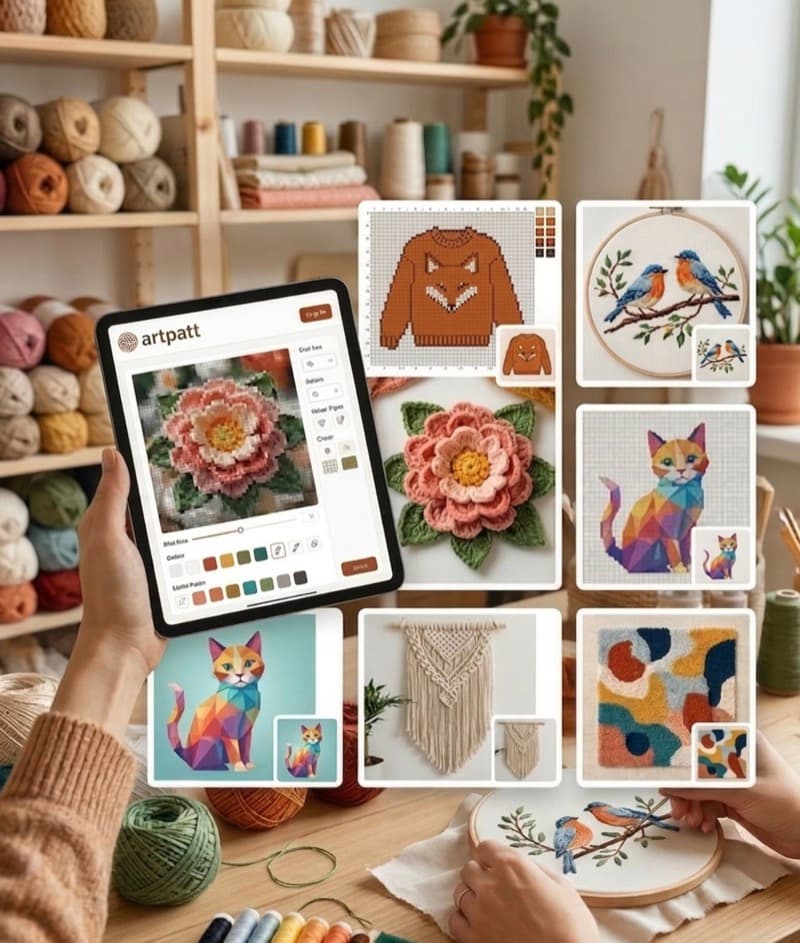
The best first project is small (under 50×50 stitches), uses 3-6 colors, and is something you actually want finished and displayed. Avoid starting with a 200-color photo portrait — the complexity will overwhelm a beginner and the project will never get finished. Good starter options: a small text design (your name, a short quote) with simple letter forms, a geometric pattern with clear color regions, or a small pixel art sprite (a 16×16 Minecraft item is genuinely achievable in one weekend). When you've finished your first 10×10 or 20×20 stitch piece and understand the rhythm of the craft, graduate to larger designs. ArtPatt can generate any photo as a cross-stitch pattern — start with a simple subject (a solid-colored flower, a bold logo, a simple animal silhouette) before attempting a full pet portrait.
Finishing and Framing Your Finished Piece
When all stitching is done: wash the piece gently by hand in cool water with a tiny drop of hand soap to remove any handling oils and hoop marks. Do not wring or twist — press between two towels to remove excess water. Lay flat or block on foam tiles (pinning to shape) and allow to dry completely. Iron from the back with a damp cloth — never iron directly on the stitched side as this crushes the stitches. Framing: cross-stitch looks best in a frame without glass (the texture reads better without reflection) or with UV-protective glass. Use a foam board as a backing — lace the fabric tightly over the board to keep it taut. Alternatively, display in an embroidery hoop with the hoop itself as the frame — trim the excess fabric and cover the back with felt for a clean finish. Avoid hanging in direct sunlight as DMC thread can fade.
Next Steps: Growing Your Cross-Stitch Practice
After your first project, the natural progressions are: larger designs (moving from 50×50 to 100×100+ stitches), more colors (from 6 colors to 15-20), photo conversion (upload any personal photo to ArtPatt and generate a pattern — pets, portraits, landscapes), and specialty stitches (backstitch for outlines and detail lines, French knots for texture and dots, quarter stitches for diagonal edges). The ArtPatt generator auto-adds backstitch lines when the Backstitch option is enabled — it detects edges in the source image and converts them to backstitch suggestions. For photo portraits, this dramatically improves the realism of the result by outlining key features. Community resources: r/CrossStitch on Reddit has a beginner thread, monthly project sharing, and an exceptionally helpful community. For DMC thread storage, the standard system is small zip bags labeled with DMC numbers, or wooden thread bobbins wound with floss and numbered.
Hoops vs Q-Snaps vs Scroll Frames
The hoop, Q-snap, and scroll frame are the three main options for holding fabric taut while you stitch. A round embroidery hoop is the standard beginner choice — it holds fabric taut with a screw mechanism and is inexpensive and portable. Downsides: the hoop leaves a circular indentation in Aida fabric that must be pressed out, and fabric can loosen over long sessions requiring re-tightening. A Q-snap frame (a rectangular frame made of PVC pipe with push-on clamps) holds larger pieces without a round indentation. It does not leave hoop marks and is faster to move across the fabric. Best for pieces larger than 6 inches. A scroll frame holds the fabric between two rollers at the top and bottom, with the side edges attached to tape — good for very large pieces that cannot be held in a hoop or Q-snap. Scroll frames keep constant, even tension across the full fabric width. For beginners starting with small pieces on 14-count Aida, a 6-inch or 8-inch round hoop is the practical starting point — low cost, widely available, and suitable for projects up to 5×5 inches on 14-count.
Cross-Stitch and Focus: Why Counting Stitches Calms the Mind
Cross-stitch has a practical relaxation effect that many practitioners describe as similar to meditation. The mechanism is simple: counting stitches occupies the part of the mind that generates anxious or intrusive thought while leaving the creative and observational brain free. The repetitive physical rhythm — needle up, needle down, move one space — is predictable enough to be calming without requiring focused problem-solving. The visible, incremental progress of a pattern taking shape provides a regular source of accomplishment that most day-to-day work cannot match. Research on repetitive manual crafts suggests they reduce cortisol levels and improve mood in ways similar to meditation. Cross-stitch in particular benefits from the counting structure: when you must count 15 stitches across and 12 rows down, there is simply no cognitive bandwidth left for the worries of the day. This is not incidental to the craft — many experienced stitchers explicitly choose their projects based on complexity, choosing complex counted patterns for difficult periods and simpler repetitive fills for projects meant to accompany conversation or television.
FAQ
What are the most common mistakes beginners make on their first project?
Losing count of the center starting point is the single most common problem — a stitch placed one hole off early on means the whole design drifts and the error usually isn't spotted until much later. Mark the fabric center with a removable pen and count from it rather than eyeballing position. Mixed stitch direction is the second common issue: every top diagonal in a project should cross the same way, and mixing (/) and (\\) on top at random makes the finished piece look uneven even when every stitch is technically correct. Pulling thread too tight is third — it distorts the Aida holes and puckers the fabric; aim for stitches that lie flat without pulling the fabric weave out of square. Finally, starting with too large or too colorful a project is a motivation killer more than a technical mistake: a 200-color portrait as a first project has a low finish rate, while a small 20×20 design in 4-6 colors gets completed and builds the habit.
What supplies do I need for a first cross-stitch project?
Start with a small chart, 14-count Aida, stranded cotton in the listed colors, a size 24 or 26 tapestry needle, small scissors, and a hoop if it helps you keep the fabric comfortable. A printed symbol chart and a highlighter are useful for tracking completed sections.
How do I keep count while stitching a cross-stitch pattern?
Find and mark the fabric center, then work in small blocks of ten stitches or use a removable grid. Mark completed rows on the chart as you go, and count both the empty spaces and the stitches when moving to a new section.
Related Articles