How to Make an Embroidery Pet Portrait from a Photo (Thread Painting & Counted Methods)
Quick Answer
Step-by-step guide to converting a pet photo into a hand embroidery pattern — thread painting vs counted embroidery methods, choosing the right photo, picking floss colors, and managing fur texture realistically.
Two Approaches: Thread Painting vs Counted Embroidery
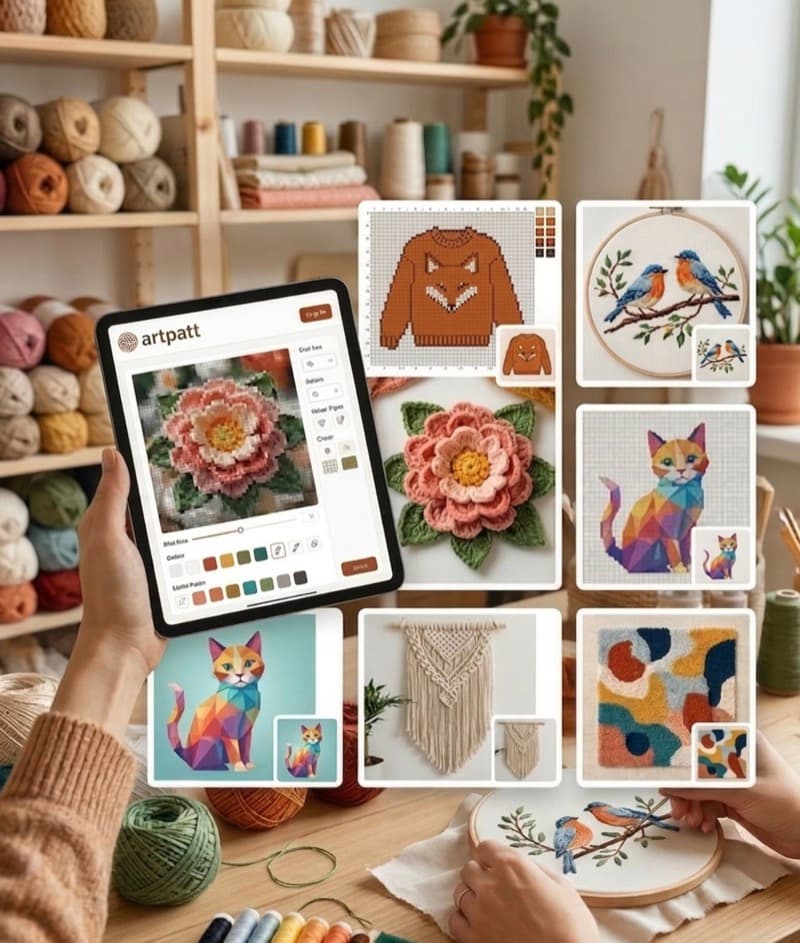
There are two fundamentally different ways to embroider a pet portrait. (1) Thread painting (also called needle painting or long-and-short stitch portraiture) — freeform embroidery using long-and-short satin stitch, split stitch, and french knots to recreate the pet's fur as if painting with thread. The design is traced as a line outline on plain fabric; you choose which stitches and colors fill each area. Highly artistic, infinitely flexible, requires significant skill to execute well. Time investment: 50–200 hours per portrait. (2) Counted embroidery from a photo-generated chart — same workflow as cross-stitch but using counted thread on evenweave or aida fabric, executing the chart as cross-stitch or as filled satin stitch within counted boundaries. Easier for beginners, faster than thread painting, results that look cleaner-but-less-painterly. ArtPatt's photo-to-embroidery generator targets the second method — converts any photo into a counted DMC chart with backstitch and color blocks ready to execute as counted embroidery.
Choosing the Right Pet Photo for Embroidery
Both thread painting and counted embroidery benefit from the same photo qualities as cross-stitch (covered in detail in our cross-stitch pet portrait guide). Best photos: face filling 60–80% of the frame, eye-level angle, even diffused lighting, plain or removable background, pet looking at the camera or in profile. For thread painting specifically, slightly more dynamic lighting is acceptable — the artistic interpretation can handle directional shadows better than counted embroidery. For counted embroidery, photos that work for cross-stitch also work for embroidery (the chart generation is similar). Edit before converting: tight crop on head and shoulders, increase contrast 15–25%, remove or simplify background, sharpen eyes. The 5 minutes of photo editing saves dozens of hours of stitching time regardless of method.
Fabric and Floss for Embroidery Pet Portraits
Thread painting fabric: 100% cotton or linen, fine smooth weave, light color (white, ecru, light grey). Quilter's cotton (Kona, Robert Kaufman) is the standard. The fabric is tensioned in a hoop and the design is traced or printed onto the fabric. Avoid: open-weave fabrics (Aida, evenweave), fabrics with visible texture or weave (linen for fine portraits), dark fabrics (the design is hard to trace and the threads sit oddly on dark surfaces). Counted embroidery fabric: 14–18 count Aida cloth or 28–32 count evenweave (over 1 or over 2). Same fabric choice as cross-stitch. White or off-white is the safe default. Floss for both methods: DMC stranded cotton, 1–2 strands at a time for thread painting (1 strand for fine detail and shading, 2 strands for fills); 2 strands for counted embroidery on 14-count, 1 strand on 18-count or fine evenweave. A pet portrait may use 20–40 different DMC colors — significantly more than a typical embroidery design.
Thread Painting Pet Portraits — The Painterly Method
Thread painting recreates the pet's fur as continuous flowing strokes of thread. The signature stitch is long-and-short stitch — alternating long and short straight stitches that interlock with the next row to create gradient color transitions. For pet fur: stitch in the direction the fur grows (which varies across the body — face fur radiates outward from the nose, leg fur goes downward, back fur goes head-to-tail). Layer multiple shades of color in the same area to create dimension — a brown dog might use 8–12 shades from black through dark brown to medium brown to tan to highlight cream, layered one over the next. Eyes are the key feature: stitch the iris in 3–5 shades of color radiating from the pupil center, the pupil in pure black satin stitch, the catch-light in white satin stitch (one or two stitches). Whiskers in single-strand backstitch in white or light grey. Time investment: 50–200 hours for a high-quality 15×20cm portrait. Skill ceiling: very high — thread painting at the gallery level is a multi-year skill. Beginner-acceptable thread painting (recognizable but not photo-real): 30–60 hours of work after 3–5 practice projects.
Counted Embroidery Pet Portraits — The Faster Method
Counted embroidery from a chart is the faster, more accessible method for pet portraits. Generate the chart from a photo using ArtPatt's photo-to-embroidery generator. Pick fabric count: 16-count Aida or 28-count linen over 2 for medium detail, 18-count Aida or 32-count linen over 1 for fine detail. Color count: 16–24 DMC colors for short-haired solid pets, 20–30 for long-haired multi-color pets, 24–32 for pets with iridescent feathers (parrots, peacocks). Confetti reduction: heavy — same as cross-stitch pet portraits. Execute the chart in cross-stitch (faster, more uniform texture) OR in counted satin stitch within the chart's color boundaries (more painterly look, slower). Time investment: 60–120 hours for a 15×20cm portrait at 16-count Aida. The result is recognizably your pet but with the slightly stylized look of all counted work — like a printed photograph with visible pixels at close inspection.
Managing Fur Texture in Embroidery (Where the Magic Happens)
Fur texture is what separates a flat embroidered pet portrait from a stunning one. Three techniques. (1) Direction of stitches — always stitch in the direction the fur grows. Face fur radiates outward from the nose; back fur goes head-to-tail; leg fur goes downward. Following fur direction creates the visual illusion of real fur even at low stitch resolution. (2) Layered color — even short-haired pets have 4–8 visible color variations in their fur. Layer multiple shades of brown/grey/cream in the same area rather than using a single 'dog brown' color. The layering creates depth and dimension. ArtPatt's pattern generator picks 16–24 colors automatically; use them as layers, not as separate solid blocks. (3) Mixed stitch types — combining cross-stitch (uniform texture) with counted satin stitch (smooth fill) and backstitch (sharp outlines) within the same piece creates textural variety. For example: cross-stitch the body, counted satin stitch the eyes, backstitch the fur outlines. This mixed-stitch approach is more advanced but produces results closer to thread-painting quality with less time investment.
Framing and Finishing Embroidery Pet Portraits
When the embroidery is finished, wash gently in cold water with mild soap (Eucalan or Soak Wash) to remove any tracing pen marks and fabric oils. Roll in a clean towel to remove excess water, lay flat on a fresh towel to air dry. Iron face-down on a fluffy towel to preserve the texture without flattening the stitches. Mount on acid-free foam board, lacing or stretching to keep the fabric taut. Frame in a standard photo frame matching the piece dimensions. For thread-painted portraits, use a deep frame with matting that lifts the glass off the surface (the textured stitches sit closer to the glass than flat photos and need clearance). Use UV-protective glass or acrylic for portraits hanging in sunlit rooms. For counted embroidery, standard frames work fine. Total finishing cost: $20–60 depending on frame quality. As a gift, a finished framed embroidery pet portrait commissions for $300–800 — your supply cost is $30–80.
Embroidery Pet Portrait FAQ
How long does an embroidery pet portrait take? Counted embroidery (16-count, 150×200 stitches, 20 colors): 60–120 hours. Thread painting (15×20 cm, 12 colors layered): 50–200 hours depending on skill level and detail. Both produce gallery-quality results with practice. Which is easier — thread painting or counted embroidery? Counted embroidery is dramatically easier for beginners — follow the chart, no artistic decisions required. Thread painting is the more advanced technique, requires color theory and stitch direction intuition, ceiling is much higher but the floor is also higher. Can I generate an embroidery pattern from a photo? Yes — use ArtPatt's photo-to-embroidery generator. Upload any pet photo, pick fabric count and color count, get a counted DMC chart with backstitch boundaries. Preview it in the browser for free; a PNG/PDF export with per-color floss estimates is $2.99 for one pattern or $6.99/month unlimited with Pro. How is embroidery pet portrait different from cross-stitch pet portrait? Same chart can be executed as cross-stitch (uniform X texture) or as counted embroidery (mixed stitches: satin fills, backstitch outlines, french knot accents). Embroidery has more textural variety; cross-stitch is faster and more uniform. Both produce recognizable pet portraits. What about embroidered pet portrait kits? Several Etsy designers sell printed-fabric kits with floss included for $50–150. The kit format is convenient (no chart-following needed — just stitch over printed lines) but limits you to the designer's chosen photos. For a custom portrait of your specific pet, generate a chart from your own photo using ArtPatt's tool.
Related Articles