How Many Skeins of Yarn Do I Need for a Crochet Blanket?
Quick Answer
Calculate exactly how much yarn you need for any crochet blanket. Includes SC, DC, and HDC rates, gauge math, colorwork overhead, and size-specific estimates — baby, lap, 50×60, and full throw.
The Basic Formula
Total yarn (meters) = Number of stitches × Yarn per stitch × 1.15 buffer. Number of stitches = Grid width × Grid height. Yarn per stitch by stitch type: Single crochet (SC): ~12cm per stitch. Half double crochet (HDC): ~15cm per stitch. Double crochet (DC): ~19cm per stitch. C2C DC cluster: ~90-100cm per cluster (three DCs plus joins and chains). Example: 120-stitch SC blanket (120 wide × 160 rows = 19,200 stitches) × 12cm × 1.15 buffer = 264,960cm = 2,650 meters. At 200m per standard worsted skein, that's 13-14 skeins. This is the total — for colorwork blankets, the split by color comes from the ArtPatt per-color breakdown.
Why Stitch Type Changes Everything
The stitch type is the single biggest variable in yarn consumption. A DC blanket uses 58% more yarn than an SC blanket of the same finished dimensions — because DC stitches are taller, you need more yarn to wrap around the hook and create the stitch height. SC at 16 stitches per 10cm produces a tight, detailed fabric — great for colorwork portraits, but slow and yarn-efficient. DC at roughly 10 stitches per 10cm covers area faster but costs more yarn. HDC splits the difference. For budget and timeline planning: SC is the most yarn-efficient; DC is the fastest per square cm but most yarn-intensive. Always calculate based on your actual stitch type.
Why Your Gauge Changes the Skein Count
Two crocheters using the same pattern can need very different amounts of yarn. If your gauge is 14 SC per 10cm (looser than standard 16), each stitch uses slightly more yarn because the loops are larger. If your gauge is 18 SC per 10cm (tighter), each stitch uses slightly less. The yarn per stitch estimates above are based on a standard worsted weight at 16 SC/10cm gauge. For significantly looser or tighter gauge, adjust: Loose gauge (14/10cm): multiply stitch count by 14/16 but add 10% per stitch (the loops are larger). Tight gauge (18/10cm): you'll have more stitches but each uses slightly less. In practice, for most crocheters using worsted weight, the standard estimates are accurate within 10-15%. Always swatch first and calculate from your actual stitch count for the target blanket size.
Extra Yarn for Colorwork Blankets
Colorwork adds significant yarn overhead beyond the basic stitch calculation. Every color change requires: cutting the old yarn (leaving a tail to weave), attaching the new yarn (another tail), and sometimes carrying yarn across the back for 1-2 stitches (wasting yarn). The more fragmented your color distribution — many small isolated patches of each color — the more overhead per color. ArtPatt calls this fragmentation overhead and includes it in the per-color estimate. For a simple 2-color striped blanket, overhead is minimal (one cut per row). For a 12-color portrait graphghan with hundreds of small color patches, overhead per color can add 15-25% to the raw stitch calculation. This is why ArtPatt adds a 15% buffer on top of the fragmentation-adjusted estimate.
Practical Skein Estimates by Blanket Type
Baby blanket (75×90cm / 30×36 in), SC, single color: approximately 600-700m = 3-4 skeins. Lap blanket (90×120cm / 36×48 in), SC, single color: 1,100-1,300m = 6-7 skeins. 50×60 inch throw (127×152cm), SC, single color: 2,500-3,000m = 13-15 skeins worsted; DC, single color: 4,000-4,600m = 20-23 skeins worsted. Standard throw (120×150cm), SC, single color: 2,400-2,800m = 12-14 skeins. Standard throw, DC, single color: 3,800-4,400m = 19-22 skeins. Colorwork graphghan throw (120×150cm, 12 colors): 2,800-3,200m total, distributed across colors — each color typically 150-400m depending on how much of the image it covers. Full/Queen blanket (150×200cm), SC: 4,000-5,000m = 20-25 skeins. These are single-color estimates using worsted weight at standard gauge. Use ArtPatt's yarn calculator for precise per-color colorwork estimates.
Using ArtPatt for Exact Colorwork Yarn Estimates
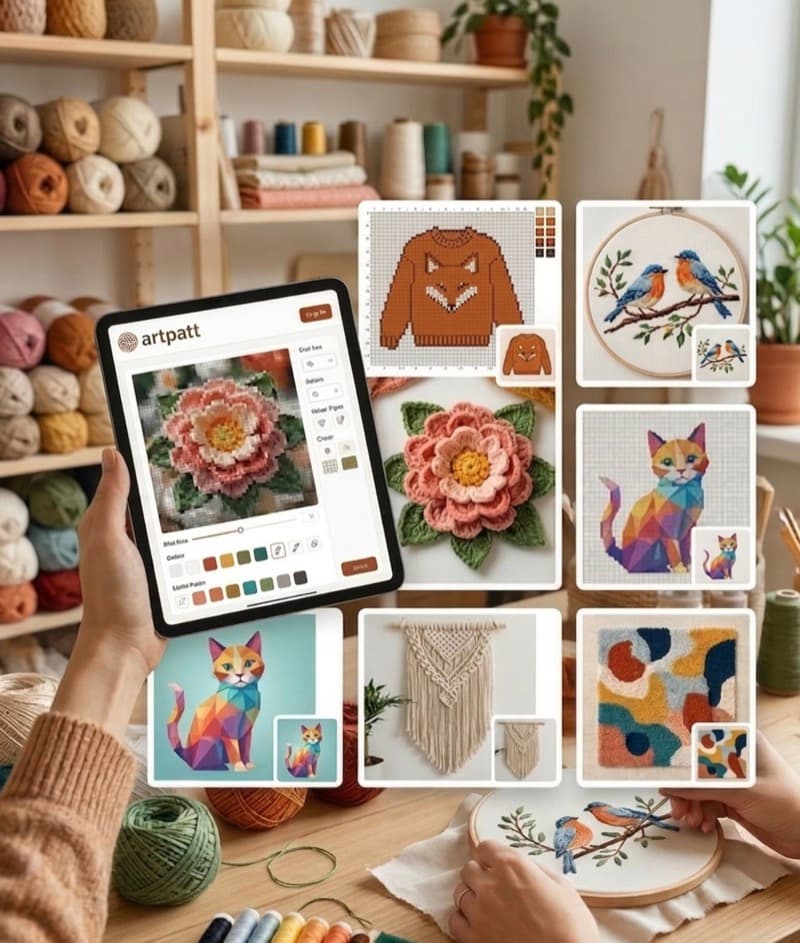
Upload your image, set stitch type and grid size, and generate the pattern. The stats panel shows per-color yarn estimates automatically. These are calculated using the stitch-type consumption rate for each stitch in that color, plus fragmentation overhead (based on how scattered vs. concentrated the color is across the pattern), plus 15% waste buffer. The color legend on the PDF shows meters per color and how many skeins to buy. Shopping tip: screenshot the color legend before going to the yarn store — it shows the color swatch, yarn quantity, and (if you swap colors) the specific yarn name you selected. Buy all yarn in a single trip to ensure the same dye lot. For large blankets, buying one extra skein of the dominant color costs $8-15 but prevents the nightmare of running out during the final rows and finding the dye lot is discontinued.
Common Yarn Buying Mistakes
Buying by weight without checking yardage: two skeins of the same weight (200g each) can have wildly different yardage — a wool skein might have 400m while a cotton skein of the same weight has only 200m. Always check meters, not grams. Forgetting the buffer: buying exactly the calculated amount leaves no room for error. Always buy 15-20% more than the calculation. Not buying in the same dye lot: yarn is dyed in batches. Two skeins of the same color number from different dye lots can have a visibly different shade — especially noticeable in large solid-color areas. Check the dye lot number on the label and buy all skeins from the same batch. Underestimating colorwork overhead: simple stripe calculations don't account for the extra yarn at each color change. Use ArtPatt's automated fragmentation overhead calculation for multi-color projects — it has empirically measured this overhead for different color distribution patterns.
How Fiber Type Affects Yarn Consumption
Fiber type affects how much yarn you use even at the same gauge and stitch count, because different fibers stretch differently as you crochet. Cotton has almost no stretch — the stitch size is locked in from the moment you pull the loop through, and cotton yarn does not compact or expand during washing. Cotton yarn estimates are very accurate because there is no recovery slack. Acrylic stretches during crocheting but recovers after washing — your actual yarn consumption is slightly less than calculated because the stitches tighten up after blocking. Wool is springy: it compresses into the stitch body more than cotton, and wool yarn estimates tend to run 5–10% lower than cotton estimates at the same nominal gauge. For very stretchy fibers (bamboo, some silk blends), consumption can be significantly higher than standard estimates because the fiber stretches during crocheting and does not fully recover — add an extra 20% to the standard estimate for these materials. ArtPatt's yarn estimates are calibrated for standard acrylic and wool at typical working tension.
Yarn Planning Checklist Before You Start
Run through this checklist before buying yarn for any blanket project to avoid the most common supply problems. First, confirm the stitch count: use ArtPatt or a gauge calculator to verify the number of stitches and rows for your target size and gauge — do not estimate. Second, calculate total yarn in meters using the formula (stitches × yarn-per-stitch × 1.15 buffer). Third, convert to skeins by dividing total meters by the meters per skein on the label — always check the label, not the weight. Fourth, add 20% to the estimate for your dominant color and 10% for all other colors. Fifth, check yarn availability: search for the exact colorway and confirm it is currently in stock before building your project around it — yarn gets discontinued. Sixth, check dye lot availability: order all skeins from the same retailer in the same transaction to maximize the chance of matching dye lots. Seventh, take a photo of the skein labels including dye lot numbers before winding the yarn — if you need to reorder, the dye lot number is on the original label.
Reading Yarn Labels for Blanket Calculations
The yarn label is your source of truth for skein calculations, but it requires careful reading. The most important number is yardage (or meterage) — look for a unit followed by 'yd' or 'm'. This is usually listed alongside the weight in grams. Two skeins weighing 100g each can have entirely different yardages: a wool DK at 100g might have 220m, while a cotton worsted at 100g might have only 180m. Always use meters, not grams, as your calculation unit. The recommended hook or needle size on the label tells you the expected gauge — but your personal gauge will differ, which is why swatching matters. For blanket planning, treat the label yardage as the maximum you will get per skein; real-world usage accounts for cut tails, yarn left at the end of the last skein, and any yarn used in the border that you did not include in the main body calculation. The dye lot number (usually printed near the color name) is critical for large blankets: each lot is a separate production batch, and color variation between lots can be visible in large solid areas. If you buy in multiple transactions, compare lot numbers before starting.
FAQ
How many skeins of yarn do I need for a throw-sized crochet blanket?
For a standard throw (120×150cm) in single crochet at worsted weight, expect roughly 2,400-2,800m, or about 12-14 standard 200m skeins. The same size in double crochet needs closer to 3,800-4,400m — 19-22 skeins — because DC uses about 58% more yarn per stitch than SC.
How much yarn do I need for a baby blanket vs a queen-size blanket?
A baby blanket (75×90cm) in single crochet typically needs 600-700m, about 3-4 skeins. A full/queen blanket (150×200cm) in the same stitch needs 4,000-5,000m, roughly 20-25 skeins — more than six times the yarn for a modest size increase, since yarn needs scale with area, not linear dimensions.
Does stitch type really make that much difference in yarn usage?
Yes — it's the single biggest variable. Single crochet uses about 12cm of yarn per stitch, half double about 15cm, and double crochet about 19cm. A DC blanket at the same finished dimensions as an SC blanket uses roughly 58% more yarn, because taller stitches need more yarn wrapped around the hook per stitch.
How much extra yarn should I buy for a colorwork or graphghan blanket?
Add 15-25% on top of the raw stitch calculation for colorwork, versus the standard 10-15% buffer for a single-color piece. Every color change costs yarn for cut tails and re-attachment, and a heavily fragmented graphghan with hundreds of small color patches accumulates that overhead fast — ArtPatt's per-color estimate builds this fragmentation overhead in automatically rather than requiring you to guess at a flat percentage.
Related Articles