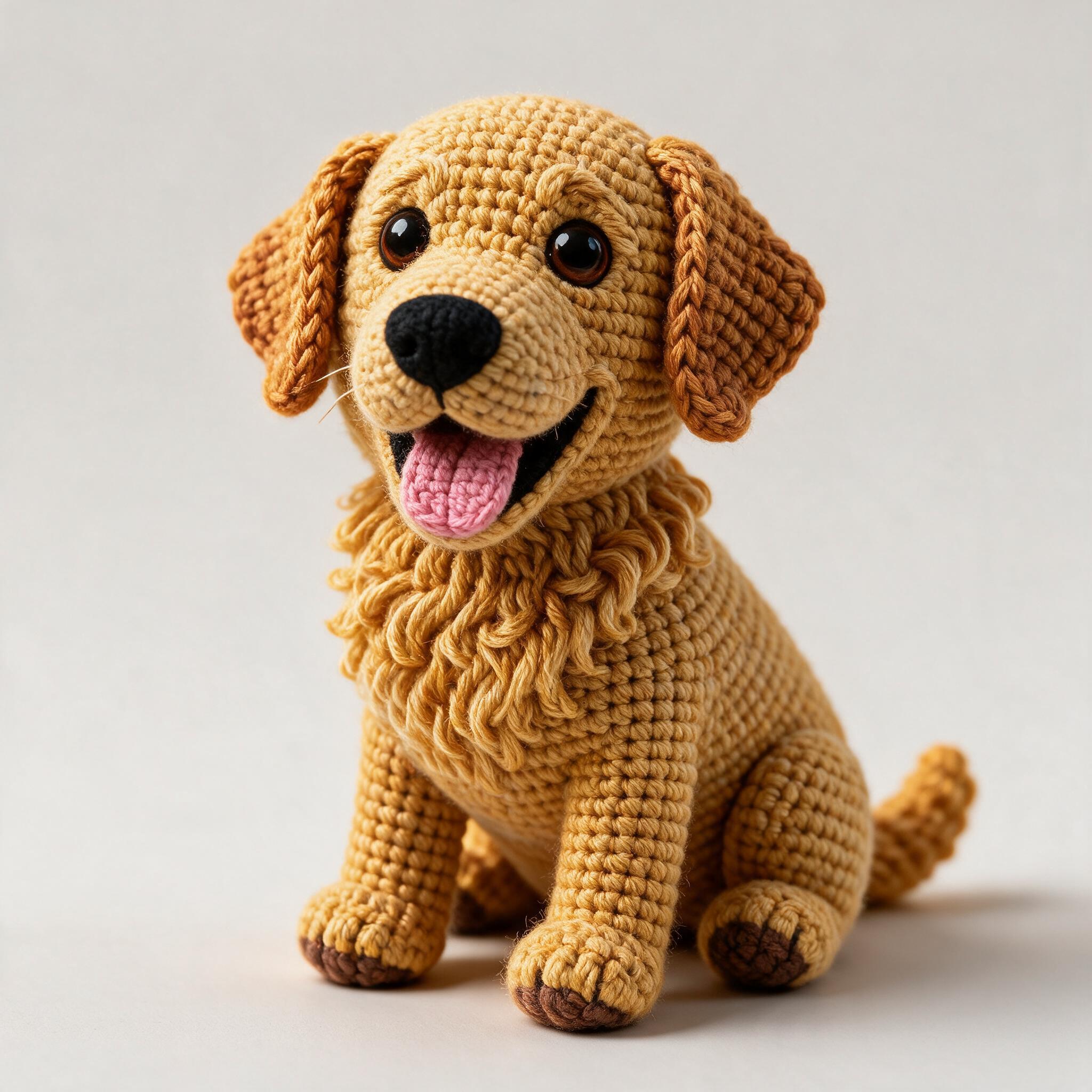
How to Increase Amigurumi Size: Hook, Yarn, and Pattern Scaling Explained
Quick Answer
How to make amigurumi bigger — change hook and yarn weight, scale stitch counts mathematically, or use gauge conversion. Covers all three methods with worked examples and common pitfalls.
Why Amigurumi Sizing Works Differently From Other Crochet
In most crochet projects — blankets, garments, dishcloths — size is adjusted by adding or removing stitches and rows. Amigurumi works differently because the shape is three-dimensional and stuffed. The finished size depends on three things simultaneously: the hook size, the yarn weight, and the stitch count in the pattern. Change any one of these without adjusting the others and the shape either stays the same size (if you only change hook within the same yarn weight band), distorts (if you add stitches without changing the shaping ratios), or becomes floppy or stiff (if the gauge is wrong for the stuffing density). This is why a beginner who simply buys a larger hook and uses their existing yarn is often confused when the amigurumi comes out only slightly bigger and full of visible holes. Understanding which lever to pull — and by how much — is the key to predictable size changes.
Method 1: Change Hook Size and Yarn Weight Together
The fastest and most reliable way to resize amigurumi is to move up one or two yarn weight categories and use the corresponding hook. A pattern written for fingering weight yarn on a 2mm hook produces a small, dense piece — a typical 10-round sphere comes out roughly 2–3 inches in diameter. The same pattern on DK weight with a 3.25mm hook produces roughly 3–4 inches. On worsted weight with a 4–5mm hook, the same stitch count produces 5–6 inches. The key rule: keep the hook at least one size smaller than the yarn label recommends, because amigurumi needs a tight fabric with no gaps for stuffing to show through. If the yarn label says 5mm hook, use 3.5–4mm. If you can see the stuffing through the stitches, go down another half size. Moving from fingering to DK roughly doubles the diameter. Moving from DK to worsted adds roughly another 30–50%. These ratios hold across most amigurumi patterns because the stitch count stays constant and the physical size of each stitch scales with yarn thickness.
Method 2: Gauge-Based Scaling (Most Accurate)
If you need a specific finished size rather than just 'bigger,' use gauge to calculate the target hook and yarn combination. First, find the gauge the original pattern was written for — either stated explicitly or determined by making the pattern as written and measuring a completed piece. Then decide your target size. If the original produces a 3-inch sphere and you want a 6-inch sphere, you need each stitch to be twice as large, which means you need half as many stitches per inch. Find a yarn and hook combination that gives you half the original gauge. For example: original pattern worked in sport weight at a gauge of 5 sc per inch. You want a 6-inch head instead of a 3-inch head. Target gauge: 2.5 sc per inch. Use bulky weight yarn (which typically achieves 2–3 sc per inch with a tight amigurumi hook). Crochet a test swatch, count stitches over 2 inches, divide by 2, and adjust hook size up or down until the gauge matches. This method works for any size target and does not require rewriting the stitch counts — you change the physical size of each stitch, not the number of them.
Method 3: Scale the Stitch Counts (For Bigger Jumps)
When you want a size that gauge-swapping alone cannot achieve — for example, a very large decorative amigurumi using chunky yarn but needing to be even bigger — you can scale the stitch counts mathematically. The formula: new stitch count = original stitch count × (desired size ÷ original size). If the pattern's magic ring starts with 6 stitches and you want 1.5× the size, start with 9 stitches. Every increase round adds 1.5× as many stitches as the original. Every decrease round removes stitches at the same ratio. Round any non-integer stitch counts to the nearest whole number. This method requires rewriting the entire pattern, which is tedious but produces exact results. It is most useful when you already have a specific yarn chosen (with a fixed gauge) and cannot change it. Two important caveats: scaling stitch counts changes the head-to-body ratio only if you scale every piece consistently. If you scale only the head but not the eyes, the eyes look undersized. Scale all components proportionally, including safety eyes — if the original used 12mm safety eyes, a 1.5× scale calls for approximately 18mm eyes.
Amigurumi Hook and Yarn Weight Size Reference
As a quick reference, here are approximate finished sizes for a standard 6-round magic ring sphere (the most common amigurumi head construction) at different yarn and hook combinations. Fingering weight (2mm hook): approximately 2–2.5 inches diameter. Fingering weight (2.5mm hook): approximately 2.5–3 inches — slightly looser fabric, watch for gaps. Sport weight (3mm hook): approximately 3–3.5 inches. DK weight (3.25mm hook): approximately 3.5–4 inches. Worsted weight (4mm hook): approximately 4.5–5 inches. Bulky weight (5mm hook): approximately 6–7 inches. Super bulky (6mm hook): approximately 8–9 inches. These numbers vary by brand and fiber — acrylic runs slightly larger than cotton at the same weight, and tightly spun yarn runs smaller than loosely spun at the same weight. Always crochet a test sphere before committing to a full pattern at a new size.
Scaling All Pieces Proportionally
The most common mistake when sizing up amigurumi is scaling only the main body and head while leaving the limbs, ears, and features at the original size. The result looks off — a large body with tiny stubby arms. When you change hook and yarn weight, all pieces automatically scale together because every piece uses the same hook and yarn. When you scale stitch counts, you must rewrite every single piece at the same ratio: if the main body scales by 1.5×, the arms, legs, ears, tail, and any embellishments all scale by 1.5×. Safety eyes also need to scale — use the diameter ratio to find the right size. Embroidery for the nose and mouth should also be proportionally larger; if the original used 3 strands of embroidery floss, the scaled version may need 6 strands or a thicker perle cotton thread to look correct. Pay attention to the stuffing amount too: volume scales as the cube of the linear dimension, so a 1.5× linear scale needs roughly 3.4× the stuffing by volume.
Common Problems When Sizing Up Amigurumi
Visible holes: the hook is too large relative to the yarn. Go down one hook size and try again — tight stitches are essential for a finished look and to prevent stuffing from showing. Misshapen head: usually caused by inconsistent tension when changing to a new yarn type. Practice a few rounds before starting the final piece. Floppy finished object: the stuffing is insufficient for the increased size. A larger amigurumi needs more stuffing by volume than you might expect — pack it firmly. Stiff fabric that is hard to stitch through: the hook is too small. Go up a half size. Proportional imbalance: as described above, not all pieces were scaled. Recheck every component. If the limbs are worked on a different hook than the body (sometimes done for texture variation), scale each independently but in proportion — if the body hook scales from 4mm to 5mm, and the limbs originally used a 3mm hook, the limbs should scale to a 3.75mm hook to maintain the same ratio.
Using a Calculator for Amigurumi Sizing
Rather than doing the math manually, ArtPatt's amigurumi size calculator lets you input the original gauge and target gauge (or target finished size) and outputs the adjusted stitch counts for a standard sphere. Enter the original pattern's magic ring count (usually 6) and the finished diameter from the original pattern, then enter your target diameter. The calculator outputs the adjusted stitch counts for each round of the sphere and estimates the finished diameter at your new gauge. For non-standard amigurumi shapes — cubes, cylinders, flat circles, tubes — the same mathematical ratio applies to each component: all stitch counts multiply by the same scale factor (new gauge ÷ original gauge). The calculator also estimates yarn requirements at the new size, since a 1.5× sphere uses approximately 2.25× the yarn (area scales as the square of the linear dimension, and yarn usage is roughly proportional to surface area for filled spheres). This is a significant increase — plan your yarn purchase before scaling up.
FAQ
How do I make an amigurumi pattern larger?
The safest approach is to scale the yarn and hook while preserving the pattern’s increase and decrease structure, then check the resulting gauge. Simply adding random rounds can change the proportions of the head, body, or limbs and produce a stretched shape.
Can I use thicker yarn to enlarge amigurumi?
Yes. A thicker yarn and appropriately sized hook usually enlarges the finished piece without changing every round. Keep the stitches tight enough that stuffing does not show, and make a small gauge sample before committing to the full project.
How do I keep a scaled amigurumi from becoming distorted?
Preserve the original increase rhythm, compare measurements after each major section, and adjust only one variable at a time. If the body grows wider but not taller, add length rounds in the straight section rather than moving increases into the shaping rounds.
Related Articles