How to Price Crochet Items: The Formula That Actually Works
Quick Answer
How to price and charge for crochet items — the correct formula for Etsy, craft fairs, and wholesale. Covers yarn cost, hourly rate, overhead, Etsy fees, and the most common pricing mistakes.
Why Crochet Pricing Is Hard
Pricing handmade crochet items feels uncomfortable for most makers — partly because it forces you to put a number on your time, and partly because the correct price often feels 'too high.' It is not. The discomfort comes from comparing handmade prices to mass-produced equivalents. A crocheted blanket from a fast-fashion retailer costs $30 because a machine made it in minutes. Your version took 15 hours. These are not the same product, and they should not be the same price. The biggest mistake is starting from what a customer 'might pay' and working backward. That produces a price that covers materials and ignores labor — which means you are effectively paying someone to buy your work. The correct approach: start from your costs, calculate a fair price, then evaluate whether the market supports it.
The Crochet Pricing Formula
The formula has four components. First, materials: the total cost of everything that goes into the item — yarn, stuffing, buttons, safety eyes, labels, and any notions. Track this per project, not in general. Second, labor: hours spent × your hourly rate. This is the most commonly skipped step and the most important. If you spend 8 hours making something at $15/hr, that is $120 in labor before you buy a single ball of yarn. Third, overhead: the portion of your business costs that belong to this item — packaging materials (tissue paper, boxes, tape), a share of your electricity, tool wear, platform subscription fees, shipping supplies. For most small crochet sellers this is $1–5 per item. Fourth, profit margin: the amount above cost that stays in the business. 15–25% is common. This is not 'extra money' — it is what funds restocking materials, replacing worn hooks, and keeping the business running during slow months. The formula: Price = (Materials + Labor + Overhead) × (1 + Profit Margin%).
How to Account for Etsy and Amazon Handmade Fees
Platform fees must be grossed up, not subtracted. The mistake: you want to net $50, so you add Etsy's 9.5% fee to get $54.75. The correct calculation: $50 ÷ (1 − 0.095) = $55.25. The difference seems small on one item but adds up across a shop with hundreds of listings. Etsy's current fee structure: 6.5% transaction fee + 3% Etsy Payments processing + $0.20 listing fee per item sold. On a $55 item that is $5.25 in fees — you receive $49.75. Amazon Handmade charges a flat 15% referral fee with no listing fee and no separate payment processing charge. On that same $55 item, Amazon takes $8.25 — you receive $46.75. Neither platform charges you to list items (Etsy's $0.20 is per sale, not per listing), but Etsy's $0.20 listing renewal fee applies every time an item sells or every 4 months if it doesn't sell.
What Hourly Rate Should You Use?
There is no single correct answer, but there are reasonable ranges. If you are selling locally or in a lower-cost-of-living market (Philippines, Eastern Europe, rural US), $8–12/hr may reflect local wages and price expectations. For Etsy with an international buyer base, $12–20/hr is common. For established makers with a strong brand, recognizable style, and consistent customer base, $20–35/hr is achievable. The test: calculate your price at your target hourly rate, then look at whether comparable handmade items on Etsy sell for that price. If they do, your rate is market-appropriate. If your calculated price is significantly above market, you have a few options: work faster (practice, simpler patterns), reduce materials cost, or accept a lower hourly rate and build toward higher rates as your reputation grows. What you should not do is set your hourly rate to whatever makes the final price 'feel right' to you — that is working backward and produces underpricing.
Pricing Crochet Items on Etsy
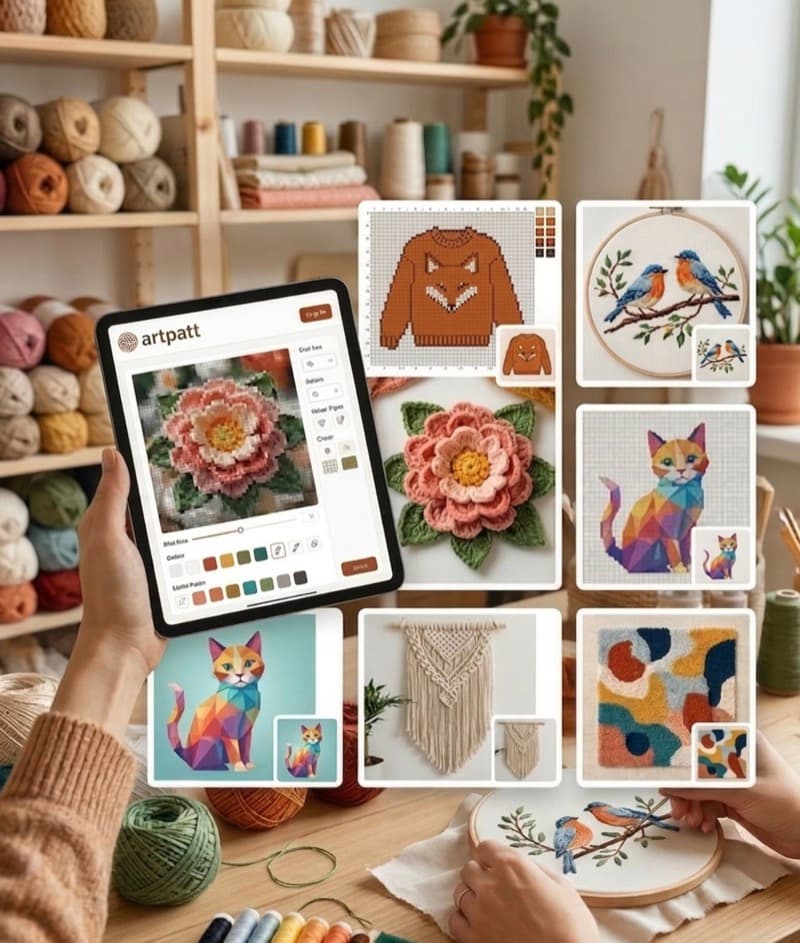
Etsy buyers expect handmade prices to be higher than mass-market alternatives. The platform's customers are specifically looking for unique, handcrafted goods and they understand the price premium. That said, Etsy is competitive — search any common item like 'crochet baby blanket' and you will see a wide price range. The lower end is usually underpriced (makers who have not done the math) and the higher end is usually correctly priced or premium-positioned. When setting your Etsy price, use the ArtPatt crochet pricing calculator to get your base number, then look at the top 20 search results for your item type. If your calculated price is in the upper half, your product photography and listing copy need to justify it. If it is in the lower half, consider whether you have undervalued your hourly rate. One practical tip: list at your calculated price from day one. Many Etsy sellers undercharge at launch and then feel unable to raise prices without losing customers. Start where you mean to be.
Pricing Crochet Items at Craft Fairs and Local Markets
Craft fairs have a different cost structure from online platforms. No per-item transaction fee, but booth rent can be significant — $50–300 or more for a day. Divide your booth cost by the number of items you expect to sell to get per-item overhead. A $200 booth at which you sell 25 items = $8 overhead per item from the booth alone. Add that to your regular overhead calculation. Local pricing can sometimes be slightly higher than Etsy for the same item because buyers value the in-person experience, the story behind the work, and the inability to comparison-shop instantly. Cash transactions also avoid payment processing fees. A common approach: use Etsy prices at craft fairs (already include a fee buffer) and any in-person sales without those fees become extra margin.
Wholesale Pricing for Crochet
Wholesale means selling to shops or boutiques who will retail your items at a markup to their customers. The standard wholesale price is 50% of retail. This means your retail price must be high enough that 50% of it covers all your costs (materials + labor + overhead) and still leaves a margin. If your total cost per item is $45, your retail price needs to be at least $90 for wholesale to be viable — so wholesale would be $45, which just breaks even. More realistically: total cost $45, retail $110, wholesale $55, leaving $10 margin per wholesale unit. Many small crochet makers find wholesale unviable unless they work fast, buy yarn in bulk (significantly lower unit cost), or create simpler items with lower time investment per unit.
The Most Common Crochet Pricing Mistakes
Pricing from materials only: adding 50% or 'a bit extra' to yarn cost and calling it done. The result is usually well below minimum wage after labor. Setting prices to match the cheapest Etsy listings: the cheap listings are almost certainly underpriced too. Copy them and you copy their mistake. Not accounting for Etsy fees correctly: subtracting fees instead of grossing up, or forgetting the listing fee adds up across hundreds of renewals. Pricing differently for friends and family: either charge your full price or give it as a gift. 'Friend pricing' trains people to expect discounts and undervalues your work. Not raising prices over time: as your skills improve, your speed increases and your stitch quality rises. Your prices should reflect that. Review your pricing formula quarterly. Use the ArtPatt crochet pricing calculator to audit your existing listings at current costs and hourly rate — you may find several are now underpriced.
Selling Crochet Patterns vs Finished Items
Many experienced crochet sellers pivot to selling patterns rather than finished items because the economics are dramatically better. A finished item pays you once for the hours you put in — a pattern can sell hundreds of times after the initial design and writing investment. A good pattern on Etsy for a blanket ($5–12) can sell 300–500 copies per year, generating $1,500–$6,000 from work you did once. The challenges: writing a clear, tested pattern takes significant time (5–15 hours for a complex design), photos must be high quality (often requiring hiring a model or investing in good product styling), and customer service questions from pattern buyers require time ongoing. For pattern pricing: $4–8 for simple designs (hats, small amigurumi), $8–15 for intermediate (sweaters, bags), $12–25 for advanced (full garments, large blankets with colorwork). Unlike finished item pricing, pattern pricing is less tied to your hourly rate and more tied to market positioning — what other designers charge for comparable patterns in your niche.
How to Price Crochet Items — Quick FAQ
How to price crochet items? Use Price = (Materials + Hours × Hourly Rate + Overhead) × (1 + Margin%) ÷ (1 − Platform Fee%). Track real material cost, log real hours, pick a real hourly rate, and gross up by dividing by (1 − fee%) — never subtract the fee. How to charge for crochet items? Charge for time first, materials second. Labor is typically 60–80% of a fair handmade price. If a customer says the price is too high, the answer is rarely to lower it — the answer is to find buyers who value handmade or to redesign for fewer hours. How to price crochet products on Etsy? Etsy fees are 6.5% transaction + 3% payment processing + $0.20 listing per sale ≈ 9.5%, so divide your target net by 0.905. Crochet pricing chart / crochet price list reference at $15/hr labor on Etsy: dishcloth $8–15, beanie $20–40, fingerless gloves $25–45, scarf $35–70, small amigurumi $15–35, large amigurumi $45–120, market tote $30–60, baby blanket $60–120, throw blanket $150–350, granny square afghan $180–400, cardigan $160–380. Pricing crochet for craft fairs vs Etsy? Same formula, but swap Etsy fees for booth-fee-divided-by-expected-units in the overhead line. Use the ArtPatt crochet pricing calculator to plug in your numbers and get an exact figure per item.
Pricing Custom Orders and Photo-Based Commissions
Custom commissions — pet portraits, memorial pieces, a specific colorway a customer requests — deserve a separate pricing line from your standard catalog items, because the hidden cost isn't yarn or hours at the hook, it's the planning and revision time before you even pick up the yarn. Converting a customer's photo into a workable colorwork chart (checking the photo quality, choosing grid size and color count, running confetti reduction, reviewing the preview) typically adds 30–90 minutes of design time that a standard pattern doesn't require, and that time should be billed at your hourly rate just like stitching time — many makers charge a flat $15–25 'custom design fee' on top of their standard formula specifically to cover this without having to itemize it. Revisions are the other cost that standard pricing doesn't account for: cap free revisions at one round (adjusting colors or grid size before production starts) and charge separately for any change requested after yarn is purchased or work has begun, since at that point a revision means partially redoing paid labor, not refining a plan.
FAQ
What is the best formula for pricing crochet items?
Start with materials + labor + overhead, then add your profit margin and account for selling-platform fees. Materials-only pricing hides the time spent crocheting, finishing, photographing, packaging, and communicating with buyers, so it usually underpays the maker.
What hourly rate should I use for crochet work?
Use the hourly rate you want the business to pay you, then test the finished price against the market. A rate around $15–20 per hour is a practical starting point for many part-time makers, but local wages, skill, speed, and product positioning should influence the final number.
How should I include Etsy or craft-fair fees?
Add recurring and per-sale fees to overhead, then gross up the retail price so the fee does not come out of your labor. For a craft fair, divide booth cost by the number of items you realistically expect to sell. Keep platform assumptions current because fee schedules change.
Related Articles