How to Start Needlepoint: A Complete Beginner Guide (Canvas, Wool, First Project, Common Mistakes)
Quick Answer
Complete beginner guide to starting needlepoint — what canvas and wool you actually need, the 3 stitches that cover most beginner patterns, your first finishable project, and the 4 mistakes every new needlepointer makes.
What Is Needlepoint and How Is It Different from Cross-Stitch
Needlepoint is counted needlework done on a stiff open-weave canvas with wool yarn or cotton thread, typically using tent stitch (a single diagonal across each canvas hole) to cover the entire surface. The result is a dense, slightly raised, durable fabric — used historically for chair seats, pillow covers, kneelers, handbag panels, and decorative wall art. The stiffness and durability is the signature feature: needlepoint is structural rather than drapey. Needlepoint differs from cross-stitch in three key ways: (1) canvas is much stiffer than Aida cloth and has fewer threads per inch (10–18 mesh vs 14–22 for cross-stitch); (2) wool yarn is the traditional thread, not 6-strand cotton floss; (3) tent stitch (single diagonal) is the standard, not the X of cross-stitch — produces a smoother surface. Many needlepoint kits come with the design pre-stamped or hand-painted onto the canvas, so the 'count and follow chart' step of cross-stitch is bypassed.
Needlepoint Starter Supplies — What You Actually Need
Six essentials, total cost about $35–60 (more expensive than cross-stitch starter kit because canvas and wool cost more). (1) A pre-stamped or hand-painted needlepoint canvas, 5×5 inches or 6×6 inches, beginner design (single subject, 3–6 colors). Available at needlepoint specialty stores and online retailers (Amy Bunger, Needlepoint Joint, Two Trick Pony). $20–40 for a beginner kit. (2) Tapestry wool — Paternayan, Appleton Crewel, or Anchor Tapestry. Match the wool to the canvas mesh: 12-mesh canvas = 3-ply Paternayan, 14-mesh = 2-ply, 18-mesh = 1-ply. (3) Tapestry needle, size 18 or 20 (blunt tip). (4) Embroidery hoop or stretcher bars to keep the canvas tensioned. (5) Sharp scissors. (6) A pattern chart if your canvas is not pre-stamped (most beginner canvases are pre-stamped — the design is printed on the canvas). SKIP: silk floss (advanced material), specialty stitches kit, expensive needlepoint frames.
The 3 Essential Needlepoint Stitches
Three stitches cover 95% of beginner needlepoint patterns. (1) Continental tent stitch (the workhorse) — diagonal stitches worked horizontally across the canvas, all slanting in the same direction (lower-left to upper-right). Quick to learn, slightly distorts the canvas. (2) Basketweave tent stitch (the workhorse for filled backgrounds) — diagonal stitches worked in a back-and-forth diagonal pattern, producing a basketweave texture on the back. Slower per stitch but does not distort the canvas — preferred for large filled areas like backgrounds. (3) Half-cross stitch — diagonal stitches worked horizontally without the underlying thread bar of Continental tent stitch. Looks similar from the front but uses about 30% less yarn. Cheaper but less durable than Continental tent stitch. For a first canvas, use Continental tent stitch for small details and Basketweave for large background areas. Add decorative stitches (Bargello, Scotch, Mosaic, Hungarian) on later canvases.
Your First Needlepoint Project (Pick a Pre-Stamped Canvas)
For the first needlepoint project, buy a pre-stamped canvas with a small bold design (single flower, geometric shape, monogram letter, simple animal silhouette). The canvas comes with the design printed on it in colored ink that you stitch over — no chart counting required. Beginner-appropriate canvas size: 4×4 to 6×6 inches at 12-mesh. Time to complete: 15–25 hours. Recommended themes for first canvas: simple flower or rosette, monogram initial, small animal (frog, butterfly, ladybug), geometric mandala, classic stripes or chevron pattern. Avoid for first canvas: large pieces (over 8×8 inches), painted canvases with fine shading detail (require stitch direction expertise), Bargello-only canvases (require precise vertical stitch counting), pet portraits (require thread blending). Once you finish the first pre-stamped canvas, you can graduate to chart-based needlepoint and to painted canvases with shading.
4 Common Beginner Needlepoint Mistakes
(1) Inconsistent stitch direction. Some stitches slant lower-left to upper-right, some upper-left to lower-right. The work looks textured and confused. Fix: always stitch in the same direction across the entire canvas — pick one slant and never deviate. (2) Distorting the canvas with Continental tent stitch over large areas. The canvas warps into a parallelogram shape. Fix: use Basketweave tent stitch for large filled background areas; Continental only for small detail areas. (3) Using too few or too many plies of wool for the canvas mesh. Too few plies = canvas shows through; too many plies = stitches bulge and distort. Fix: 12-mesh = 3-ply Paternayan; 14-mesh = 2-ply; 18-mesh = 1-ply. (4) Not blocking the finished canvas. Most needlepoint distorts during stitching even with Basketweave. Fix: after finishing, dampen the canvas, pull and pin to a square shape on a blocking board, let dry. The canvas returns to true square shape. Skip blocking and your finished pillow or framed piece will be a parallelogram.
What to Needlepoint After Your First Project
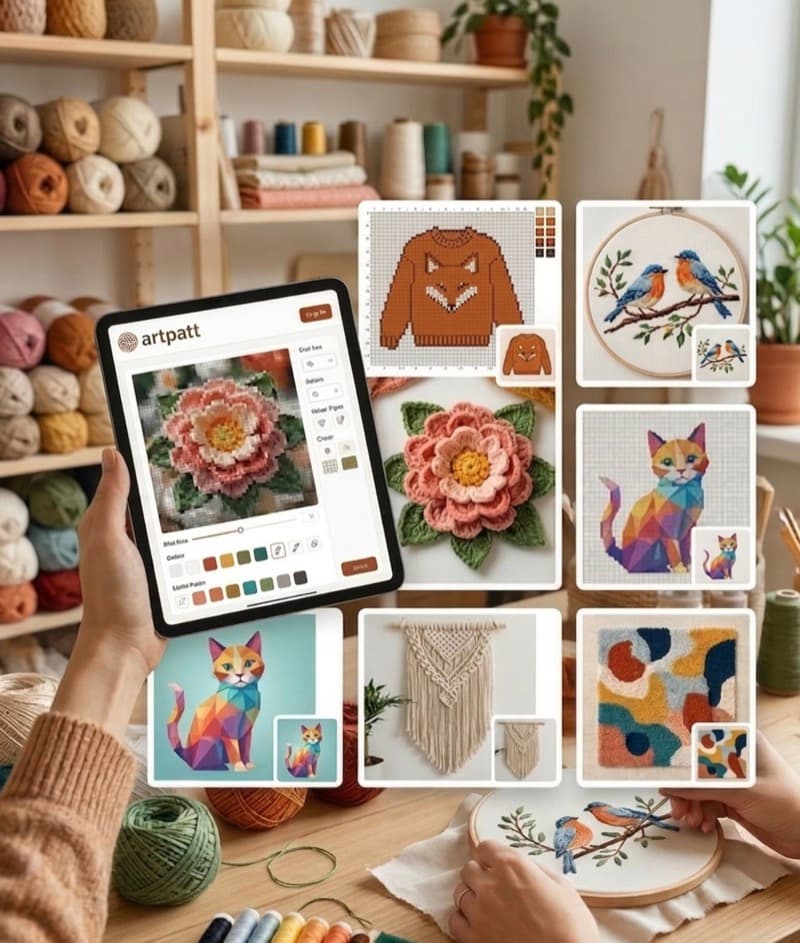
Once you finish a small pre-stamped canvas, ramp up gradually. Second project: try a hand-painted canvas with simple shading (more visual depth than pre-stamped flat colors). Third project: try a pillow-front canvas (8×8 to 10×10 inches), then learn to finish it as a pillow with backing fabric and zipper. Fourth project: introduce decorative stitches — try Bargello (vertical satin stitch in stepped patterns) on a small canvas, or Scotch and Cushion stitches for textural variety. Fifth project: try a chart-based canvas (counted, no pre-printed design) — graduates you from kit-following to chart-following. Sixth project: try a more ambitious chair seat or kneeler-cushion canvas (12×12+ inches, 50–100 hours). Or convert a photo to a needlepoint chart using ArtPatt's photo-to-cross-stitch generator (cross-stitch and counted needlepoint share the chart format) — execute the chart on canvas with tent stitch instead of cross-stitch.
Needlepoint Beginner FAQ
How long does needlepoint take to learn? About 30 minutes to learn Continental tent stitch. About 5–10 hours of stitching to develop consistent tension. About 1–2 finished projects (kit format) to feel comfortable; counted needlepoint requires more practice. Is needlepoint harder than cross-stitch? Slightly. The canvas is stiffer (harder on the hands), wool is fussier than cotton floss, and the stitch direction discipline is critical. But pre-stamped canvases remove the chart-counting step entirely, making the actual stitching simpler than cross-stitch for beginners. What canvas mesh for a beginner? 12-mesh or 14-mesh canvas — large enough holes to see clearly, fine enough for detail. 10-mesh and 18-mesh both work but are less common for first canvases. Can I needlepoint with cotton floss instead of wool? Yes — pearl cotton (DMC #5 or #8) is the modern alternative to wool, used in many contemporary needlepoint designs. Cotton is easier to clean and less attractive to moths than wool. Wool is the traditional choice and produces more dimensional texture. Where do I find needlepoint kits? Specialty needlepoint shops (Needlepoint Joint, Two Trick Pony, Amy Bunger, Stitch by Stitch), Etsy designers (search 'needlepoint kit beginner'), and major craft chains carry limited beginner selections. Pre-stamped beginner kits run $20–60.
Related Articles