How to Start Punch Needle: A Complete Beginner Guide (Tool, Yarn, First Project, Common Mistakes)
Quick Answer
Complete beginner guide to starting punch needle embroidery — what punch needle and yarn you actually need, how to set up the foundation fabric, your first finishable project, and the 5 mistakes every new punch needle artist makes.
What Is Punch Needle Embroidery and Why It Is Different
Punch needle is a textile craft where you push a hollow needle (the 'punch needle') through a stretched foundation fabric, creating loops of yarn or thread on the back of the fabric. The 'right side' of the finished piece is the loopy/fluffy side; the 'wrong side' shows the design as flat outlined stitches. Unlike traditional embroidery (where each stitch is individually placed) or hooked rugs (where loops are pulled through with a hook from underneath), punch needle uses gravity and the fabric tension to hold the loops in place. There is no actual stitch to learn — just push the needle in and out at consistent depth and spacing. This makes punch needle one of the fastest fiber crafts to produce visible results: a 6-inch hoop wall piece finishes in 4–10 hours, vs the 60+ hours a comparable cross-stitch piece takes. Trade-off: punch needle is less detailed than cross-stitch (the loops are larger than X stitches) and works at low resolution.
Punch Needle Starter Supplies — What You Actually Need
Six essentials, total cost about $30–50. (1) A medium punch needle — Lavor adjustable medium punch needle is the most popular beginner tool ($15–20). Adjustable needles let you change loop length for different effects. (2) Monk's cloth foundation fabric — a loose-weave 100% cotton fabric specifically designed for punch needle. 50×50 cm piece is enough for several projects ($8–12). Other options: weaver's cloth (finer weave, smaller projects), burlap (rougher, larger needles only). (3) A 14–17 cm wood embroidery hoop with adjustable closure (a Q-snap frame is better but a basic hoop works). The fabric must be drum-tight — punch needle will not work on loose fabric. (4) Worsted-weight (CYC 4) yarn in 4–8 colors, depending on your design. Cotton yarn for wall art and pillows; wool yarn for rugs. (5) Sharp scissors. (6) Latex glue (Elmer's glue-all or rug-binding latex) for finishing the back of the piece to lock the loops permanently. SKIP for now: punch needle starter kits ($25–40 — overpriced for what you get), expensive needle sets, fancy frames.
Setting Up the Frame and Tracing the Design
Punch needle requires the foundation fabric to be drum-tight in the frame. Loose fabric causes loops to fall out the moment you punch them. Steps: (1) Cut a piece of monk's cloth ~5 cm larger on all sides than the frame's inner diameter. (2) Place the cloth over the inner ring of the embroidery hoop. (3) Push the outer ring down over both, then tighten the screw firmly. (4) Re-tension the fabric by pulling the corners outward, then re-tighten the screw. The cloth should bounce back when you tap it like a drum. Trace your design onto the fabric using a fine permanent marker (Sharpie ultra-fine). Trace on the WRONG side — the side that will face the back of the finished piece. Punch needle is mirrored: you punch on the wrong side, the design appears mirrored on the right (loop) side. If your design has text or asymmetric details, mirror it before tracing.
Your First Punch Needle Project (A Simple Hoop Art Piece)
Pick a simple bold-shape design at 12–15 cm diameter. Recommended first projects: a simple flower (3–4 colors, ~10cm design, 4–6 hours, mounted in the embroidery hoop itself), a heart or star silhouette (1 color filled, 2-color background, 3–5 hours), a single-letter monogram (2 colors: letter + background, 4–6 hours), a small landscape (sun, simple mountain shape, base color ground, 3–4 colors, 5–8 hours), an abstract shape with color blocking (geometric shapes in 3–4 colors, 4–6 hours). Use thick-line bold designs only — punch needle resolution is roughly 8–12 'pixels' per inch (vs 14 for cross-stitch). Fine detail does not translate. Trace the design on the wrong side, set up the frame, punch each color section completely before moving to the next color. Total time: 4–8 hours for a 12–15 cm hoop piece.
The Punch Needle Motion (Surprisingly Simple)
There is no real 'stitch' — just one repeated motion. Thread the punch needle (most needles have a built-in threading wire — the yarn passes through the hollow shaft and out the eye at the tip). Hold the needle perpendicular to the fabric with the needle's bevel/slot facing the direction you are about to move. Push the needle straight down through the fabric until the handle touches the cloth surface. Lift the needle straight up just enough to clear the fabric (about 1 cm — DO NOT lift the needle high above the fabric or you will pull out the previous loop). Slide the needle 3–4 mm in your working direction (parallel to the fabric, almost touching it). Push down again. Lift, slide, push, repeat. The yarn forms loops on the back (the right side of the finished piece) automatically. Keep the working yarn behind the needle so it feeds smoothly. Most beginner mistakes come from lifting the needle too high or pulling the yarn too tight — both cause loops to come undone.
5 Common Beginner Punch Needle Mistakes
(1) Loose foundation fabric. The single most common mistake. Loops fall out the moment you punch them. Fix: re-tighten the hoop frequently as you work. The fabric should drum like a snare. (2) Lifting the needle too high between punches. Pulls out the previous loop. Fix: lift the needle just enough to clear the fabric — 1 cm at most. (3) Wrong yarn weight for the needle. Too thick = drags and snags. Too thin = loops fall out because the cloth doesn't grip. Fix: medium punch needle = worsted-weight yarn. Ultra punch needle (smaller) = embroidery floss or pearl cotton. Rug punch needle (larger) = bulky yarn or wool roving. (4) Spacing punches too far apart. Sparse loops show the foundation fabric through gaps. Fix: punch every 3–4mm — closer than you think necessary. The loops compress against each other. (5) Dragging the working yarn while punching. Pulls loops out the moment the needle lifts. Fix: keep the working yarn relaxed behind the needle, never tense.
Finishing a Punch Needle Piece
Three finishing options. (1) Hoop art (easiest) — leave the finished piece in the embroidery hoop, trim excess fabric to ~2 cm beyond the hoop, fold the fabric to the back, glue or stitch a felt circle to cover the back. Hangs from the hoop screw. 5 minutes finishing. (2) Pillow front — punch a 30×30 cm or 40×40 cm panel, then sew it to a plain back fabric with a zipper or envelope closure, stuff with a pillow form. 1–2 hours finishing. (3) Wall art with frame — mount the finished piece on a stretcher bar frame (artist canvas frame), wrap and staple the excess fabric to the back. Hangs flush against a wall. 30–45 minutes finishing. For all three, brush latex glue on the BACK of the finished piece (the flat-stitch side) using a foam brush. The latex locks the loops permanently — without it, loops can pull out over time, especially in high-traffic items like rugs. Let the latex dry 12–24 hours before further finishing.
Punch Needle Beginner FAQ
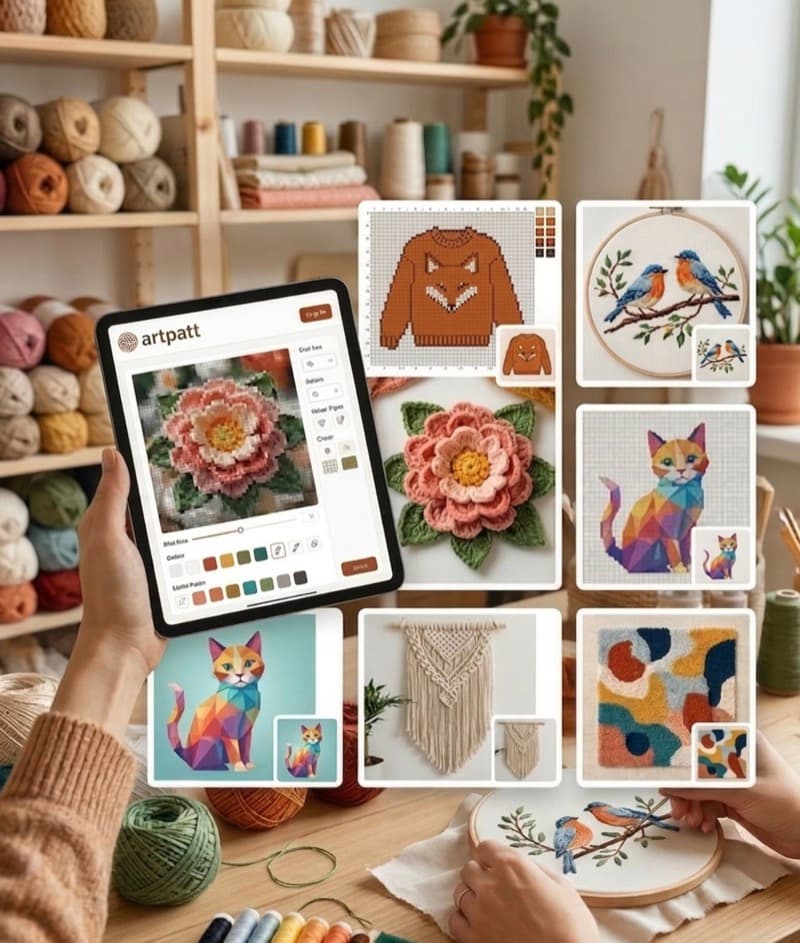
How long does punch needle take to learn? About 30 minutes to set up the frame and learn the motion. About 2–3 hours of practice to develop consistent loop depth and spacing. About 1–2 finished projects to feel confident. Is punch needle easier than embroidery or cross-stitch? Yes for visual results — punch needle covers area faster than either. But the foundation setup (drum-tight fabric, exact yarn-to-needle pairing) is finicky compared to cross-stitch's grab-and-go simplicity. Net: punch needle has a higher initial setup hurdle but rewards faster once running. What yarn for punch needle? Medium punch needle = worsted-weight yarn (CYC 4). Ultra punch = embroidery floss or pearl cotton. Rug punch = bulky yarn or wool roving. Match the yarn to the tool. Wool yarn works best for rugs (durable, holds loops); cotton yarn works for wall art and pillows. Why are my punch needle loops falling out? Three causes: foundation fabric not drum-tight, lifting the needle too high between punches, or wrong yarn weight for the needle. Re-tension the frame, lower your lift height, check the yarn-to-needle match. See our detailed troubleshooting guide at /blog/why-punch-needle-yarn-keeps-coming-out. Can I make a punch needle pattern from a photo? Yes — use ArtPatt's punch needle pattern maker. Upload any bold-shape image, generate a 60×80 to 100×100 stitch chart with 4–8 colors and heavy confetti reduction. The chart shows you where each color goes; replicate by punching one color at a time with matching yarn.
FAQ
What supplies do I need to start punch needle?
A beginner setup needs a punch needle that matches your material, a frame or hoop, suitable foundation fabric, smooth yarn or thread, scissors, and a design to follow. Add a finishing adhesive or backing only after you have tested that the loops hold in the fabric.
What foundation fabric is best for punch needle?
Use a stable, even-weave foundation made for punch needle rather than stretchy fabric or irregular craft-store burlap. Monk’s cloth suits many medium and rug-style tools; finer weaver’s cloth suits smaller needles and thread. The fabric must grip the loops firmly when the piece is turned over.
What is a good first punch needle project?
Choose a small design with large color areas and a limited palette, such as a simple heart, flower, or geometric shape. Large blocks let you practice tension and depth without losing the outline in tiny details, and the project is short enough to diagnose problems before you buy more material.
Related Articles