Tapestry Crochet vs Intarsia Knitting vs Fair Isle: Colorwork Compared
Quick Answer
Tapestry crochet vs intarsia knitting vs Fair Isle stranded knitting — what each technique actually does, how they compare on color limit, fabric thickness, project speed, and which one fits your colorwork project.
Three Colorwork Techniques — Different Crafts, Different Trade-offs
Tapestry crochet, intarsia knitting, and Fair Isle (stranded) knitting are the three dominant techniques for working multi-color charted designs in fiber crafts. Each handles colors differently. Tapestry crochet (single crochet, working back and forth, carrying unused colors hidden inside the stitches): produces dense, sturdy fabric with crisp pixel-by-pixel color boundaries. Limited to 2–3 active colors at any moment. Best for blankets, bags, and wall hangings. Intarsia knitting (knit in stockinette, separate yarn bobbins for each color block): produces flat, drapy fabric without floats. Color blocks are large and self-contained. Best for sweaters with large picture motifs (a single graphic on the front), modular blanket panels, drapy garments. Fair Isle (stranded knitting, carrying 2 colors across the row): produces light, slightly thick fabric with horizontal color bands. Limited to 2 active colors per row. Best for hats, mittens, sweater yokes, traditional Scandinavian/Nordic designs.
Color Limit Per Row
Each technique limits how many colors you can have active at once. Tapestry crochet: 2–3 colors active per row maximum. The unused color is carried inside the stitches, which limits to a few colors before the back becomes too bulky. For more colors, you must stop and cut/restart — slows the work. Intarsia: unlimited colors per row, but each color block requires its own yarn bobbin. A pattern with 12 separate color blocks per row = 12 bobbins dangling and getting tangled. Practical limit: 4–6 separate color blocks per row before management becomes painful. Fair Isle: strictly 2 colors per row maximum. The two colors are both held simultaneously, alternating stitches as the chart calls. For 3 or more colors, you must stop the row and switch one of the two — slows the work and creates color-change artifacts. For pattern-design intent, Fair Isle works best with patterns that use exactly 2 colors per row throughout.
Fabric Thickness and Drape
Tapestry crochet: thickest, stiffest fabric of the three. The carried inactive color adds bulk inside every stitch. Excellent for blankets and bags where structure helps; bad for garments where drape matters. Intarsia: drapest fabric of the three. No carried strands means the fabric stays at the natural drape of single-color stockinette. Excellent for sweaters where drape and softness matter. The downside: the back of intarsia work has loose tail ends from each color block that need careful weaving in. Fair Isle: medium thickness, slightly thicker than plain stockinette due to the carried second color. The carried strands ('floats') sit on the back of the fabric. Floats need to be loose enough to allow the fabric to stretch but tight enough to not snag. The result is warm, slightly insulated fabric — perfect for hats, mittens, and yokes in cold-weather garments.
Speed Per Stitch
Tapestry crochet: medium speed. Single crochet is fast as a stitch type, but managing the carried color (laying the inactive yarn flat under each stitch as you carry it) slows the per-stitch rate by ~20%. Net throughput: ~12–15 stitches per minute for a practiced worker. Intarsia: slow on the surface but no per-stitch overhead within a single color block. Color block transitions slow you down (twist the two colors at the boundary, change bobbins, deal with tangled bobbins). Net throughput: ~10–14 stitches per minute, varying widely with color block frequency. Fair Isle: medium-slow. Carrying two colors simultaneously is slower than knitting with one color, but no bobbin management. Most efficient when you can hold one color in each hand (Continental + English combined). Net throughput: ~12–16 stitches per minute for a practiced two-handed Fair Isle knitter. Speed differences across the three techniques are smaller than the design-fit differences — pick the technique that suits the project, not based on speed.
Which Technique for Which Project?
Picture blankets and graphghan throws → Tapestry crochet (or C2C, a variant). Crochet techniques produce blanket-weight fabric efficiently. Sweaters with large picture motifs (single graphic on the front, plain back and sleeves) → Intarsia. The drape is essential for garments. Sweater yokes, hats, mittens with allover patterning → Fair Isle. The 2-color-per-row constraint matches the natural design vocabulary of Scandinavian/Nordic colorwork. Bags and structured accessories → Tapestry crochet. Stiffness is a feature for bags. Wall hangings and decorative pieces → Tapestry crochet (for crisp pixel detail) or Fair Isle (for soft horizontal-band aesthetic). Modular blanket panels (each panel a different motif) → Intarsia. Each panel becomes its own color-block sequence, sewn together. Custom photo-realistic pet portraits → Tapestry crochet (for blankets) or counted intarsia (for wall art). Cross-stitch and embroidery handle photo-realistic detail at finer resolution.
Generating Charts from Photos for Each Technique
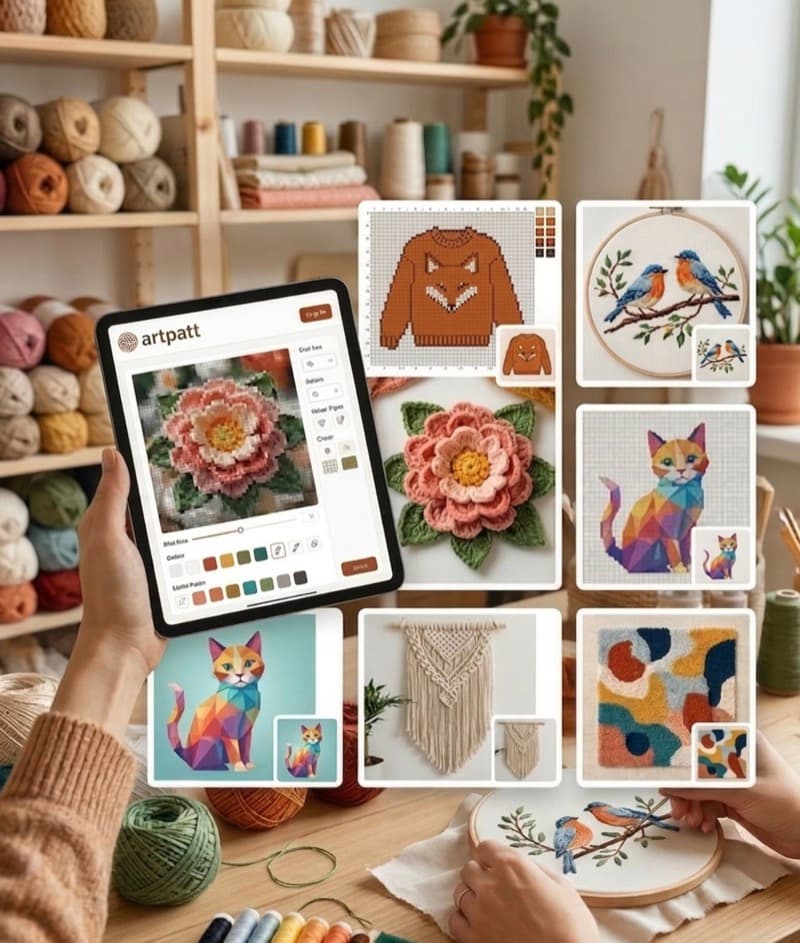
ArtPatt's pattern generators handle all three techniques with the correct stitch ratios applied automatically. Tapestry crochet pattern generator: sizes the chart for single crochet (a little wider than tall), limits color count to 4–6 with heavy confetti reduction. C2C pattern generator: one square per C2C tile (the tiles come out close to square), suitable for full blankets. Intarsia knitting pattern generator: applies stockinette 1.3:1 stitch ratio (rows shorter than stitches are wide), recommends 4–6 large color blocks for manageable bobbin count. Fair Isle knitting pattern generator: applies stockinette 1.3:1 ratio, restricts to 2 active colors per row across the chart. Upload any photo, pick the generator matching your intended technique, get a chart with correct proportions for the finished piece. Use the full browser preview for free; PNG/PDF export is $2.99 for one pattern or $6.99/month unlimited with Pro.
Tapestry vs Intarsia vs Fair Isle FAQ
Which is easiest to learn? Fair Isle (only 2 colors per row, predictable rhythm) is generally the easiest to learn IF you already know basic stockinette knitting. Tapestry crochet is easier to learn from scratch (basic crochet skill required, no prior knit skill needed). Intarsia is the trickiest because of bobbin management. Which uses the most yarn? Tapestry crochet uses the most yarn (carried inactive color adds yarn at every stitch). Intarsia uses the least yarn (each block is its own yarn — no carrying). Fair Isle is in the middle. Can I do tapestry crochet with more than 3 colors? Yes — by cutting and restarting yarns at color boundaries, but this slows the work dramatically and increases tail-weaving time. For more than 3 colors, switch to graphghan or C2C technique. Can I do Fair Isle with more than 2 colors per row? Technically yes (by carrying 3 yarns), but tension management becomes nearly impossible and the back becomes too floaty. For more than 2 colors per row, switch to intarsia or layered embroidery. Which technique is best for beginners getting into colorwork? Tapestry crochet — the dense fabric is forgiving of tension variation, and crochet is generally easier to learn than knitting in the first place.
Related Articles