How to Start Knitting: A Complete Beginner Guide (Needles, Yarn, First Project, Common Mistakes)
Quick Answer
Complete beginner guide to starting knitting — what supplies you actually need, the 2 stitches that cover 90% of patterns, your first finishable project, and the 6 mistakes every new knitter makes (and how to avoid them).
What Is Knitting and Why Is It Different from Crochet
Knitting uses two needles to manipulate loops of yarn into fabric. Unlike crochet (one hook, one stitch on the hook at any time), knitting holds the entire row of stitches on one needle while you work them onto the other. This is what makes knitted fabric stretchier and finer-textured than crochet — and what makes it slightly harder to learn. The two essentials are the knit stitch and the purl stitch; combined in different patterns they produce stockinette (smooth side facing out), garter (textured both sides), ribbing (stretchy alternating columns), and more complex textures. Mistakes are harder to fix than in crochet because dropped stitches can run down the work, but the techniques to recover are learnable. The biggest beginner trap is picking too ambitious a first project — pick a small flat piece, finish it, then ramp up.
Knitting Starter Supplies — What You Actually Need
Six essentials, total cost about $15–25. (1) One pair of straight needles, US size 8 (5.0mm), 10–14 inches long. Wood or bamboo grips the yarn better than metal for beginners. (2) One ball of worsted-weight (CYC 4) wool or wool-blend yarn in a light solid color. Pure acrylic is cheaper but slips on the needles too much; wool grips and is forgiving while you learn. Avoid: dark colors (cannot see stitches), variegated yarn (cannot count rows), fuzzy yarn (hides stitches). (3) Tapestry needle for weaving in tails. (4) Sharp scissors. (5) A printed pattern or video tutorial. (6) Stitch markers (or use bobby pins/paperclips) for marking row count. SKIP for now: circular needles (start with straights), interchangeable needle sets (one pair is enough), pattern books (free patterns online cover everything you need), yarn winder. Total starter kit fits in a small bag.
The Knit Stitch and the Purl Stitch (90% of Knitting)
Two stitches cover 90% of beginner knitting. Knit stitch (k): insert the right needle through the front of the first stitch on the left needle, from front to back, wrap the yarn around the right needle counter-clockwise, pull the new loop through the old stitch, slide the old stitch off the left needle. The new stitch sits on the right needle. Repeat for every stitch in the row. Purl stitch (p): bring the yarn to the front, insert the right needle through the front of the first stitch on the left needle from back to front, wrap yarn around the right needle counter-clockwise, pull the new loop through, slide the old stitch off. The new stitch sits on the right needle. Patterns combine these: garter stitch is knit every row; stockinette alternates knit row, purl row; 1×1 ribbing alternates k1, p1 across each row. Three other techniques (cast on, bind off, decrease/increase) are essential utilities, learnable in 15 minutes each.
Your First Knitting Project (Pick Something Flat and Small)
Pick a flat project under 30 stitches wide and under 6 inches long — finishes in 4–10 hours. Recommended first projects: a garter-stitch dishcloth (cotton yarn, 30 stitches × 30 rows, 4–6 hours, useful when finished), a small bookmark (15 stitches × 80 rows, 2–4 hours, instant gift), a coaster set (25 stitches × 25 rows, 3–4 hours each, batch 4 for a set), a phone-case rectangle (25 stitches × 60 rows, fold and seam, 6–10 hours), a swatch sampler (30 stitches × 60 rows, alternating between garter, stockinette, and ribbing in 10-row blocks — teaches three stitch patterns in one project). Avoid for first project: scarves (too long and demoralizing), hats (require working in the round), socks (require double-pointed needles, decreases, and gauge precision), garments (sizing, shaping, gauge swatching).
How to Hold the Needles and Yarn (English vs Continental)
Two main knitting styles. English ('throwing'): hold the working yarn in your right hand. After inserting the right needle into a stitch, you 'throw' the yarn around the needle by moving your right hand. Slower per stitch but easier to control tension while learning. Most common in the US and UK. Continental ('picking'): hold the working yarn in your left hand, draped over your left index finger. After inserting the right needle, 'pick' the yarn from your left index finger with the right needle tip. Faster per stitch once mastered, slightly more efficient hand motion. Most common in Germany and Eastern Europe. Either style produces identical fabric. If you crochet, Continental will feel more natural (yarn in non-dominant hand, same as crochet). If you have no fiber-craft background, try both for one row each and stick with whichever feels less awkward. You can switch later but learning both at once slows you down.
6 Common Beginner Knitting Mistakes
(1) Inconsistent tension — too tight on some stitches, too loose on others. Cause: stitching at irregular speed and forgetting to maintain even yarn tension. Fix: stitch slowly and rhythmically until tension becomes muscle memory (5–10 hours of practice). (2) Adding stitches by accident. The work gets wider over time. Cause: yarn-over slipping over the needle when transitioning between stitches, or splitting a stitch into two. Fix: count stitches at the end of every row for the first 10 projects. (3) Dropping stitches. A loop slips off the needle and runs down the work. Fix: catch dropped stitches immediately with a crochet hook before they run; for prevention, hold the work close to the needle tips while stitching. (4) Twisting stitches. Inserting the needle into the back of a stitch instead of the front. Cause: misreading stitch orientation. Fix: the active leg of each stitch should be on the front; insert from front to back for knit, back to front for purl. (5) Confusing knit and purl rows in stockinette. Cause: losing track of right-side vs wrong-side rows. Fix: place a stitch marker on the right side as a visual cue. (6) Picking too ambitious a first project. The most common mistake of all. A scarf is not a beginner project — too much repetition, too long. Pick a 30-stitch dishcloth instead.
What to Knit After Your First Project
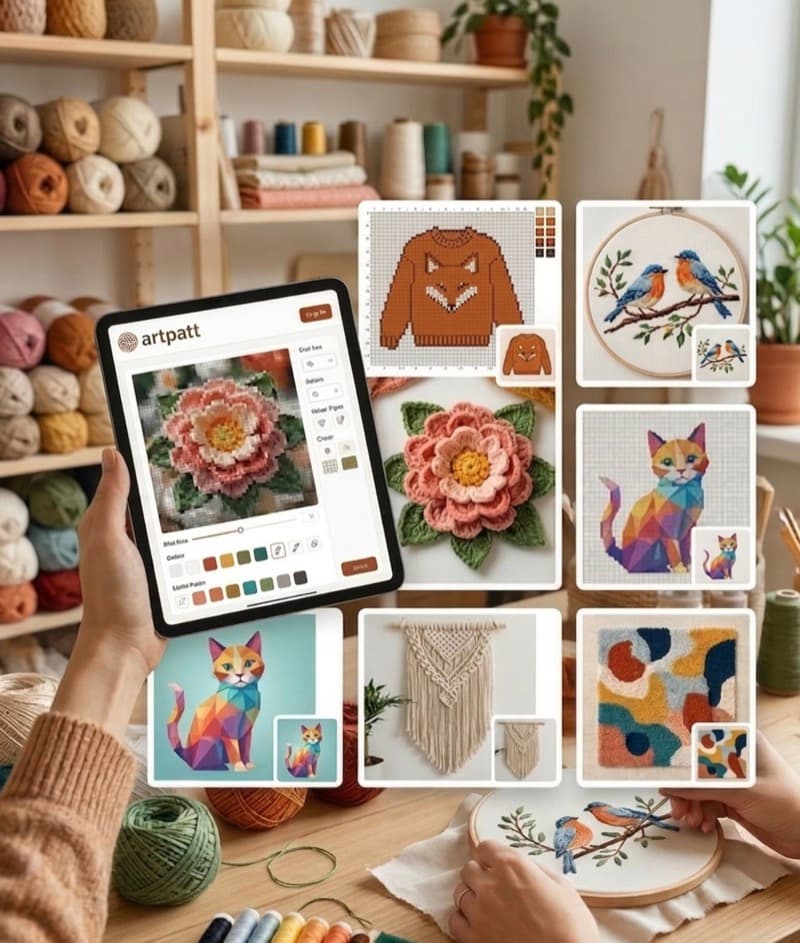
Once you finish a dishcloth or coaster, ramp up gradually. Second project: introduce stockinette stitch (knit row, purl row alternating) — make a striped washcloth or a stockinette bookmark. Learn that stockinette curls — the edges roll, which is normal and corrected later by adding garter or ribbed borders. Third project: try ribbing — make a 1×1 ribbed coaster or a simple headband. Ribbed fabric is stretchy and lies flat at the edges. Fourth project: try working in the round on circular needles — a simple beanie hat using a single-color stockinette pattern. Magic loop and double-pointed needles are advanced; stick to a 16 inch circular for hats. Fifth project: introduce decreases and increases — a baby beanie, a small triangle shawl, or a beret. Sixth project: try following a written pattern with abbreviations (k, p, k2tog, ssk, yo, m1) — an introductory cowl or simple shawl. Or jump into colorwork using a custom photo-to-knitting pattern from ArtPatt's knitting pattern generator — generates Fair Isle or intarsia charts from any photo with correct 1.3:1 stockinette row-to-stitch ratio.
Knitting Beginner FAQ
How long does knitting take to learn? About 1–2 hours to learn the knit stitch motion. About 10–15 hours of stitching to develop consistent tension. About 3–4 finished projects to feel comfortable with pattern reading. Is knitting harder than crochet? Slightly. Knitting holds many stitches on the needle simultaneously, dropped stitches can run, and mistakes are harder to fix. Crochet has one loop on the hook at a time and undoes cleanly. Many people learn crochet first then add knitting. Should I use straight or circular needles to start? Straight needles for the first 1–3 projects (flat pieces), then circular for round projects. Some experienced knitters use circular needles for everything (you can knit flat on circulars too) but straights are more intuitive for absolute beginners. What size needles for a beginner? US 8 (5.0mm) with worsted-weight yarn (CYC 4). The most beginner-friendly combination — comfortable fabric weight, visible stitches, forgiving tension. Can I knit from a photo? Yes — use a photo-to-knitting pattern generator like ArtPatt's. Upload any image, pick the colorwork technique (Fair Isle, intarsia, or stockinette stripes), and download a counted color chart with correct 1.3:1 row-to-stitch ratio and per-color yarn estimates.
Related Articles