How to Start Macrame: A Complete Beginner Guide (Cord, Knots, First Project, Common Mistakes)
Quick Answer
Complete beginner guide to starting macrame — what cord and supplies you actually need, the 4 knots that cover most beginner patterns, your first wall hanging project, and the 5 mistakes every new macrame artist makes.
What Is Macrame and Why It Is Beginner-Friendly
Macrame is the craft of decorative knotting using cord — usually 100% cotton string in 3mm or 5mm thickness — to create wall hangings, plant hangers, jewelry, and decor. Unlike crochet or knitting, there is no needle or hook; you tie knots directly with your fingers. The four foundational knots (lark's head, square knot, half hitch, and gathering knot) cover 90% of beginner patterns. The visual results scale dramatically: simple patterns look beautiful with just one knot type, advanced patterns layer many knots into intricate geometric designs. Macrame is one of the most beginner-friendly fiber crafts because: there is no tension precision needed (knots are visible and easy to fix), mistakes untie easily, the supplies are minimal, and a finished wall hanging takes just a few hours rather than dozens. The 'craft' is composition more than technique — picking which knots to use where to create a balanced design.
Macrame Starter Supplies — What You Actually Need
Five essentials, total cost about $20–30. (1) 100% cotton macrame cord, 3mm thickness, 50–100m roll. White or natural color is the safe default — color cord exists but white shows knot detail clearest while learning. Single-strand twisted cord (the most common type) is forgiving for beginners. (2) A wooden dowel, branch, or curtain rod, 30–45 cm long, for the top of your wall hanging. A real branch from outside (sanded smooth) costs nothing and looks rustic. (3) Sharp scissors. (4) A fine-tooth comb (for fringing the bottom of pieces). (5) A hook or nail in a wall, or a clothes hanger over a door, to hang the project at eye height while working. SKIP for now: macrame project boards (cork or foam boards with grid markings — useful later, not necessary for first projects), expensive multi-color cord packs (white is fine), beads or wooden rings (add later as accents).
The 4 Essential Macrame Knots
(1) Lark's head knot (mounting knot) — folds a cord in half over the dowel and pulls the loose ends through the fold, locking the cord onto the dowel. Used to attach every cord to the dowel at the start of a project. (2) Square knot — uses 4 cords (the outer 2 are 'working cords', the inner 2 are 'filler cords'). Pass the left working cord over the fillers and under the right working cord; pass the right working cord under the fillers and up through the left loop. Pull tight. Mirror to make the second half. The signature knot of macrame — most patterns use it constantly. (3) Half hitch — a single working cord wraps around a filler cord. Diagonal half hitches (DHH) and horizontal half hitches (HHH) are used for diagonal lines and horizontal bars in designs. (4) Gathering (wrapping) knot — a single cord wraps around all the other cords below to bind them into a tassel. Used at the bottom of plant hangers and at intentional 'pinch points' in wall hangings. Master these four and most beginner-to-intermediate patterns become accessible.
Your First Macrame Project (A Simple Wall Hanging)
Pick a 30 cm wide wall hanging using only lark's head and square knots. Materials: a 30cm dowel, 8 lengths of 3mm cotton cord cut to 250cm each (you'll need ~20m total). Cut and fold each cord in half, attach to the dowel with lark's head knots. You now have 16 cord ends hanging down. Take groups of 4 cords and tie 5 square knots in each group, working down. Skip a row, then offset the groups (take 2 cords from one group + 2 from the next group, tie square knots in alternating positions). Continue alternating for 6–10 rows. Trim the bottom into a straight line, then comb out the cord ends to create a fringe. Total time: 4–6 hours. Finished size: ~30×60 cm. The result is a clean, modern wall hanging that looks intentional and uses only one decorative knot. Hang on a wall for instant boho decor.
How Much Cord Do I Need? (The Cutting Factor)
Macrame cord consumption is the trickiest beginner calculation. Rule of thumb: the working length of each cord (how long the cord ends up in the finished piece) is roughly the cut length divided by 3.5–4. So for a wall hanging where the finished piece is 60cm long below the dowel, cut cords at 250–280cm minimum (the cord folds in half over the dowel, then each half gets shortened by knotting). Always cut 20% extra for safety. ArtPatt's macrame cord calculator gives precise estimates by knot count and cord thickness — input the design dimensions and number of knots to get cut length per cord. For a beginner first project, simpler to overestimate: cut all cords 3 meters long, work the design, trim excess at the end. Wasted cord costs $1–2 — much less expensive than running out mid-project and having to redo a section in slightly different cord lot.
5 Common Beginner Macrame Mistakes
(1) Cutting cords too short. The most common beginner mistake. The piece runs out mid-knot. Fix: always cut at least 4× the desired finished length; for first projects, cut even longer (5×). (2) Inconsistent knot tightness. Some knots tight, some loose, the design distorts. Fix: pull each knot the same amount — you can re-tighten loose knots by pulling on the working cords carefully. (3) Working with the design held loose in your hands. The whole piece sways and knots end up at slightly different vertical positions. Fix: hang the dowel at eye level on a hook or nail before starting; the cords hang straight down and the piece stays straight. (4) Picking too complex a first pattern. Beginner videos make it look easy; the hands-on experience requires practice. Fix: start with one knot type only. Add a second knot type on the second project. (5) Using synthetic cord or yarn instead of cotton. Synthetic cord slips, doesn't hold knots well, and frays oddly when combed. Fix: always use 100% cotton macrame cord (3mm or 5mm twisted single-strand) for first projects.
What to Macrame After Your First Project
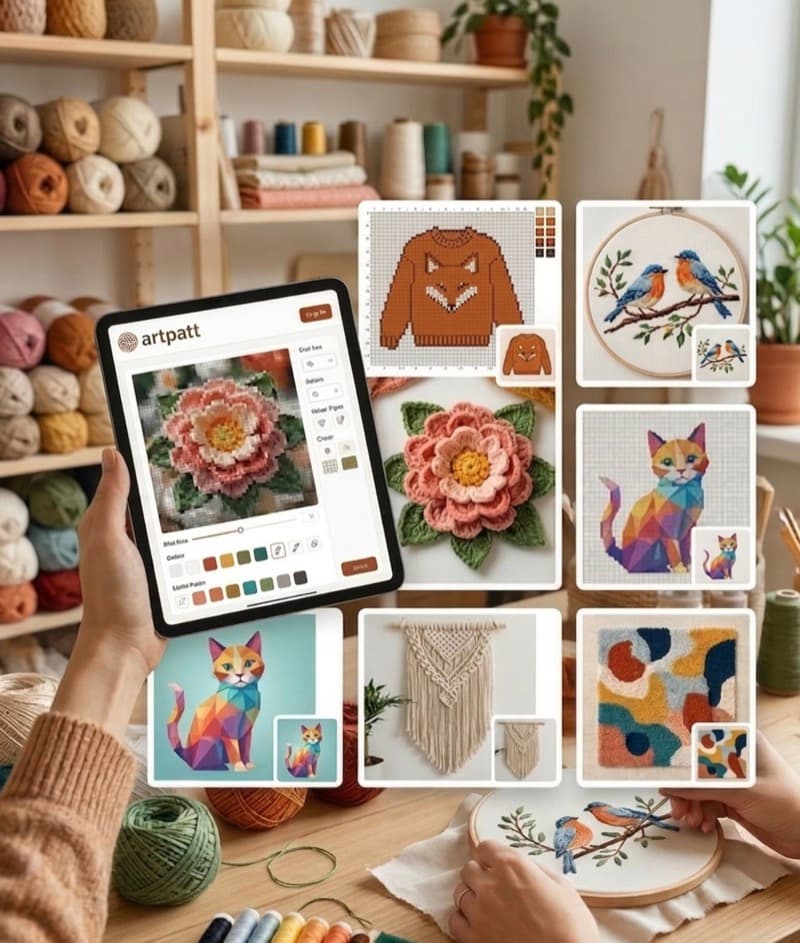
Once you finish a small wall hanging, ramp up gradually. Second project: add diagonal half hitches — a wall hanging with V-shaped or diamond-shaped diagonal lines. Third project: try a plant hanger — uses square knots and gathering knots, holds a small pot, decorates a window or hook. Fourth project: try a larger wall hanging (60cm wide, 90cm long below dowel) with mixed knot types — square knots, half hitches, and gathering knots in one design. Fifth project: try a macrame curtain or room divider — large-scale geometric design, 100×200cm or larger, takes 20–40 hours. Sixth project: try macrame jewelry (bracelets, necklaces) using fine 1–2mm cord and very small knots — different scale skill set, gateway to bohemian fashion accessories. Or generate a custom photo-based macrame pattern using ArtPatt's macrame pattern generator — converts any photo into a knot grid suited to macrame's bold low-resolution aesthetic.
Macrame Beginner FAQ
How long does macrame take to learn? About 30 minutes to learn the lark's head and square knot. About 5–10 hours of practice to develop tension consistency. About 2–3 finished projects to feel comfortable with knot composition. Is macrame easier than crochet or knitting? Generally yes — no needle or hook to coordinate, no counted stitches to track, mistakes untie cleanly. Macrame is one of the easiest fiber crafts to learn. What size cord for a beginner? 3mm 100% cotton single-strand twisted cord for medium-sized wall hangings (30–50 cm wide). 5mm cord for larger pieces or chunky bohemian aesthetic. 1–2mm cord for fine work and jewelry. How much cord do I need for a wall hanging? For a 30cm wide × 60cm long below-dowel wall hanging using square knots: ~20m of 3mm cord. ArtPatt's macrame cord calculator gives precise estimates by design. Can I make a macrame pattern from a photo? Yes — use ArtPatt's macrame pattern generator. Upload any bold-shape image, pick 30×40 to 50×60 grid dimensions and 4–6 colors. The chart shows the knot grid you replicate in cord — each cell in the chart is one square knot or knot group in the finished piece.
Related Articles