Alpha Patterns

An alpha pattern is a color grid you work row by row, where every column is one base string of a friendship bracelet or one stitch of crochet. Here are 16 free alpha patterns for bracelets, keychains and wall hangings, each with its string count, a knot count per color, every row written out and a PNG to print.

Easy bracelet alpha patterns

Narrow repeats of 9 to 11 base strings for friendship bracelets. Tie the rows until the band fits your wrist; the last row of each chart runs straight into the first, so the motif keeps going.

Repeating Hearts

9 base strings × 16 rows · 2 colors · ~0.9 cm wide
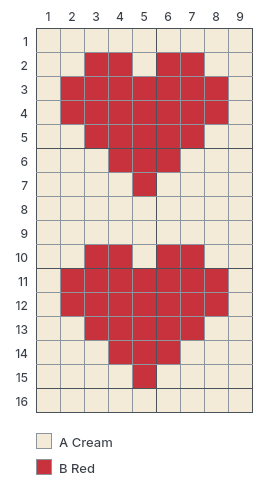
Repeating Hearts alpha pattern chart, 9 × 16 squares in 2 colors, with numbered columns and rows
  • A Cream: 90 knots
  • B Red: 54 knots

Two colors and one heart shape, repeated down the bracelet. The plain row between hearts gives you a natural place to stop and check your count.

Row-by-row color guide

9 base strings and 2 working strings, one per color. Start at the top: odd rows go left to right in forward knots (FK), even rows right to left in backward knots (BK).

  1. Row 1 (L→R, FK): 9 Cream
  2. Row 2 (R→L, BK): 2 Cream, 2 Red, 1 Cream, 2 Red, 2 Cream
  3. Row 3 (L→R, FK): 1 Cream, 7 Red, 1 Cream
  4. Row 4 (R→L, BK): 1 Cream, 7 Red, 1 Cream
  5. Row 5 (L→R, FK): 2 Cream, 5 Red, 2 Cream
  6. Row 6 (R→L, BK): 3 Cream, 3 Red, 3 Cream
  7. Row 7 (L→R, FK): 4 Cream, 1 Red, 4 Cream
  8. Row 8 (R→L, BK): 9 Cream
  9. Row 9 (L→R, FK): 9 Cream
  10. Row 10 (R→L, BK): 2 Cream, 2 Red, 1 Cream, 2 Red, 2 Cream
  11. Row 11 (L→R, FK): 1 Cream, 7 Red, 1 Cream
  12. Row 12 (R→L, BK): 1 Cream, 7 Red, 1 Cream
  13. Row 13 (L→R, FK): 2 Cream, 5 Red, 2 Cream
  14. Row 14 (R→L, BK): 3 Cream, 3 Red, 3 Cream
  15. Row 15 (L→R, FK): 4 Cream, 1 Red, 4 Cream
  16. Row 16 (R→L, BK): 9 Cream
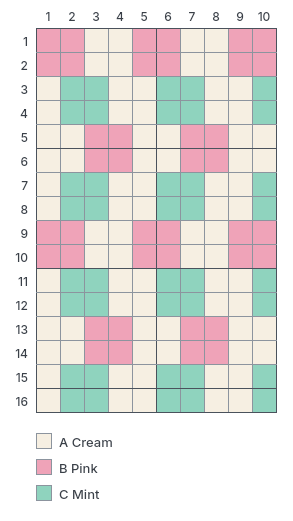
Pastel Checkered Wave

10 base strings × 16 rows · 3 colors · ~1.0 cm wide

Pastel Checkered Wave alpha pattern chart, 10 × 16 squares in 3 colors, with numbered columns and rows
  • A Cream: 80 knots
  • B Pink: 40 knots
  • C Mint: 40 knots

Two-by-two checks that step one string sideways every two rows and back again, so the checkerboard ripples down the bracelet. Pink and mint alternate by band.

Row-by-row color guide

10 base strings and 3 working strings, one per color. Start at the top: odd rows go left to right in forward knots (FK), even rows right to left in backward knots (BK).

  1. Row 1 (L→R, FK): 2 Pink, 2 Cream, 2 Pink, 2 Cream, 2 Pink
  2. Row 2 (R→L, BK): 2 Pink, 2 Cream, 2 Pink, 2 Cream, 2 Pink
  3. Row 3 (L→R, FK): 1 Cream, 2 Mint, 2 Cream, 2 Mint, 2 Cream, 1 Mint
  4. Row 4 (R→L, BK): 1 Mint, 2 Cream, 2 Mint, 2 Cream, 2 Mint, 1 Cream
  5. Row 5 (L→R, FK): 2 Cream, 2 Pink, 2 Cream, 2 Pink, 2 Cream
  6. Row 6 (R→L, BK): 2 Cream, 2 Pink, 2 Cream, 2 Pink, 2 Cream
  7. Row 7 (L→R, FK): 1 Cream, 2 Mint, 2 Cream, 2 Mint, 2 Cream, 1 Mint
  8. Row 8 (R→L, BK): 1 Mint, 2 Cream, 2 Mint, 2 Cream, 2 Mint, 1 Cream
  9. Row 9 (L→R, FK): 2 Pink, 2 Cream, 2 Pink, 2 Cream, 2 Pink
  10. Row 10 (R→L, BK): 2 Pink, 2 Cream, 2 Pink, 2 Cream, 2 Pink
  11. Row 11 (L→R, FK): 1 Cream, 2 Mint, 2 Cream, 2 Mint, 2 Cream, 1 Mint
  12. Row 12 (R→L, BK): 1 Mint, 2 Cream, 2 Mint, 2 Cream, 2 Mint, 1 Cream
  13. Row 13 (L→R, FK): 2 Cream, 2 Pink, 2 Cream, 2 Pink, 2 Cream
  14. Row 14 (R→L, BK): 2 Cream, 2 Pink, 2 Cream, 2 Pink, 2 Cream
  15. Row 15 (L→R, FK): 1 Cream, 2 Mint, 2 Cream, 2 Mint, 2 Cream, 1 Mint
  16. Row 16 (R→L, BK): 1 Mint, 2 Cream, 2 Mint, 2 Cream, 2 Mint, 1 Cream

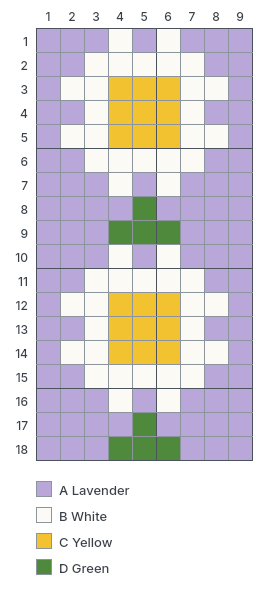
Mini Daisies

9 base strings × 18 rows · 4 colors · ~0.9 cm wide

Mini Daisies alpha pattern chart, 9 × 18 squares in 4 colors, with numbered columns and rows
  • A Lavender: 88 knots
  • B White: 48 knots
  • C Yellow: 18 knots
  • D Green: 8 knots

Round white daisies joined by a short green stem, two per repeat. Tie the yellow centers carefully: three knots wide on three rows.

Row-by-row color guide

9 base strings and 4 working strings, one per color. Start at the top: odd rows go left to right in forward knots (FK), even rows right to left in backward knots (BK).

  1. Row 1 (L→R, FK): 3 Lavender, 1 White, 1 Lavender, 1 White, 3 Lavender
  2. Row 2 (R→L, BK): 2 Lavender, 5 White, 2 Lavender
  3. Row 3 (L→R, FK): 1 Lavender, 2 White, 3 Yellow, 2 White, 1 Lavender
  4. Row 4 (R→L, BK): 2 Lavender, 1 White, 3 Yellow, 1 White, 2 Lavender
  5. Row 5 (L→R, FK): 1 Lavender, 2 White, 3 Yellow, 2 White, 1 Lavender
  6. Row 6 (R→L, BK): 2 Lavender, 5 White, 2 Lavender
  7. Row 7 (L→R, FK): 3 Lavender, 1 White, 1 Lavender, 1 White, 3 Lavender
  8. Row 8 (R→L, BK): 4 Lavender, 1 Green, 4 Lavender
  9. Row 9 (L→R, FK): 3 Lavender, 3 Green, 3 Lavender
  10. Row 10 (R→L, BK): 3 Lavender, 1 White, 1 Lavender, 1 White, 3 Lavender
  11. Row 11 (L→R, FK): 2 Lavender, 5 White, 2 Lavender
  12. Row 12 (R→L, BK): 1 Lavender, 2 White, 3 Yellow, 2 White, 1 Lavender
  13. Row 13 (L→R, FK): 2 Lavender, 1 White, 3 Yellow, 1 White, 2 Lavender
  14. Row 14 (R→L, BK): 1 Lavender, 2 White, 3 Yellow, 2 White, 1 Lavender
  15. Row 15 (L→R, FK): 2 Lavender, 5 White, 2 Lavender
  16. Row 16 (R→L, BK): 3 Lavender, 1 White, 1 Lavender, 1 White, 3 Lavender
  17. Row 17 (L→R, FK): 4 Lavender, 1 Green, 4 Lavender
  18. Row 18 (R→L, BK): 3 Lavender, 3 Green, 3 Lavender

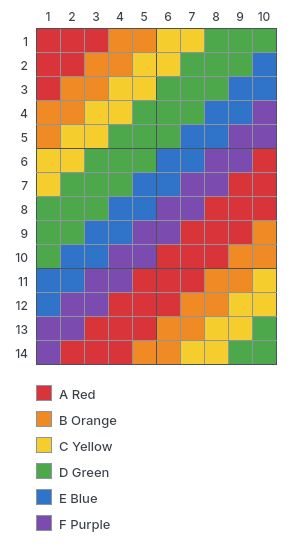
Diagonal Rainbow

10 base strings × 14 rows · 6 colors · ~1.0 cm wide

Diagonal Rainbow alpha pattern chart, 10 × 14 squares in 6 colors, with numbered columns and rows
  • A Red: 30 knots
  • B Orange: 20 knots
  • C Yellow: 20 knots
  • D Green: 30 knots
  • E Blue: 20 knots
  • F Purple: 20 knots

Six colors in diagonal bands that step one string per row. Red and green are three knots wide, the rest two, so the 14 rows join seamlessly when you repeat them.

Row-by-row color guide

10 base strings and 6 working strings, one per color. Start at the top: odd rows go left to right in forward knots (FK), even rows right to left in backward knots (BK).

  1. Row 1 (L→R, FK): 3 Red, 2 Orange, 2 Yellow, 3 Green
  2. Row 2 (R→L, BK): 1 Blue, 3 Green, 2 Yellow, 2 Orange, 2 Red
  3. Row 3 (L→R, FK): 1 Red, 2 Orange, 2 Yellow, 3 Green, 2 Blue
  4. Row 4 (R→L, BK): 1 Purple, 2 Blue, 3 Green, 2 Yellow, 2 Orange
  5. Row 5 (L→R, FK): 1 Orange, 2 Yellow, 3 Green, 2 Blue, 2 Purple
  6. Row 6 (R→L, BK): 1 Red, 2 Purple, 2 Blue, 3 Green, 2 Yellow
  7. Row 7 (L→R, FK): 1 Yellow, 3 Green, 2 Blue, 2 Purple, 2 Red
  8. Row 8 (R→L, BK): 3 Red, 2 Purple, 2 Blue, 3 Green
  9. Row 9 (L→R, FK): 2 Green, 2 Blue, 2 Purple, 3 Red, 1 Orange
  10. Row 10 (R→L, BK): 2 Orange, 3 Red, 2 Purple, 2 Blue, 1 Green
  11. Row 11 (L→R, FK): 2 Blue, 2 Purple, 3 Red, 2 Orange, 1 Yellow
  12. Row 12 (R→L, BK): 2 Yellow, 2 Orange, 3 Red, 2 Purple, 1 Blue
  13. Row 13 (L→R, FK): 2 Purple, 3 Red, 2 Orange, 2 Yellow, 1 Green
  14. Row 14 (R→L, BK): 2 Green, 2 Yellow, 2 Orange, 3 Red, 1 Purple

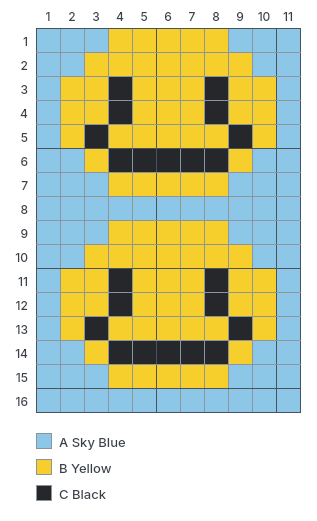
Classic Smileys

11 base strings × 16 rows · 3 colors · ~1.1 cm wide

Classic Smileys alpha pattern chart, 11 × 16 squares in 3 colors, with numbered columns and rows
  • A Sky Blue: 74 knots
  • B Yellow: 80 knots
  • C Black: 22 knots

Round yellow faces with dot eyes and a wide grin, two per repeat on a sky blue ground. The black mouth is one row of five knots with its corners turned up a row.

Row-by-row color guide

11 base strings and 3 working strings, one per color. Start at the top: odd rows go left to right in forward knots (FK), even rows right to left in backward knots (BK).

  1. Row 1 (L→R, FK): 3 Sky Blue, 5 Yellow, 3 Sky Blue
  2. Row 2 (R→L, BK): 2 Sky Blue, 7 Yellow, 2 Sky Blue
  3. Row 3 (L→R, FK): 1 Sky Blue, 2 Yellow, 1 Black, 3 Yellow, 1 Black, 2 Yellow, 1 Sky Blue
  4. Row 4 (R→L, BK): 1 Sky Blue, 2 Yellow, 1 Black, 3 Yellow, 1 Black, 2 Yellow, 1 Sky Blue
  5. Row 5 (L→R, FK): 1 Sky Blue, 1 Yellow, 1 Black, 5 Yellow, 1 Black, 1 Yellow, 1 Sky Blue
  6. Row 6 (R→L, BK): 2 Sky Blue, 1 Yellow, 5 Black, 1 Yellow, 2 Sky Blue
  7. Row 7 (L→R, FK): 3 Sky Blue, 5 Yellow, 3 Sky Blue
  8. Row 8 (R→L, BK): 11 Sky Blue
  9. Row 9 (L→R, FK): 3 Sky Blue, 5 Yellow, 3 Sky Blue
  10. Row 10 (R→L, BK): 2 Sky Blue, 7 Yellow, 2 Sky Blue
  11. Row 11 (L→R, FK): 1 Sky Blue, 2 Yellow, 1 Black, 3 Yellow, 1 Black, 2 Yellow, 1 Sky Blue
  12. Row 12 (R→L, BK): 1 Sky Blue, 2 Yellow, 1 Black, 3 Yellow, 1 Black, 2 Yellow, 1 Sky Blue
  13. Row 13 (L→R, FK): 1 Sky Blue, 1 Yellow, 1 Black, 5 Yellow, 1 Black, 1 Yellow, 1 Sky Blue
  14. Row 14 (R→L, BK): 2 Sky Blue, 1 Yellow, 5 Black, 1 Yellow, 2 Sky Blue
  15. Row 15 (L→R, FK): 3 Sky Blue, 5 Yellow, 3 Sky Blue
  16. Row 16 (R→L, BK): 11 Sky Blue

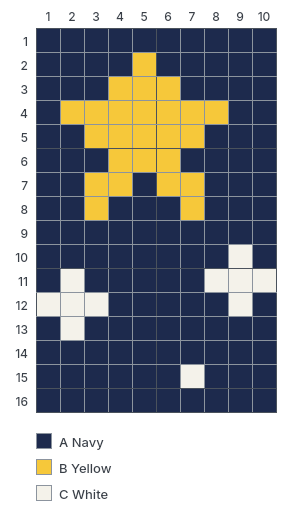
Little Stars

10 base strings × 16 rows · 3 colors · ~1.0 cm wide

Little Stars alpha pattern chart, 10 × 16 squares in 3 colors, with numbered columns and rows
  • A Navy: 124 knots
  • B Yellow: 25 knots
  • C White: 11 knots

A yellow five-point star and two small white sparkles on navy. The sparkles sit off to the sides, so the band does not look like a row of identical stamps.

Row-by-row color guide

10 base strings and 3 working strings, one per color. Start at the top: odd rows go left to right in forward knots (FK), even rows right to left in backward knots (BK).

  1. Row 1 (L→R, FK): 10 Navy
  2. Row 2 (R→L, BK): 5 Navy, 1 Yellow, 4 Navy
  3. Row 3 (L→R, FK): 3 Navy, 3 Yellow, 4 Navy
  4. Row 4 (R→L, BK): 2 Navy, 7 Yellow, 1 Navy
  5. Row 5 (L→R, FK): 2 Navy, 5 Yellow, 3 Navy
  6. Row 6 (R→L, BK): 4 Navy, 3 Yellow, 3 Navy
  7. Row 7 (L→R, FK): 2 Navy, 2 Yellow, 1 Navy, 2 Yellow, 3 Navy
  8. Row 8 (R→L, BK): 3 Navy, 1 Yellow, 3 Navy, 1 Yellow, 2 Navy
  9. Row 9 (L→R, FK): 10 Navy
  10. Row 10 (R→L, BK): 1 Navy, 1 White, 8 Navy
  11. Row 11 (L→R, FK): 1 Navy, 1 White, 5 Navy, 3 White
  12. Row 12 (R→L, BK): 1 Navy, 1 White, 5 Navy, 3 White
  13. Row 13 (L→R, FK): 1 Navy, 1 White, 8 Navy
  14. Row 14 (R→L, BK): 10 Navy
  15. Row 15 (L→R, FK): 6 Navy, 1 White, 3 Navy
  16. Row 16 (R→L, BK): 10 Navy

Alpha keychain patterns

One motif on 14 base strings, sized for a keychain or a bag charm. Tie a few plain rows above and below, then fold the ends into a jump ring.

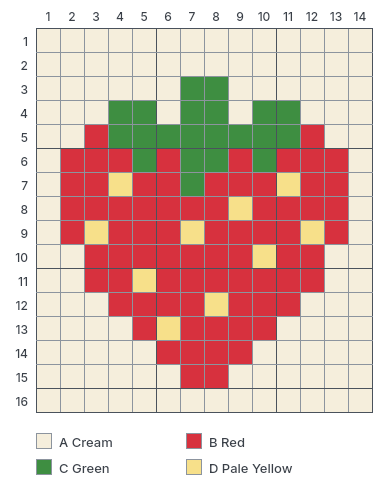
Strawberry

14 base strings × 16 rows · 4 colors · ~1.4 cm wide

Strawberry alpha pattern chart, 14 × 16 squares in 4 colors, with numbered columns and rows
  • A Cream: 118 knots
  • B Red: 75 knots
  • C Green: 21 knots
  • D Pale Yellow: 10 knots

A red berry with a leafy green top and pale seeds in a staggered grid. The seeds are single knots, so they are the only spots where you change color for one knot and back.

Row-by-row color guide

14 base strings and 4 working strings, one per color. Start at the top: odd rows go left to right in forward knots (FK), even rows right to left in backward knots (BK).

  1. Row 1 (L→R, FK): 14 Cream
  2. Row 2 (R→L, BK): 14 Cream
  3. Row 3 (L→R, FK): 6 Cream, 2 Green, 6 Cream
  4. Row 4 (R→L, BK): 3 Cream, 2 Green, 1 Cream, 2 Green, 1 Cream, 2 Green, 3 Cream
  5. Row 5 (L→R, FK): 2 Cream, 1 Red, 8 Green, 1 Red, 2 Cream
  6. Row 6 (R→L, BK): 1 Cream, 3 Red, 1 Green, 1 Red, 2 Green, 1 Red, 1 Green, 3 Red, 1 Cream
  7. Row 7 (L→R, FK): 1 Cream, 2 Red, 1 Pale Yellow, 2 Red, 1 Green, 3 Red, 1 Pale Yellow, 2 Red, 1 Cream
  8. Row 8 (R→L, BK): 1 Cream, 4 Red, 1 Pale Yellow, 7 Red, 1 Cream
  9. Row 9 (L→R, FK): 1 Cream, 1 Red, 1 Pale Yellow, 3 Red, 1 Pale Yellow, 4 Red, 1 Pale Yellow, 1 Red, 1 Cream
  10. Row 10 (R→L, BK): 2 Cream, 2 Red, 1 Pale Yellow, 7 Red, 2 Cream
  11. Row 11 (L→R, FK): 2 Cream, 2 Red, 1 Pale Yellow, 7 Red, 2 Cream
  12. Row 12 (R→L, BK): 3 Cream, 3 Red, 1 Pale Yellow, 4 Red, 3 Cream
  13. Row 13 (L→R, FK): 4 Cream, 1 Red, 1 Pale Yellow, 4 Red, 4 Cream
  14. Row 14 (R→L, BK): 5 Cream, 4 Red, 5 Cream
  15. Row 15 (L→R, FK): 6 Cream, 2 Red, 6 Cream
  16. Row 16 (R→L, BK): 14 Cream

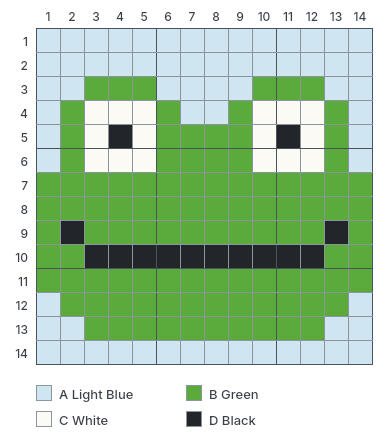
Green Frog

14 base strings × 14 rows · 4 colors · ~1.4 cm wide

Green Frog alpha pattern chart, 14 × 14 squares in 4 colors, with numbered columns and rows
  • A Light Blue: 64 knots
  • B Green: 102 knots
  • C White: 16 knots
  • D Black: 14 knots

A round frog face with big eyes on top and a wide smile. The eyes sit higher than the head, which is what makes it read as a frog at this size.

Row-by-row color guide

14 base strings and 4 working strings, one per color. Start at the top: odd rows go left to right in forward knots (FK), even rows right to left in backward knots (BK).

  1. Row 1 (L→R, FK): 14 Light Blue
  2. Row 2 (R→L, BK): 14 Light Blue
  3. Row 3 (L→R, FK): 2 Light Blue, 3 Green, 4 Light Blue, 3 Green, 2 Light Blue
  4. Row 4 (R→L, BK): 1 Light Blue, 1 Green, 3 White, 1 Green, 2 Light Blue, 1 Green, 3 White, 1 Green, 1 Light Blue
  5. Row 5 (L→R, FK): 1 Light Blue, 1 Green, 1 White, 1 Black, 1 White, 4 Green, 1 White, 1 Black, 1 White, 1 Green, 1 Light Blue
  6. Row 6 (R→L, BK): 1 Light Blue, 1 Green, 3 White, 4 Green, 3 White, 1 Green, 1 Light Blue
  7. Row 7 (L→R, FK): 14 Green
  8. Row 8 (R→L, BK): 14 Green
  9. Row 9 (L→R, FK): 1 Green, 1 Black, 10 Green, 1 Black, 1 Green
  10. Row 10 (R→L, BK): 2 Green, 10 Black, 2 Green
  11. Row 11 (L→R, FK): 14 Green
  12. Row 12 (R→L, BK): 1 Light Blue, 12 Green, 1 Light Blue
  13. Row 13 (L→R, FK): 2 Light Blue, 10 Green, 2 Light Blue
  14. Row 14 (R→L, BK): 14 Light Blue

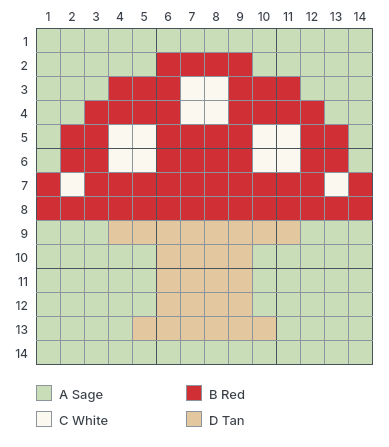
Spotted Mushroom

14 base strings × 14 rows · 4 colors · ~1.4 cm wide

Spotted Mushroom alpha pattern chart, 14 × 14 squares in 4 colors, with numbered columns and rows
  • A Sage: 96 knots
  • B Red: 60 knots
  • C White: 14 knots
  • D Tan: 26 knots

A wide red cap with round white spots over a short pale stem. The underside of the cap is one row of stem color, which separates the cap from the stem.

Row-by-row color guide

14 base strings and 4 working strings, one per color. Start at the top: odd rows go left to right in forward knots (FK), even rows right to left in backward knots (BK).

  1. Row 1 (L→R, FK): 14 Sage
  2. Row 2 (R→L, BK): 5 Sage, 4 Red, 5 Sage
  3. Row 3 (L→R, FK): 3 Sage, 3 Red, 2 White, 3 Red, 3 Sage
  4. Row 4 (R→L, BK): 2 Sage, 4 Red, 2 White, 4 Red, 2 Sage
  5. Row 5 (L→R, FK): 1 Sage, 2 Red, 2 White, 4 Red, 2 White, 2 Red, 1 Sage
  6. Row 6 (R→L, BK): 1 Sage, 2 Red, 2 White, 4 Red, 2 White, 2 Red, 1 Sage
  7. Row 7 (L→R, FK): 1 Red, 1 White, 10 Red, 1 White, 1 Red
  8. Row 8 (R→L, BK): 14 Red
  9. Row 9 (L→R, FK): 3 Sage, 8 Tan, 3 Sage
  10. Row 10 (R→L, BK): 5 Sage, 4 Tan, 5 Sage
  11. Row 11 (L→R, FK): 5 Sage, 4 Tan, 5 Sage
  12. Row 12 (R→L, BK): 5 Sage, 4 Tan, 5 Sage
  13. Row 13 (L→R, FK): 4 Sage, 6 Tan, 4 Sage
  14. Row 14 (R→L, BK): 14 Sage

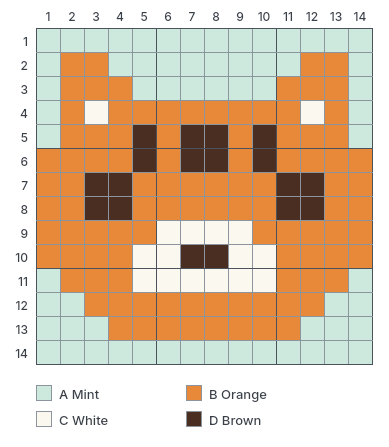
Tabby Cat

14 base strings × 14 rows · 4 colors · ~1.4 cm wide

Tabby Cat alpha pattern chart, 14 × 14 squares in 4 colors, with numbered columns and rows
  • A Mint: 62 knots
  • B Orange: 100 knots
  • C White: 16 knots
  • D Brown: 18 knots

An orange tabby face with pointed ears, forehead stripes and a white muzzle. Brown does the eyes, nose and stripes, so it is the only color you pick up for small details.

Row-by-row color guide

14 base strings and 4 working strings, one per color. Start at the top: odd rows go left to right in forward knots (FK), even rows right to left in backward knots (BK).

  1. Row 1 (L→R, FK): 14 Mint
  2. Row 2 (R→L, BK): 1 Mint, 2 Orange, 8 Mint, 2 Orange, 1 Mint
  3. Row 3 (L→R, FK): 1 Mint, 3 Orange, 6 Mint, 3 Orange, 1 Mint
  4. Row 4 (R→L, BK): 1 Mint, 1 Orange, 1 White, 8 Orange, 1 White, 1 Orange, 1 Mint
  5. Row 5 (L→R, FK): 1 Mint, 3 Orange, 1 Brown, 1 Orange, 2 Brown, 1 Orange, 1 Brown, 3 Orange, 1 Mint
  6. Row 6 (R→L, BK): 4 Orange, 1 Brown, 1 Orange, 2 Brown, 1 Orange, 1 Brown, 4 Orange
  7. Row 7 (L→R, FK): 2 Orange, 2 Brown, 6 Orange, 2 Brown, 2 Orange
  8. Row 8 (R→L, BK): 2 Orange, 2 Brown, 6 Orange, 2 Brown, 2 Orange
  9. Row 9 (L→R, FK): 5 Orange, 4 White, 5 Orange
  10. Row 10 (R→L, BK): 4 Orange, 2 White, 2 Brown, 2 White, 4 Orange
  11. Row 11 (L→R, FK): 1 Mint, 3 Orange, 6 White, 3 Orange, 1 Mint
  12. Row 12 (R→L, BK): 2 Mint, 10 Orange, 2 Mint
  13. Row 13 (L→R, FK): 3 Mint, 8 Orange, 3 Mint
  14. Row 14 (R→L, BK): 14 Mint

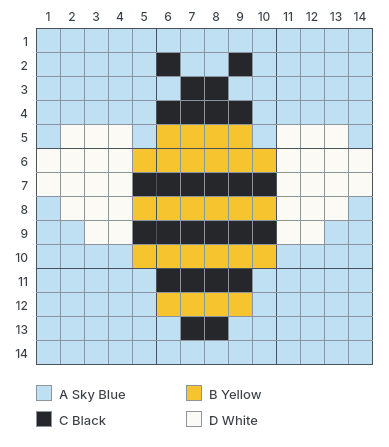
Bumblebee

14 base strings × 14 rows · 4 colors · ~1.4 cm wide

Bumblebee alpha pattern chart, 14 × 14 squares in 4 colors, with numbered columns and rows
  • A Sky Blue: 112 knots
  • B Yellow: 26 knots
  • C Black: 26 knots
  • D White: 32 knots

A striped bee seen from above, with white wings either side of the body. Black and yellow alternate every row on the body, so it is quick to tie once you have the wing edges.

Row-by-row color guide

14 base strings and 4 working strings, one per color. Start at the top: odd rows go left to right in forward knots (FK), even rows right to left in backward knots (BK).

  1. Row 1 (L→R, FK): 14 Sky Blue
  2. Row 2 (R→L, BK): 5 Sky Blue, 1 Black, 2 Sky Blue, 1 Black, 5 Sky Blue
  3. Row 3 (L→R, FK): 6 Sky Blue, 2 Black, 6 Sky Blue
  4. Row 4 (R→L, BK): 5 Sky Blue, 4 Black, 5 Sky Blue
  5. Row 5 (L→R, FK): 1 Sky Blue, 3 White, 1 Sky Blue, 4 Yellow, 1 Sky Blue, 3 White, 1 Sky Blue
  6. Row 6 (R→L, BK): 4 White, 6 Yellow, 4 White
  7. Row 7 (L→R, FK): 4 White, 6 Black, 4 White
  8. Row 8 (R→L, BK): 1 Sky Blue, 3 White, 6 Yellow, 3 White, 1 Sky Blue
  9. Row 9 (L→R, FK): 2 Sky Blue, 2 White, 6 Black, 2 White, 2 Sky Blue
  10. Row 10 (R→L, BK): 4 Sky Blue, 6 Yellow, 4 Sky Blue
  11. Row 11 (L→R, FK): 5 Sky Blue, 4 Black, 5 Sky Blue
  12. Row 12 (R→L, BK): 5 Sky Blue, 4 Yellow, 5 Sky Blue
  13. Row 13 (L→R, FK): 6 Sky Blue, 2 Black, 6 Sky Blue
  14. Row 14 (R→L, BK): 14 Sky Blue

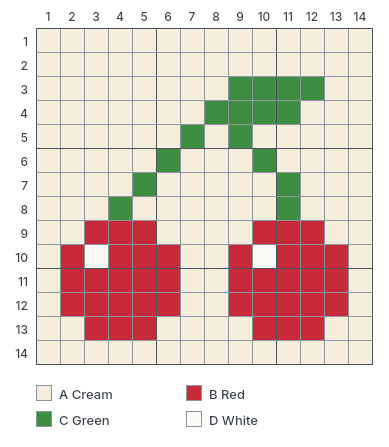
Twin Cherries

14 base strings × 14 rows · 4 colors · ~1.4 cm wide

Twin Cherries alpha pattern chart, 14 × 14 squares in 4 colors, with numbered columns and rows
  • A Cream: 138 knots
  • B Red: 40 knots
  • C Green: 16 knots
  • D White: 2 knots

Two round cherries on stems that meet under one leaf. A single white knot on each cherry is the shine that makes them look round.

Row-by-row color guide

14 base strings and 4 working strings, one per color. Start at the top: odd rows go left to right in forward knots (FK), even rows right to left in backward knots (BK).

  1. Row 1 (L→R, FK): 14 Cream
  2. Row 2 (R→L, BK): 14 Cream
  3. Row 3 (L→R, FK): 8 Cream, 4 Green, 2 Cream
  4. Row 4 (R→L, BK): 3 Cream, 4 Green, 7 Cream
  5. Row 5 (L→R, FK): 6 Cream, 1 Green, 1 Cream, 1 Green, 5 Cream
  6. Row 6 (R→L, BK): 4 Cream, 1 Green, 3 Cream, 1 Green, 5 Cream
  7. Row 7 (L→R, FK): 4 Cream, 1 Green, 5 Cream, 1 Green, 3 Cream
  8. Row 8 (R→L, BK): 3 Cream, 1 Green, 6 Cream, 1 Green, 3 Cream
  9. Row 9 (L→R, FK): 2 Cream, 3 Red, 4 Cream, 3 Red, 2 Cream
  10. Row 10 (R→L, BK): 1 Cream, 3 Red, 1 White, 1 Red, 2 Cream, 3 Red, 1 White, 1 Red, 1 Cream
  11. Row 11 (L→R, FK): 1 Cream, 5 Red, 2 Cream, 5 Red, 1 Cream
  12. Row 12 (R→L, BK): 1 Cream, 5 Red, 2 Cream, 5 Red, 1 Cream
  13. Row 13 (L→R, FK): 2 Cream, 3 Red, 4 Cream, 3 Red, 2 Cream
  14. Row 14 (R→L, BK): 14 Cream

Wide wall hangings & crochet alpha grids

16 to 18 columns wide: small tapestry crochet pieces, coasters, pillow fronts and wall hangings. In crochet each square is one single crochet, and you read the chart from the bottom row up.

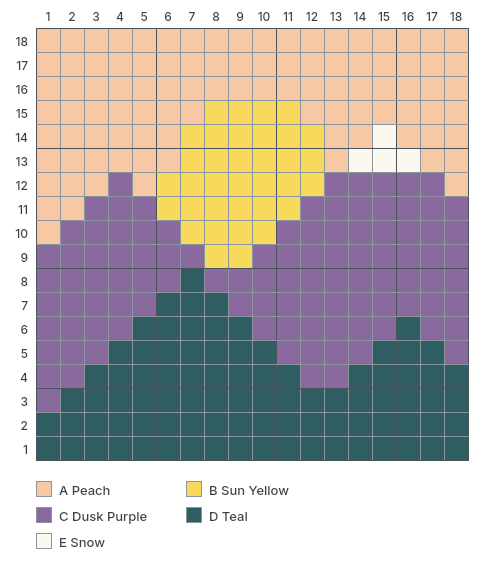
Sunset Mountains

18 stitches × 18 rows · 5 colors · ~9 × 8 cm in DK

Sunset Mountains alpha pattern chart, 18 × 18 squares in 5 colors, with numbered columns and rows
  • A Peach: 96 sts
  • B Sun Yellow: 35 sts
  • C Dusk Purple: 102 sts
  • D Teal: 87 sts
  • E Snow: 4 sts

A low sun behind two ranges of mountains, the far one dusky purple and the near one deep teal. Mostly long color runs, so it is a calm first tapestry piece.

Row-by-row color guide

Single crochet, worked flat from the bottom of the chart up: right side rows read right to left, wrong side rows left to right. Carry the colors you are not using inside the stitches. Ch 19 to start.

  1. Row 1 (RS, R→L): 18 Teal
  2. Row 2 (WS, L→R): 18 Teal
  3. Row 3 (RS, R→L): 17 Teal, 1 Dusk Purple
  4. Row 4 (WS, L→R): 2 Dusk Purple, 9 Teal, 2 Dusk Purple, 5 Teal
  5. Row 5 (RS, R→L): 1 Dusk Purple, 3 Teal, 4 Dusk Purple, 7 Teal, 3 Dusk Purple
  6. Row 6 (WS, L→R): 4 Dusk Purple, 5 Teal, 6 Dusk Purple, 1 Teal, 2 Dusk Purple
  7. Row 7 (RS, R→L): 10 Dusk Purple, 3 Teal, 5 Dusk Purple
  8. Row 8 (WS, L→R): 6 Dusk Purple, 1 Teal, 11 Dusk Purple
  9. Row 9 (RS, R→L): 9 Dusk Purple, 2 Sun Yellow, 7 Dusk Purple
  10. Row 10 (WS, L→R): 1 Peach, 5 Dusk Purple, 4 Sun Yellow, 8 Dusk Purple
  11. Row 11 (RS, R→L): 7 Dusk Purple, 6 Sun Yellow, 3 Dusk Purple, 2 Peach
  12. Row 12 (WS, L→R): 3 Peach, 1 Dusk Purple, 1 Peach, 7 Sun Yellow, 5 Dusk Purple, 1 Peach
  13. Row 13 (RS, R→L): 2 Peach, 3 Snow, 1 Peach, 6 Sun Yellow, 6 Peach
  14. Row 14 (WS, L→R): 6 Peach, 6 Sun Yellow, 2 Peach, 1 Snow, 3 Peach
  15. Row 15 (RS, R→L): 7 Peach, 4 Sun Yellow, 7 Peach
  16. Row 16 (WS, L→R): 18 Peach
  17. Row 17 (RS, R→L): 18 Peach
  18. Row 18 (WS, L→R): 18 Peach

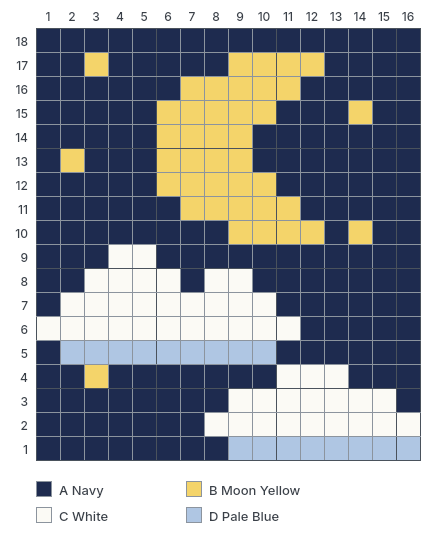
Moon & Clouds

16 stitches × 18 rows · 4 colors · ~8 × 8 cm in DK

Moon & Clouds alpha pattern chart, 16 × 18 squares in 4 colors, with numbered columns and rows
  • A Navy: 183 sts
  • B Moon Yellow: 41 sts
  • C White: 47 sts
  • D Pale Blue: 17 sts

A crescent moon over two soft clouds, with a few stars. The clouds are white with a pale blue underside, which is what gives them their puffy shape.

Row-by-row color guide

Single crochet, worked flat from the bottom of the chart up: right side rows read right to left, wrong side rows left to right. Carry the colors you are not using inside the stitches. Ch 17 to start.

  1. Row 1 (RS, R→L): 8 Pale Blue, 8 Navy
  2. Row 2 (WS, L→R): 7 Navy, 9 White
  3. Row 3 (RS, R→L): 1 Navy, 7 White, 8 Navy
  4. Row 4 (WS, L→R): 2 Navy, 1 Moon Yellow, 7 Navy, 3 White, 3 Navy
  5. Row 5 (RS, R→L): 6 Navy, 9 Pale Blue, 1 Navy
  6. Row 6 (WS, L→R): 11 White, 5 Navy
  7. Row 7 (RS, R→L): 6 Navy, 9 White, 1 Navy
  8. Row 8 (WS, L→R): 2 Navy, 4 White, 1 Navy, 2 White, 7 Navy
  9. Row 9 (RS, R→L): 11 Navy, 2 White, 3 Navy
  10. Row 10 (WS, L→R): 8 Navy, 4 Moon Yellow, 1 Navy, 1 Moon Yellow, 2 Navy
  11. Row 11 (RS, R→L): 5 Navy, 5 Moon Yellow, 6 Navy
  12. Row 12 (WS, L→R): 5 Navy, 5 Moon Yellow, 6 Navy
  13. Row 13 (RS, R→L): 7 Navy, 4 Moon Yellow, 3 Navy, 1 Moon Yellow, 1 Navy
  14. Row 14 (WS, L→R): 5 Navy, 4 Moon Yellow, 7 Navy
  15. Row 15 (RS, R→L): 2 Navy, 1 Moon Yellow, 3 Navy, 5 Moon Yellow, 5 Navy
  16. Row 16 (WS, L→R): 6 Navy, 5 Moon Yellow, 5 Navy
  17. Row 17 (RS, R→L): 4 Navy, 4 Moon Yellow, 5 Navy, 1 Moon Yellow, 2 Navy
  18. Row 18 (WS, L→R): 16 Navy

Botanical Tulip

16 stitches × 18 rows · 4 colors · ~8 × 8 cm in DK

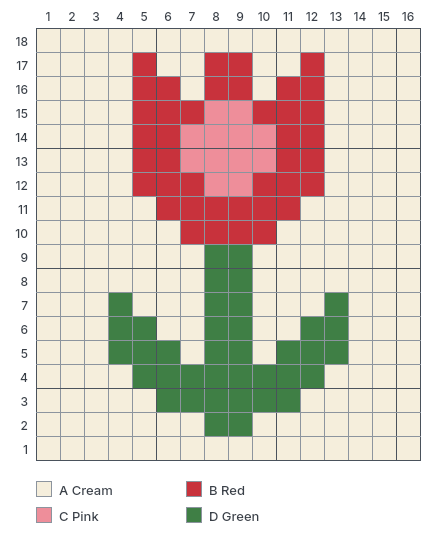
Botanical Tulip alpha pattern chart, 16 × 18 squares in 4 colors, with numbered columns and rows
  • A Cream: 198 sts
  • B Red: 40 sts
  • C Pink: 12 sts
  • D Green: 38 sts

One red tulip with a pink inner petal on a straight stem with two leaves. A good single tile for a pillow front, or repeat it in a row for a border.

Row-by-row color guide

Single crochet, worked flat from the bottom of the chart up: right side rows read right to left, wrong side rows left to right. Carry the colors you are not using inside the stitches. Ch 17 to start.

  1. Row 1 (RS, R→L): 16 Cream
  2. Row 2 (WS, L→R): 7 Cream, 2 Green, 7 Cream
  3. Row 3 (RS, R→L): 5 Cream, 6 Green, 5 Cream
  4. Row 4 (WS, L→R): 4 Cream, 8 Green, 4 Cream
  5. Row 5 (RS, R→L): 3 Cream, 3 Green, 1 Cream, 2 Green, 1 Cream, 3 Green, 3 Cream
  6. Row 6 (WS, L→R): 3 Cream, 2 Green, 2 Cream, 2 Green, 2 Cream, 2 Green, 3 Cream
  7. Row 7 (RS, R→L): 3 Cream, 1 Green, 3 Cream, 2 Green, 3 Cream, 1 Green, 3 Cream
  8. Row 8 (WS, L→R): 7 Cream, 2 Green, 7 Cream
  9. Row 9 (RS, R→L): 7 Cream, 2 Green, 7 Cream
  10. Row 10 (WS, L→R): 6 Cream, 4 Red, 6 Cream
  11. Row 11 (RS, R→L): 5 Cream, 6 Red, 5 Cream
  12. Row 12 (WS, L→R): 4 Cream, 3 Red, 2 Pink, 3 Red, 4 Cream
  13. Row 13 (RS, R→L): 4 Cream, 2 Red, 4 Pink, 2 Red, 4 Cream
  14. Row 14 (WS, L→R): 4 Cream, 2 Red, 4 Pink, 2 Red, 4 Cream
  15. Row 15 (RS, R→L): 4 Cream, 3 Red, 2 Pink, 3 Red, 4 Cream
  16. Row 16 (WS, L→R): 4 Cream, 2 Red, 1 Cream, 2 Red, 1 Cream, 2 Red, 4 Cream
  17. Row 17 (RS, R→L): 4 Cream, 1 Red, 2 Cream, 2 Red, 2 Cream, 1 Red, 4 Cream
  18. Row 18 (WS, L→R): 16 Cream

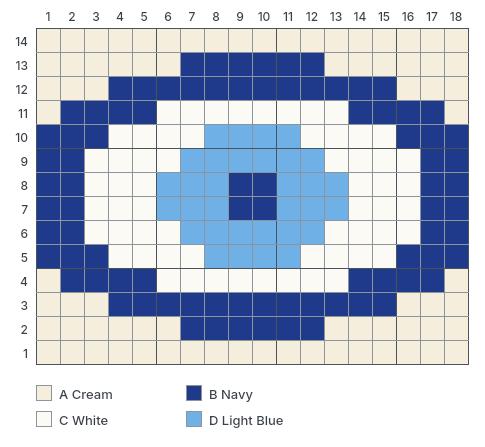
Classic Eye Motif

18 stitches × 14 rows · 4 colors · ~9 × 6 cm in DK

Classic Eye Motif alpha pattern chart, 18 × 14 squares in 4 colors, with numbered columns and rows
  • A Cream: 76 sts
  • B Navy: 84 sts
  • C White: 60 sts
  • D Light Blue: 32 sts

The blue eye motif: a dark blue almond, a white ring, a light blue iris and a dark pupil. Wider than tall, so it sits well on a bag flap or a coaster.

Row-by-row color guide

Single crochet, worked flat from the bottom of the chart up: right side rows read right to left, wrong side rows left to right. Carry the colors you are not using inside the stitches. Ch 19 to start.

  1. Row 1 (RS, R→L): 18 Cream
  2. Row 2 (WS, L→R): 6 Cream, 6 Navy, 6 Cream
  3. Row 3 (RS, R→L): 3 Cream, 12 Navy, 3 Cream
  4. Row 4 (WS, L→R): 1 Cream, 4 Navy, 8 White, 4 Navy, 1 Cream
  5. Row 5 (RS, R→L): 3 Navy, 4 White, 4 Light Blue, 4 White, 3 Navy
  6. Row 6 (WS, L→R): 2 Navy, 4 White, 6 Light Blue, 4 White, 2 Navy
  7. Row 7 (RS, R→L): 2 Navy, 3 White, 3 Light Blue, 2 Navy, 3 Light Blue, 3 White, 2 Navy
  8. Row 8 (WS, L→R): 2 Navy, 3 White, 3 Light Blue, 2 Navy, 3 Light Blue, 3 White, 2 Navy
  9. Row 9 (RS, R→L): 2 Navy, 4 White, 6 Light Blue, 4 White, 2 Navy
  10. Row 10 (WS, L→R): 3 Navy, 4 White, 4 Light Blue, 4 White, 3 Navy
  11. Row 11 (RS, R→L): 1 Cream, 4 Navy, 8 White, 4 Navy, 1 Cream
  12. Row 12 (WS, L→R): 3 Cream, 12 Navy, 3 Cream
  13. Row 13 (RS, R→L): 6 Cream, 6 Navy, 6 Cream
  14. Row 14 (WS, L→R): 18 Cream

Turn a photo into a real pattern

Want a custom name, icon, or photo as an alpha grid? Upload an image or draw from scratch in the alpha pattern generator.

Generate an Alpha Pattern from a Photo

How to read an alpha pattern

Count the columns first: that is how many base strings you need. The base strings hang straight down and never show; the color comes from the working strings knotted over them, one working string per color in the pattern. A 14-column keychain chart in four colors needs 14 base strings and 4 working strings. Each square on the chart is one knot on one base string.

Tie the rows in order from the top. Row 1 goes left to right in forward knots, row 2 comes back right to left in backward knots, and the rows keep alternating. Every square takes a double knot in the color of that square. When the color changes, knot with the new color's string and carry the others along inside the knots until you need them again. The written guide under each chart lists every row in the order you tie it, so the even rows read from the right edge.

Some sites draw alpha charts sideways, so a name reads along the bracelet as you wear it. Turn the chart a quarter turn and it is the same grid: start from the end the instructions say to tie first.

Alpha bracelets vs tapestry crochet

A knotted alpha bracelet is tied from the top of the chart down. Crochet works the other way: in tapestry crochet you start with the bottom row and build up, with each square one single crochet and the spare colors carried inside the stitches. That is why the crochet charts on this page number their rows from the bottom and their written guides start there.

Size follows the grid. In six-strand embroidery floss an alpha knot is about 1 mm wide, so 10 base strings make a band about 1 cm wide. In DK yarn with a 4 mm hook, a single crochet is about 5 mm wide, so the same 18 squares make a piece about 9 cm across. Chunkier yarn or more strands of floss scale it up.

Want a name, an icon or a photo as an alpha grid? Draw it square by square on a blank alpha grid, or turn a picture into a chart with the alpha pattern generator.

Alpha Patterns FAQ

Related Tools and Pages