Needlepoint vs Cross Stitch
Needlepoint is tent stitches covering a stiff open canvas, usually in wool; cross stitch is X stitches on soft Aida or evenweave, usually in stranded cotton, with the background often left bare. Compare the finished size of the same chart on both below.
Needlepoint vs Cross Stitch
Enter a chart size and see the finished piece and stitch count on both grounds.
| Ground | Finished size | Stitches you work | Typical thread | Typical tapestry needle |
|---|---|---|---|---|
| Aida 11 | 9.1 × 7.3 in (23.1 × 18.5 cm) | 4,800 | 3 strands floss | 22 |
| Aida 14 | 7.1 × 5.7 in (18.1 × 14.5 cm) | 4,800 | 2 strands floss | 24 |
| Aida 16 | 6.3 × 5.0 in (15.9 × 12.7 cm) | 4,800 | 2 strands floss | 24–26 |
| Aida 18 | 5.6 × 4.4 in (14.1 × 11.3 cm) | 4,800 | 1–2 strands floss | 26 |
| Canvas 10 mesh | 10.0 × 8.0 in (25.4 × 20.3 cm) | 8,000 | tapestry wool | 18 |
| Canvas 13 mesh | 7.7 × 6.2 in (19.5 × 15.6 cm) | 8,000 | tapestry or Persian wool | 20 |
| Canvas 14 mesh | 7.1 × 5.7 in (18.1 × 14.5 cm) | 8,000 | Persian wool / perle cotton 5 | 20–22 |
| Canvas 18 mesh | 5.6 × 4.4 in (14.1 × 11.3 cm) | 8,000 | perle cotton 5 / stranded silk | 22 |
Same chart, same grid: one square is one cross stitch on Aida or one tent stitch on canvas — only the finished size and the thread change.
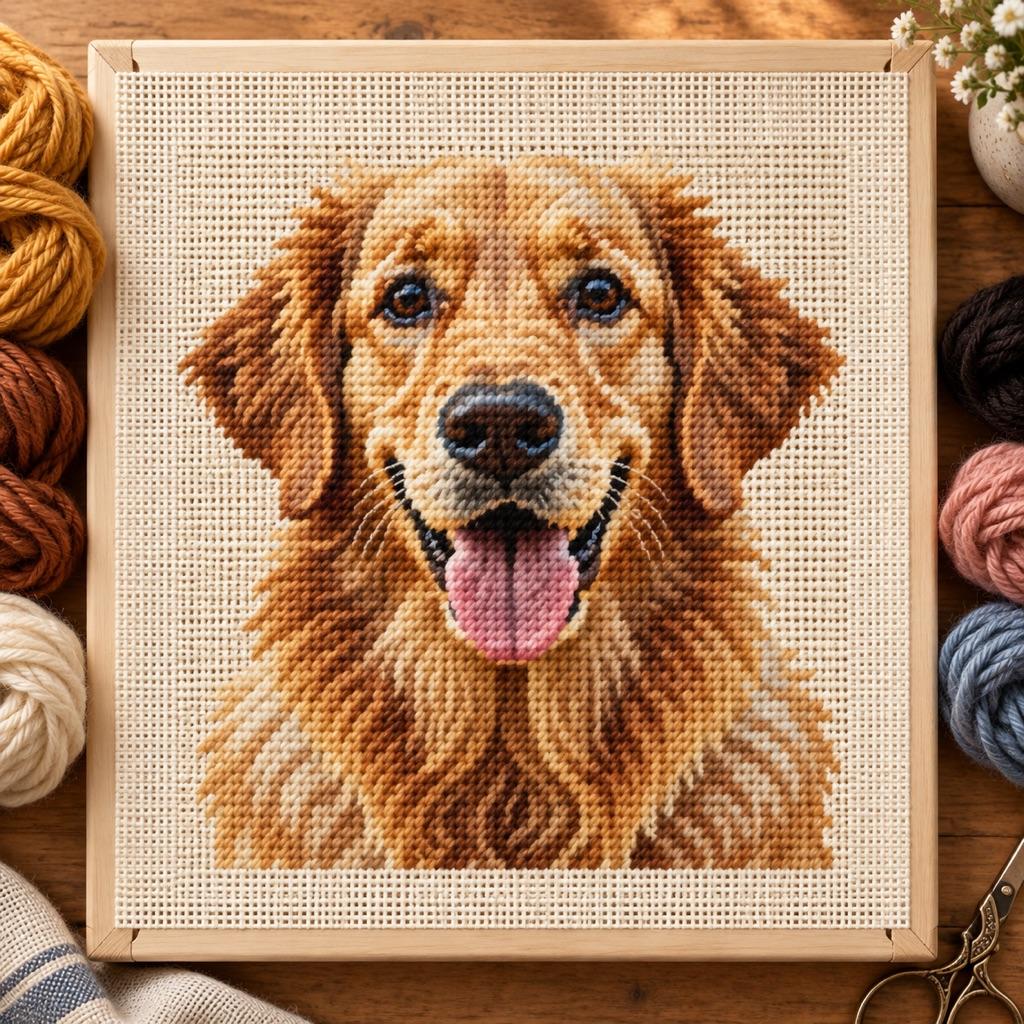
Turn a photo into a real pattern
Have a photo you want on canvas? Generate a full needlepoint chart with the mesh and size set.
Turn a photo into a needlepoint chartWhat Is the Difference Between Needlepoint and Cross Stitch?
The ground is the clearest difference. Cross stitch is worked on Aida, a soft even-weave fabric with visible blocks, in 11, 14, 16 or 18 count — 14-count is the usual starting point. Evenweave and linen are also used, worked over two threads. The fabric is held in a hoop or a Q-snap frame while you stitch. Needlepoint is worked on a stiff open canvas: mono, interlock or Penelope (a double-thread canvas). Common meshes are 10, 12, 13, 14 and 18, with 13 and 18 the most common for hand-painted canvases. Canvas is mounted on stretcher bars and stays taut without a hoop.
The stitch is different too. A cross stitch is two diagonals forming an X over one block of the fabric. A needlepoint stitch is a tent stitch — a single diagonal over one canvas intersection — worked as continental, basketweave or half-cross. Basketweave distorts the canvas the least; continental pulls a large area out of square, so the piece needs blocking afterward. Needlepoint also carries many decorative stitches beyond tent — Bargello (Florentine), Scotch, Mosaic and Cashmere among them — which is why it can build texture and pattern a counted cross-stitch chart cannot show.
Coverage changes the whole project. Needlepoint covers every hole of the canvas, background included, so it uses much more thread and builds a thick, durable fabric suited to pillows, belts, bags, chair seats and ornaments. Cross stitch usually leaves the background as bare fabric and is most often framed. The threads follow from that: cross stitch uses stranded cotton floss (DMC or Anchor), split to about two strands on 14-count; needlepoint uses tapestry wool, Persian wool, perle cotton or silk.
Both crafts are counted on a square grid, so any cross stitch chart can be stitched in needlepoint — one square is one tent stitch — and a needlepoint chart can be stitched in cross stitch. To move between them, fill in the background and pick the mesh that gives the size you want. Plenty of needlepoint is not charted at all, though: a hand-painted canvas has the design painted on the canvas and you stitch over the colors, with no chart to follow. For a first project, cross stitch is the cheapest and easiest start and suits framed pictures; needlepoint is the choice when you want a durable object with wool texture.
And embroidery?
Embroidery is a third craft, and not a counted one. It uses freeform stitches on plain fabric, following a drawn or transferred line rather than counting a grid. There is no one-square-one-stitch rule — running stitch, satin stitch, chain stitch and French knots follow the shape you drew. Where cross stitch and needlepoint are counted, embroidery is drawn.
Needlepoint vs Cross Stitch FAQ
Not really — tent stitch is as quick to learn as a cross stitch. Cross stitch is more forgiving for a beginner because the fabric grid and one stitch type make it hard to lose your place, and mistakes are easy to unpick. Needlepoint adds a few decisions: choosing a mesh, keeping the canvas square, and picking a thread that covers the mesh at the right thickness. Once those are set, the stitching itself is straightforward.
Yes. Both are counted on a square grid, so one square of a cross stitch chart becomes one tent stitch on canvas. Two things change: the finished size, because canvas mesh and Aida count are different scales, and fractional stitches, which a tent stitch cannot work — a cross stitch chart with quarter or three-quarter stitches needs those cells rounded to whole ones first.
Yes. You can work a cross stitch over one intersection of canvas, forming an X instead of a single tent stitch. It uses more thread than tent stitch because each X covers the hole twice, and it still covers the background if you want full coverage. Most canvas work uses tent stitch instead, because it covers the same ground with less thread.
In the US, "tapestry" is often used loosely for needlepoint kits and canvases, so the words get mixed. True tapestry is woven on a loom, with the image built into the fabric as it is made, not stitched onto it afterward. Needlepoint is stitched needlework on canvas. If a kit is labelled tapestry and comes with canvas and wool, it is needlepoint.
Cross stitch uses stranded cotton floss such as DMC or Anchor, split to about two strands on 14-count Aida (one to two on 18-count, three on 11-count). Needlepoint uses thicker threads that cover an open mesh: tapestry wool on 10-mesh, tapestry or Persian wool on 13-mesh, Persian wool or perle cotton 5 on 14-mesh, and perle cotton 5 or stranded silk on 18-mesh.
Needlepoint usually costs more. Canvas, wool and full coverage all add up — you buy thread for every hole, not just the worked areas — and a hand-painted canvas is the single priciest part of a project. Cross stitch is cheaper to start: Aida, a few skeins of floss and a hoop cover most projects, and the background costs nothing because it stays bare.
Related Tools and Pages
Cross-Stitch Pattern Generator
Turn a photo into a counted DMC chart worked as X stitches on Aida.
Needlepoint Pattern Generator
The same photo as a tent-stitch canvas chart with the mesh and size set.
Embroidery Pattern Generator
Freeform stitched designs with DMC colors, worked on plain fabric.
DMC Color Chart
Browse the full DMC range these charts are matched against.