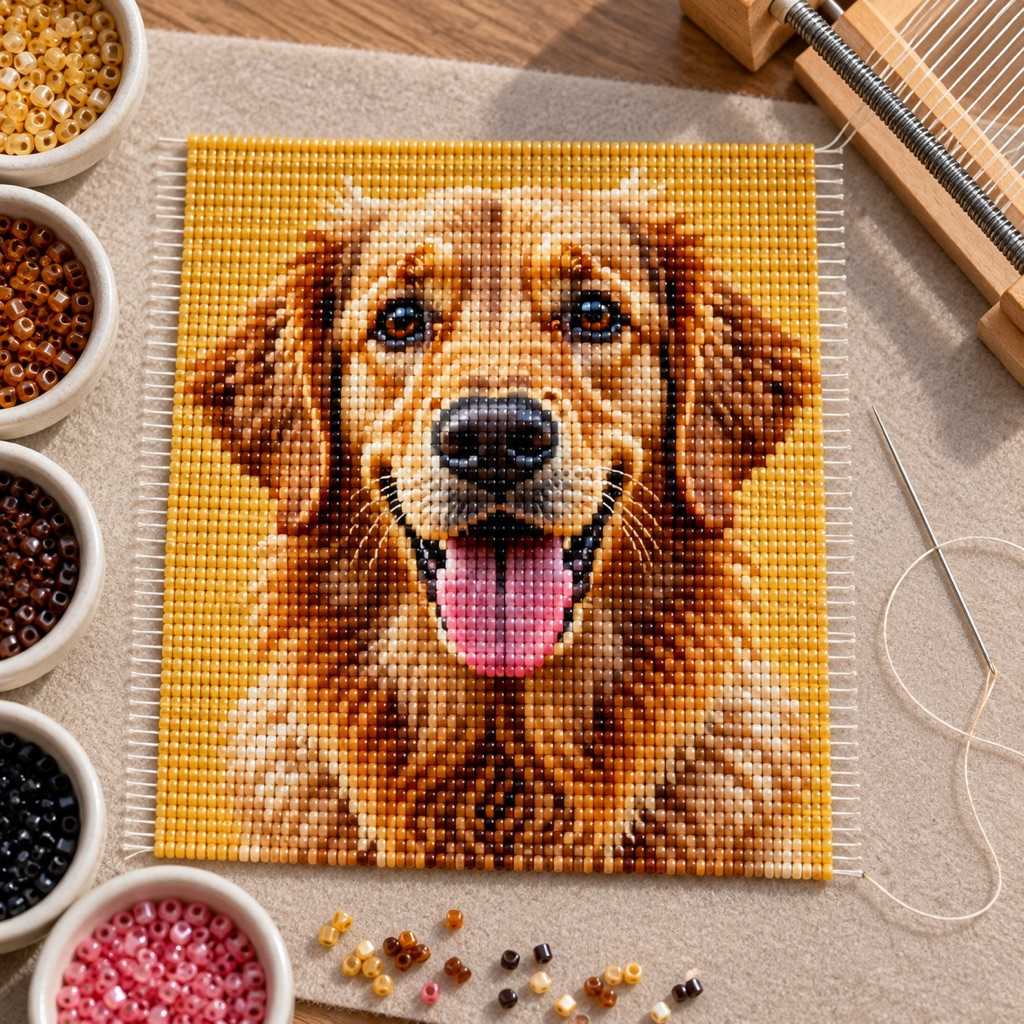
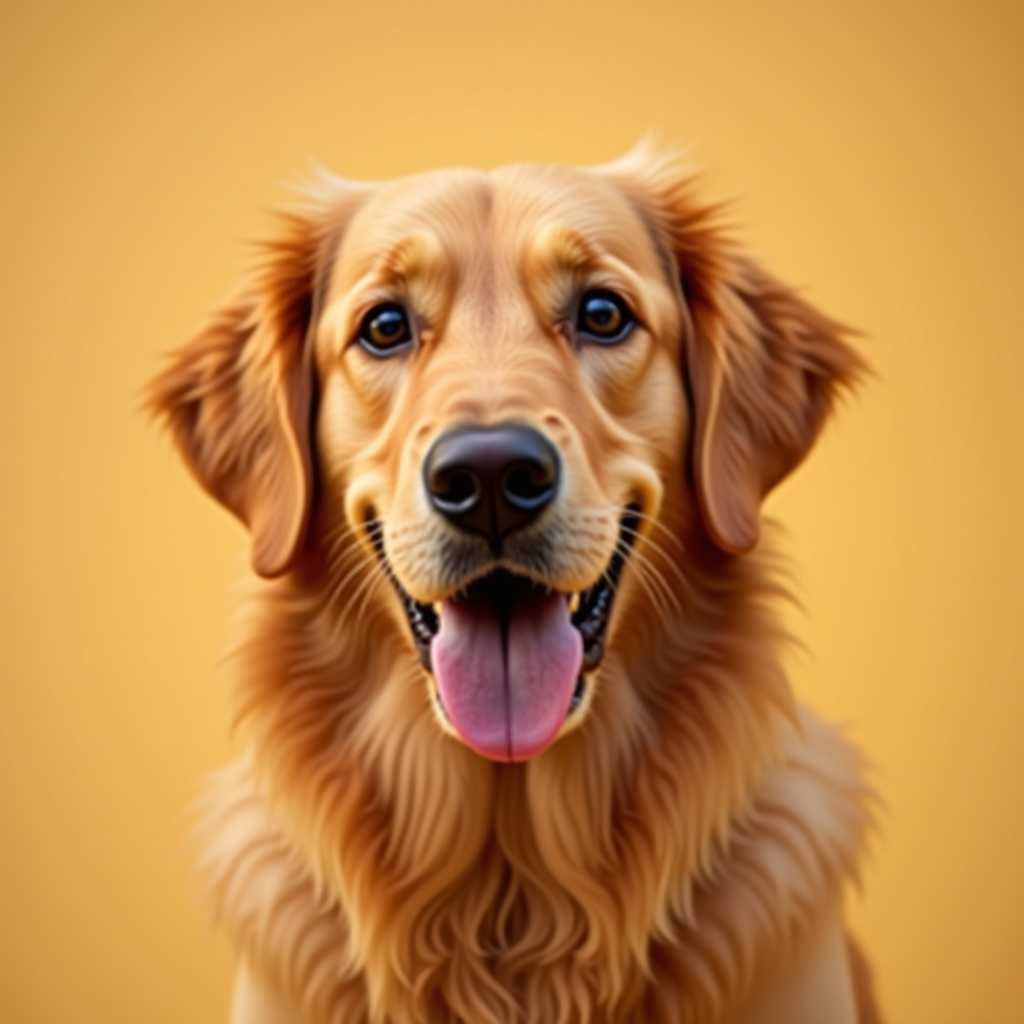
Your photo
Turn a Photo into a
Peyote or Loom Chart
Upload a photo, choose peyote or loom, and get a bead chart with Miyuki Delica colors and tubes counted.
Free to use · No sign-up
A Delica 11/0 bead is about 1.6mm tall and 1.3mm wide, so the chart's cells are taller than they are wide — the same shape as the finished beadwork.
What You Get from One Photo
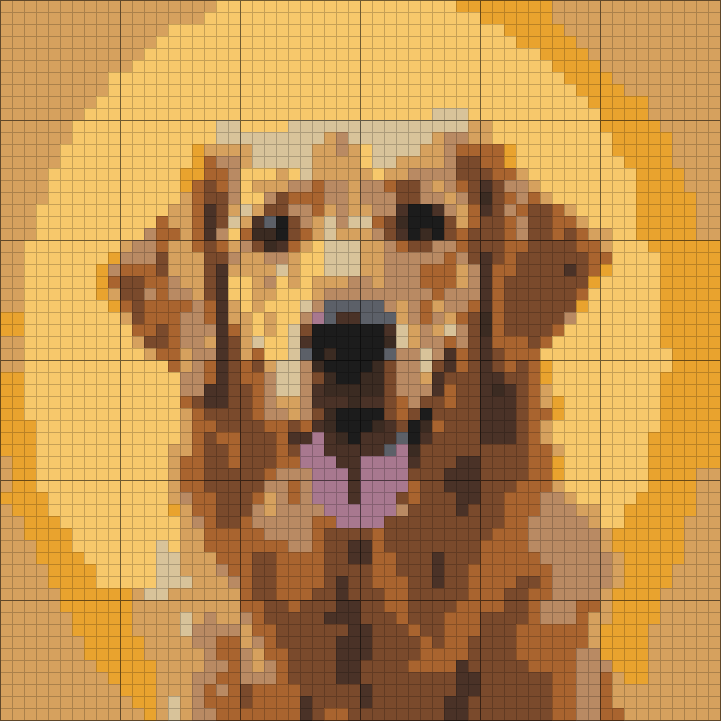
This is the chart ArtPatt made from the photo above: 60 × 60 seed bead chart in 12 colors.
Miyuki Delica numbers
Each color is matched to a Delica bead number you can order directly.
Written rows for peyote
Rows are written out bead by bead, so you can work from the list.
Tubes counted per color
Every color's beads are counted and turned into tubes to buy.
Color legend from this chart
- DB-21031 tube
- DB-04111 tube
- DB-21421 tube
- DB-06511 tube
- DB-03401 tube
- DB-22861 tube
+ 6 more colors in the full legend
From Seed Bead Chart to Finished Piece
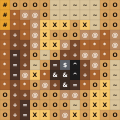
The same few squares, as they sit on the chart and as they look once worked.
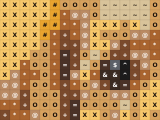
On the chart
- One square, one color, one symbol
- Rows and columns are numbered in the PDF
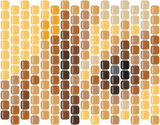
Woven in peyote stitch
- Each square of the chart is one Delica bead
- Peyote columns sit half a bead apart, and the chart shows it
- Loom work keeps the same chart square
How it works
Pick a bold photo
One bead is one pixel, and a cuff is often only 10 to 20 beads across. Silhouettes, geometric motifs, animals against a plain background, flowers, and lettering all survive that reduction. Group photos and soft gradients do not — the free preview shows you the honest result before you thread a needle.
Choose peyote or loom
Loom and square stitch put beads in a plain rectangular grid. Peyote interlocks them, so alternating columns sit half a bead lower — pick it here and the chart is drawn staggered, which is what you will actually be reading off the page.
Set the width and the palette
Width is in beads: about 19 Delica 11/0 beads to the inch, so a 20-bead row is a 1-inch cuff and 40 beads is a wide band. Then keep the palette tight — 8 to 15 Delica colors reads as a picture in beadwork, while 30 reads as speckle and means 30 tubes on the table.
Bead it row by row
Woven beadwork is worked from one end to the other, so the chart reads top to bottom. Free: the full browser preview and per-color bead counts. The printable PDF with the Delica legend, DB numbers, bead counts, and a numbered grid comes with the $2.99 single-pattern unlock or Pro ($6.99/month or $39.99/year).
Charts That Match How Beads Sit
A bead chart is only useful if its geometry is the geometry of the stitch.
Real Peyote Offset, Not a Square Grid
In peyote, each bead drops into the gap between two beads of the row before, so every other column ends up half a bead lower. Pick peyote and the chart is drawn that way — offset columns on screen, in the PNG, and across every page of the PDF, with the counting lines stepped to follow. Choose loom or square stitch instead and you get the plain rectangular grid that those stitches really are.
Bead-Shaped Cells
A Delica 11/0 cylinder is about 1.6mm across the barrel and 1.3mm along its hole, so beads pack tighter along a row than rows do on top of each other — beadwork is taller per cell than it is wide. The chart uses that ratio, which means the finished size the generator quotes is the size that comes off the loom instead of a square-grid guess.
Miyuki Delica Colors by DB Number
Every cell is matched with CIEDE2000 perceptual distance to a real Delica 11/0 colorway, and the legend prints its DB number — DB-0010 Black, DB-0200 White, DB-0726 Opaque Cobalt. That is the number printed on the tube and used in every shop, swap and substitution list, so the chart is something you can shop from directly.
Beads Counted, Tubes Rounded
A standard Miyuki tube holds 7.2 grams, roughly 1,440 Delica 11/0 beads. The generator counts beads per color from your chart, adds a spares buffer, and rounds each color up to whole tubes — so you get "2 tubes of DB-0010" instead of a raw count. Running out of one color three-quarters of the way down a cuff is how these projects die.
What Makes a Good Seed Bead Pattern
Bead weaving is pixel art at about 1.3 millimetres per pixel. A cuff bracelet is commonly 10 to 20 beads wide and 130 to 180 rows long; a wide band or a small woven tapestry might be 40 beads across. Those numbers decide everything about which photos work. A face at 15 beads wide has three or four beads for an eye, which is enough for a stylised symbol and not enough for a portrait. Bold silhouettes, geometric and southwestern motifs, flowers, animals in profile, flags, and lettering all convert cleanly.
Palette discipline matters more here than in almost any other grid craft, because every extra color is another tube to buy, another cup on the table, and another chance to pick up the wrong bead in a row of thirty. Eight to fifteen Delica colors is the practical range for a photo-derived design. Dithering is worth avoiding too: a checkerboard of two shades that reads as a blend on screen reads as a checkerboard at 1.3mm, and it doubles the number of color changes per row.
The other planning decision is length, not width. Beadwork grows one row at a time, and a row is about 1.6mm, so a 175-row cuff is roughly 28cm before the clasp. Set the chart's width to the width you want the finished piece to be, and let the length follow the photo — the generator quotes the finished centimetres for the bead size you picked, so you can check a bracelet is a bracelet before you warp anything.
Peyote, Brick and Loom — Which Chart Is Which
Loom weaving and square stitch produce the same fabric: beads in straight columns and straight rows, a plain rectangle. On a loom, warp threads run the length of the piece, the weft carries each row of beads under the warps, and a second pass back through the same row above the warps locks them in. Square stitch builds the identical grid off-loom by stitching each bead to the one below it. Either way the chart is an ordinary grid, which is why loom and square stitch share one option here.
Peyote stitch is the offset one. You add a bead, skip a bead, and each new bead settles into the gap between two beads of the previous row — so the beads interlock like bricks and alternating columns end up half a bead lower than their neighbours. That is not a drawing convention, it is where the bead physically is, and a peyote design charted on a square grid comes out distorted when it is beaded. Flat peyote comes in even-count and odd-count versions; even-count is the easier place to start, odd-count needs a turnaround stitch at one edge on every other row and is what you want when a design has a true center column.
Brick stitch is peyote rotated ninety degrees — the same interlock read across rows instead of down columns. A peyote chart can be worked as brick stitch by turning it, but ArtPatt does not yet chart brick stitch directly. Ladder stitch, herringbone and right-angle weave are different fabrics again and are not what this generator produces.
You get both formats. The chart itself is graphical — a grid of colored cells with a legend, the same thing you would draw on bead graph paper. The printable PDF then adds a written word chart for peyote: rows 1–2 strung together as one pass, every later row listed bead by bead in actual stringing order, with the direction marked and a tick box per row. Loom charts get plain row-by-row run counts the same way.
Seed Bead Pattern FAQ
Yes. 1 upload, generation, and full browser preview and all of its edits are free, with no account required. A $2.99 single-pattern unlock gives you the PNG and printable PDF. Pro ($6.99/month or $39.99/year) unlocks unlimited projects, every export, larger charts for long cuffs and tapestries, and every other craft generator.
Pick the one you are going to bead, because the two charts are not interchangeable. Loom or square stitch gives a plain rectangular grid: beads in straight rows and columns, worked on a warped loom or stitched bead-to-bead off-loom. Peyote gives a staggered chart, because peyote beads interlock and every other column sits half a bead lower. If you are making a cuff on a loom, or you like reading a plain grid, choose loom. If you are working off-loom in the round or flat peyote — which is most bracelet, pendant and amulet-bag work — choose peyote and the chart will be drawn with the offset built in.
Miyuki Delica 11/0 cylinder beads, the standard for charted beadwork. The palette covers the opaque, matte, Duracoat, Picasso, luster and galvanized ranges, and the legend prints each color's real DB number and Miyuki name so you can order from any shop. Transparent, crystal, silver-lined and color-lined finishes are left out on purpose: how they look depends on what is behind them, so matching a photo against them would be guesswork. Delica 8/0 and 15/0 use the same chart with different finished dimensions — set the bead size and the generator recalculates the size.
Yes. The printable PDF includes a written word chart alongside the graphical grid: rows 1–2 are listed as one strung pass (read straight off the bottom chart row), and every later row lists its beads as consecutive color runs ("3 Black DB-0010, 5 White DB-0200") in actual stringing order — odd columns first, then even, direction alternating every row, with a tick box per row and a left-handed mirror option. Loom charts get the same row-by-row list in plain reading order.
One grid cell is one bead. A 15-bead-wide cuff of 160 rows is 2,400 beads; a 40x60 panel is 2,400 as well. A standard Miyuki 7.2 gram tube of Delica 11/0 holds roughly 1,440 beads. ArtPatt counts beads per color from your chart, adds a buffer for the ones that end up on the floor, and rounds each color up to whole tubes, so the shopping list reads "2 tubes of DB-0010" rather than a number to divide.
Delica 11/0 gives about 19 beads to the inch across a row and about 16 rows to the inch along the piece, so a 20-bead row is roughly 2.6cm wide and 100 rows is roughly 16cm long. The generator quotes the finished centimetres for your exact chart and bead size, including 8/0 (larger, faster) and 15/0 (finer, more detail in the same space).
From a bold, simple one, yes. A bead is a pixel and a cuff is only 10 to 20 of them wide, so fine features and soft shading cannot be rendered at that scale. Silhouettes, geometric motifs, flowers, animals in profile, lettering and high-contrast subjects on plain backgrounds convert cleanly. The free preview shows exactly what you would be beading before you buy a single tube.
Not yet. Brick stitch is peyote turned ninety degrees — the same interlocking fabric read across rows instead of down columns — so a peyote chart can be beaded as brick stitch by rotating it, but ArtPatt does not currently output a brick chart directly. Loom, square stitch and peyote are what ship today.
More Bead & Grid Pattern Tools
Perler Bead Pattern Generator
Fuse beads on a pegboard: one bead per peg on a square grid, ironed flat at the end.
Cross-Stitch Pattern Generator
The same chart in thread — 489 DMC colors, symbols, and backstitch detection.
Diamond Painting Pattern Generator
The other place-a-piece craft: resin drills on adhesive canvas, with DMC codes and drill counts.
Pixel Art Pattern Generator
See how a photo reduces to a small grid before committing it to any material.
Pet Portrait Pattern Generator
Check how a pet photo survives at low bead counts before choosing a width.
Kandi Pattern Maker
Pony beads on elastic: draw ladder and multi (peyote) kandi cuffs on a grid.
Free to Try — Finished Chart from $2.99
Create and refine 1 seed bead chart free, with no account required. Unlock when you want the chart to print and stitch from.
Free
Make one pattern free every week.
- 1 free chart project with unlimited edits
- Peyote and loom / square stitch
- Miyuki Delica color matching
- Full pattern preview in the browser
- No account required
Tax is added at checkout where it applies.